Blitz Bureau
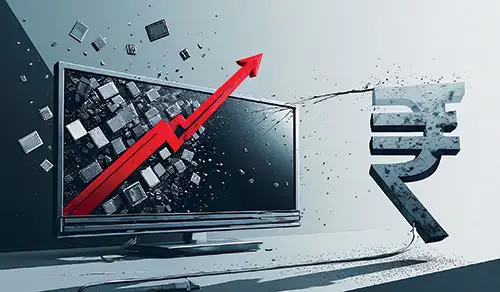
NEW DELHI:Indian consumers may have to pay more for television from January, as manufacturers grapple with a sharp spike in memory chip costs and a weakening rupee that has crossed the 90-to-a-dollar mark for the first time, reports The Economic Times.
Industry executives say prices of LED and smart television could climb between 3 per cent and 10 per cent, threatening to blunt recent demand gains triggered by lower GST.
With domestic value addition in an LED television at just about 30 per cent, the sector remains heavily exposed to imports. Key components such as open cells, semiconductor chips and motherboards are sourced from overseas, leaving manufacturers vulnerable to currency swings and global supply disruptions.
The immediate trigger is a severe global shortage of memory chips, driven by surging demand for high-bandwidth memory used in artificial intelligence servers. As chipmakers prioritise highermargin AI products, supply for legacy electronics such as televisions has tightened sharply, pushing up prices across DRAM and flash memory.
Haier Appliances India President NS Satish told news agency PTI that the combined impact of the chip shortage and currency depreciation would be hard to absorb. “Prices of LED television sets will increase by 3 per cent because of shortage of memory chips and weak rupee,” he told PTI. Some manufacturers have already informed dealers to brace for a hike from the new year.
The immediate trigger is a severe global shortage of memory chips, driven by surging demand for highbandwidth memory used in artificial intelligence servers. As chipmakers prioritise highermargin AI products, supply for legacy electronics such as televisions has tightened sharply, pushing up prices across DRAM and flash memory
Super Plastronics Pvt Ltd, which manufactures televisions under global brands including Thomson, Kodak and Blaupunkt, painted a starker picture. “Memory chip prices have gone up by 500 per cent in the last three months,” the company said. Its CEO Avneet Singh Marwah warned that retail prices could rise even more sharply. According to him, there could be a 7 to 10 per cent increase in television prices from January, driven largely by the memory chip crisis and the depreciating rupee. If current conditions persist, the pressure may not ease soon. “If memory chip prices in the next two quarters remain the same, then there could be further hike in television prices,” Marwah said.
GST gains at risk as costs climb The timing is awkward for an industry that had only recently received a demand boost after the Government cut GST on television screens of 32 inches and above to 18 per cent from 28 per cent, lowering prices by about Rs 4,500. Analysts now say the impending cost increases could dilute that benefit, especially in pricesensitive segments.
Videotex, a homegrown original design manufacturer that also sells televisions under its Daiwa brand, said it is facing sustained stress on both pricing and availability of components. “We are currently facing sustained pressure due to sharp increase in memory chip prices, with availability emerging as a critical challenge. Flash memory and DDR4 prices at the sourcing level have risen by up to 1,000 per cent, driven largely by supply being diverted to AI data centres,” said Arjun Bajaj, Director of Videotex.
The company expects the strain to persist until at least the second quarter of the coming year, depending on how global supply dynamics evolve. Currency weakness is compounding the problem. “The situation is further exacerbated by the depreciation of the rupee, which has significantly increased import costs. These increases will be reflected in the market in the coming weeks as older inventory moves out,” Bajaj said.
Videotex supplies smart televisions to a wide range of brands, including Reliance Group’s BPL and Reconnect, Havells’ Lloyd, Vijay Sales’ Vise, Hyundai, Toshiba, Compaq and more than 25 other Indian and international labels. While the company is adjusting production schedules and optimising inventories, Bajaj said the “prolonged nature of this cycle makes it challenging to fully absorb the cost escalation”.
The broader market is already showing signs of fatigue. According to Counterpoint Research, India’s smart television shipments fell 4 per cent year-on-year in the second quarter of 2025, weighed down by saturation in smaller screen sizes, fewer new demand triggers and softer consumer spending.
Even so, the long-term story remains intact. India’s television market, valued at $10–12 billion in 2024, is still expected to grow, driven by rising disposable incomes, increasing appetite for larger screens and the continued pull of OTT content. In the near term, however, consumers may find that the next upgrade comes with a higher price tag.