Blitz Bureau
NEW DELHI: The announcement of this year’s Padma awards signalled the completion of a profound institutional metamorphosis. What was once dismissed by critics as a “revolving door” for the well-connected in the power corridors of New Delhi has been fundamentally restructured into a rigorous national talent hunt. This transformation, often described as the “People’s Padma,” has successfully restored the dignity of India’s highest civilian honors by shifting the focus from the red carpets of the capital to the dusty lanes of the hinterland.
For decades, the selection of Padma awardees was largely an opaque, bureaucratic exercise. Nominations were primarily funneled through state governments and Central ministries, a system that historically favoured metropolitan elites whose proximity to the seat of power guaranteed their visibility. However, under the current administration, this “Lobbying Culture” has been replaced by a “Discovery Culture.” The implementation of the Rashtriya Puraskar Portal has democratised the nomination process, allowing public and self-nominations that bypass traditional gatekeepers. This institutional pivot has moved the benchmark from high social standing to a criterion defined by “Excellence Plus” and tangible grassroots impact.
The prominence of the awards has, paradoxically, grown by looking at the individual rather than the office. Of the 131 honours conferred in 2026, nearly one-third were dedicated to “Unsung Heroes”—individuals who have spent decades working in the shadows of the national consciousness. Among them is Anke Gowda, a former bus conductor from Karnataka who transformed a rural village by establishing one of the world’s largest free-access libraries. Similarly, the recognition of Dr. Budhri Tati, who has dedicated her life to social welfare in the Naxal-affected tribal belts of Chhattisgarh, underscores a shift where a life’s work carries more weight than political favor.
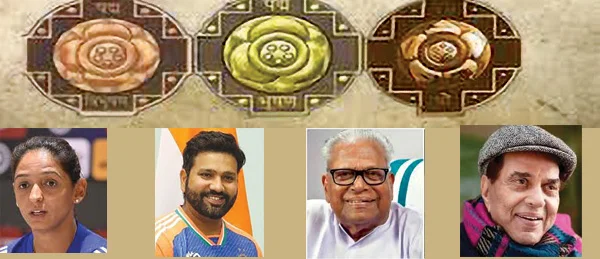
This year’s honours also reflect a sophisticated balance between grassroots merit and institutional excellence. The higher tiers of the awards— the Padma Vibhushan and Padma Bhushan—continue to serve as a platform for recognising national icons and strategic signalling. The posthumous Padma Vibhushan for cinematic legend Dharmendra Singh Deol and the recognition of Malayalam superstar Mammootty with the Padma Bhushan celebrate cultural legacies that have defined the Indian psyche. Concurrently, the inclusion of opposition stalwarts like the late VS Achuthanandan demonstrates a form of political statesmanship that seeks to bridge regional and ideological divides under the umbrella of national recognition.
The 2026 list is also notable for its inclusivity and the use of “soft power.” With 19 women honoured—including neonatal pioneer Dr Armida Fernandez and sports icons like Rohit Sharma and Harmanpreet Kaur—the awards mirror a changing social fabric. The recognition of foreign nationals and the Indian diaspora, such as the renowned oncologist Dr Nori Dattatreyudu from the United States, highlights India’s intent to honour excellence that bolsters the nation’s image from the outside.