




Blitz Bureau
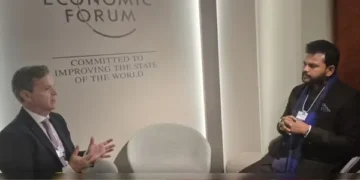
NEW DELHI: About seven in ten chief executive officers (CEOs) of companies across the world are grappling with uncertainty and do not know how to tread further, Mohamed Kande, Global Chairman, PwC told Moneycontrol in an interview at the World Economic Forum in Davos on January 19, as investments in AI are yet to yield positive results and firms deal with Trump’s tariff tantrums.
PwC’s 29th Global CEO survey found only three-in-ten, about 30 per cent, of CEOs said they are confident about revenue growth over the next 12 months, hitting a five-year-low, down from 38 per cent in 2025 and 56 per cent in 2022. The remaining are not confident.
“There is a lot of uncertainty today about what might happen next. This is creating a sentiment for many CEOs today who say I don’t know what to do next,” Kande told Moneycontrol.
The survey is based on responses from 4,454 CEOs across 95 countries and territories.
CEOs are particularly spending time on new technologies like AI. “The adoption of AI and technology is not delivering the benefits that companies would expect, and they still have to continue to invest the capital,” Kande said.
Adding to that is the uncertainty around US President Donald Trump’s tariff threats which is keeping CEOs on the edge.
Kande said: “Companies are looking at their product today and thinking how they can go back into the innovation cycle to redesign their products to be tariff efficient.”
In the whole equation, India however appears to be resilient.
“India has been very resilient most of 2025…We see some green shoots of private investments now manifesting in India to support the public investments,” Sanjeev Krishan, Chairperson, PwC India told Moneycontrol.
“From an attractiveness standpoint, jointly with the UK and Germany, India is now the second most wanted investment destination by global investors, which is a good thing, because I was surprised last year when India was number five,” he added.
For this to continue there needs to be predictability so CEOs can make decisions accordingly.
Krishan spoke to Moneycontrol at Davos days after the Supreme Court directed Tiger Global to pay taxes on the gains it made by investing in Flipkart.
“It is a pivotal moment, and I do hope that this is actually fact-based, and not something which will cause more litigation,” he said. “India would not want to repeat that (Vodafone) incident all over again, which might have an impact of scaring investors away.”
CEOs are particularly spending time on new technologies like AI. “The adoption of AI and technology is not delivering the benefits that companies would expect, and they still have to continue to invest the capital,” Mohamed Kande, Global Chairman, PwC said.
One in five CEOs said their companies were highly exposed to losses from trade tariffs and one third cited cyber risk as a major threat. A greater share – 42 per cent – were worried about what the pace of technological change meant for their companies.
“The biggest question on CEOs’ minds is whether they are transforming fast enough to keep pace with technological change, including artificial intelligence,” the survey concluded.
The survey revealed a sharp divide between those already seeing benefits from AI adoption and those not: while 56 per cent said they had seen no financial benefit to date, 33 per cent reported gains in either costs or revenue, while the remainder said AI had delivered both cost and revenue wins.
PwC said separate analysis showed that those companies which were applying AI widely to products, services and customer experiences were benefiting the most, contrasting that with the lesser benefit seen by those still experimenting with it.
“It (AI) is working and it is here to stay. AI is now a must for companies around the world to adopt – the question is how,” PwC Global Chairman Mohamed Kande told a news conference on the sidelines of World Economic Forum in Davos.