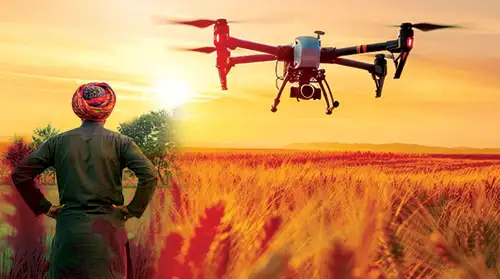
Far from the maddening furore over frivolous issues, Parliament sessions are also treasure troves of latest happenings in the Government. Often times, written replies to questions which are routinely raised by various members of both the Houses, lead to significant knowledge sharing. One example of that is the information shared by the Minister of State for Agriculture and Farmers Welfare, Ramnath Thakur, in a written reply in Rajya Sabha last week.
Agri-tech startups and digital agri mission
The Government has taken various steps for rapid growth of agri-tech startups and to promote the adoption of new and emerging technologies in agriculture such as artificial intelligence (AI), precision farming, drone technology, and climate-smart agriculture in states / UTs.
The Department of Agriculture & Farmers’ Welfare (DA&FW), is implementing the “Innovation and Agri-Entrepreneurship Development” programme under Rashtriya K rishi Vikas Yojana (RKVY) from 2018-19 onwards with an objective to promote innovation and agri-entrepreneurship by providing financial support and nurturing an incubation ecosystem in the country.
Incubation support
The department has appointed six Knowledge Partners (KPs) and 24 RKVY Agribusiness Incubators (R-ABIs) across the country for implementation assistance and incubation of startups under this programme.
Under this programme, for idea / pre-seed stage, a selected start-up is eligible for a maximum financial assistance of Rs 5 lakh in one instalment.
For seed stage, a selected start-up is eligible for a maximum financial assistance of Rs 25 lakh in two instalments of 50 per cent and 50 per cent.
Each KP can select a maximum 20-25 start-ups and each R-ABI can select a maximum 10-12 start-ups in each category of pre seed and seed stage in a financial year.
Trainings, technical and financial assistance is provided to startups to launch their products, services, business platforms, etc into the market and facilitate them to scale up their products and operations to attain business viability.
More than 6000 agri-startups have been trained by KPs and R-ABIs so far under this programme. As many as 2096 have been supported with technical and financial assistance of Rs 168.14 crore between FY 2019-20 and 2025-26.
Drone development
In order to promote the use of drones in agriculture, hundred per cent financial assistance of the cost of drone, up to a maximum of Rs 10 lakh per drone is provided by institutes under Indian Council of Agricultural Research (ICAR).
Farmers Producers Organisations (FPOs) are provided grants up to 75 per cent of the cost of Kisan Drone for its demonstrations on farmers’ fields.
Agriculture graduates get financial assistance up to 50 per cent of the cost of drone up to a maximum of Rs 5 lakh per drone. Further, Sub Mission on Agricultural Mechanization (SMAM) is being implemented w.e.f. 2014-15 through states / UT governments.
The Government has approved ‘Namo Drone Didi’ as a Central sector scheme for providing 15,000 drones to women self help groups with an outlay of Rs 1,261 crore.
Lead fertiliser companies distributed 1,094 drones in 2023-24 to the target audience using their internal resources. Out of these, 500 drones were distributed under the Namo Drone Didi scheme.
Farm training centres
The Government has established four farm machinery training and testing institutes at Budni, Madhya Pradesh; Hisar, Haryana; Garladinne, Andhra Pradesh and Biswanath Chariali in Assam.
These institutes are imparting training to farmers, technicians, engineers, unemployed youth, machinery manufacturers, etc., under various programmes on the latest technology for farm mechanisation, including Kisan Drones.
Pradhan Mantri Fasal Bima Yojana
The National Crop Insurance Portal (NCIP) and the Application for Intermediary Enrolment (AIDE) app have been developed to disseminate information about the fasal bima scheme to the farmers.
Farmers can insure themselves through the portal and apps and check the status of their application, claims etc. Further, Village Level Entrepreneurs (VLEs) under Common Service Centres (CSCs) have also been engaged to enrol farmers and disseminate coverage information, claims etc.
The Government has approved the Digital Agriculture Mission, which envisages the creation of a Digital Public Infrastructure (DPI) for agriculture, such as AgriStack, Krishi Decision Support System, and a comprehensive soil fertility and profile map to enable a robust digital agriculture ecosystem in the country.
This, in turn, would drive innovative farmer-centric digital solutions and make reliable crop-related information available to all farmers on time.
The AgriStack DPI consists of three foundational registries or databases associated with the agriculture sector, i.e., geo-referenced village maps, crop sown registry, and the farmers registry, all created and maintained by state governments / Union Territories. The Government is providing technical and financial support to all the states / UTs to implement this DPI.
The Mahalanobis National Crop Forecast Centre (MNCFC) under the Ministry of Agriculture & Farmers Welfare also plays a pivotal role by leveraging space and geospatial technologies for agricultural applications.