Blitz Bureau
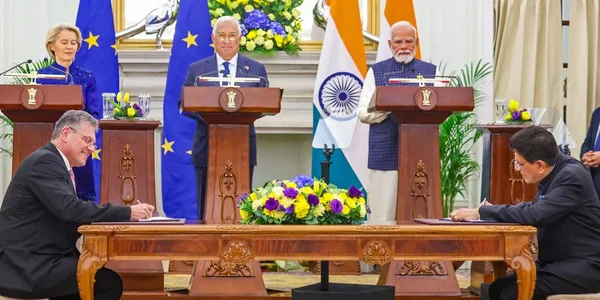
NEW DELHI: The unprecedented preferential access secured for over 99 per cent of Indian exports is a game-changer for Indian industry, the Confederation of Indian Industry (CII) said on January 27. With the India-EU deal, Rs 6.41 lakh crore ($75 billion) worth exports are poised for take-off, with $33 billion of exports in labour-intensive sectors like textiles, leather, marine products, gems and jewellery are set to gain immensely from preferential access under the FTA.
According to Chandrajit Banerjee, Director General, CII, the landmark agreement represents a strategic breakthrough in India’s global trade engagement and significantly deepens the partnership between two major democracies and economies that together account for nearly 25 per cent of global GDP. “It decisively improves competitiveness in the EU’s high-value market, anchors Indian manufacturers and service providers deeper into global value chains, and accelerates investment, technology inflows, and scale,” Banerjee said.
“Key sectors of focus include textiles and apparel, leather and footwear, gems and jewellery, marine products, engineering goods, automobiles, agriculture and processed foods, IT and IT-enabled services, and other business and professional services,” he added. By delivering tangible gains for labour-intensive sectors and MSMEs, and by enabling a future-ready mobility framework for Indian talent, the agreement lays a foundation for sustained, inclusive, and globally competitive growth which is fully aligned with India’s vision of Viksit Bharat at 2047, said CII.
Balbir Singh Dhillon, Brand Director, Audi India, welcomed the proposed FTA, recognising its potential to deepen economic ties with one of the world’s largest trading blocs. “This constructive approach to trade could support the broader automotive ecosystem, including innovation, supply-chain efficiency, and technology collaboration. That said, any implications for pricing and market can only be assessed once the final terms are available and carefully reviewed, including the timeframe of implementation. Until then, it would be premature to draw conclusions on specific commercial or product strategies,” he mentioned.