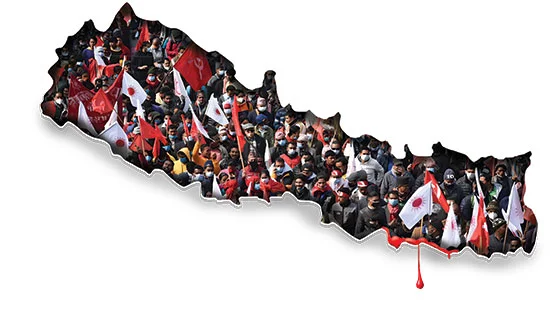
 Nepal’s rulers have learned a harsh lesson. Power is fleeting when promises are broken and public trust squandered. A furious tide of young Nepalis, armed with the amplifying force of social media, has toppled yet another government, forcing Prime Minister KP Sharma Oli to resign and flee amid violent protests. Fed up with corruption, nepotism, and a political elite that hoards wealth while the nation’s economy crumbles, these techsavvy youths have exposed the fragility of unchecked power.
In a country battered by political instability and economic paralysis for the past 16 years, the message is clear: leaders who betray the public, risk being dethroned by the very voices they ignore. Violence becomes the ultimate voice for change. They replaced an elected government with a better, credible alternative: Sushila Karki, a former Chief Justice with a clean record was sworn in as the first woman interim prime minister.
This is not a revolution with a clear purpose or a unified vision for the future. It is a raw, leaderless explosion of anger, a cry from a people tired of being betrayed by their leaders. The nation’s ruling coalition crumbled under this pressure, with Oli himself not only resigning but reportedly fleeing to an unknown destination. The scenes were apocalyptic. Ministers were attacked and Government buildings set ablaze.
This unrest reflected a deeper malaise, a profound disillusionment with a political system that has seen 14 governments in 16 years, each more ineffective than the previous one. Nepal has been struggling to define itself after abandoning its monarchical past for a secular and socialist republic in 2008.
The roots of Nepal’s crisis lie in its turbulent political history. The nation’s transition from monarchy to republic was marked by bloodshed and betrayal. In 2001, the royal family was massacred in a shocking incident that s a w Crown Prince Dipendra kill his own family.
The tragedy plunged Nepal into a constitutional crisis, paving the way for King Gyanendra Shah to ascend the throne. His rule, however, was marred by his inability to quell the Maoist insurgency that had gripped the country since the 1990s, claiming over 16,000 lives. In 2005, Gyanendra’s decision to dissolve Parliament and assume absolute power sparked widespread protests. It culminated in the 2006 people’s movement that forced him to relinquish control. By 2008, the monarchy was abolished and Nepal declared itself a secular, socialist republic under the leadership of Maoist leader Pushpa Kamal Dahal, also known as Prachanda. The promise of a new era of stability and progress was intoxicating, but it proved illusory. Since 2008, no government has completed a full term, with coalitions collapsing under the weight of internal rivalries, corruption, and opportunist alliances.
Fallout of failures
The current crisis is fallout of these failures, as the youth, dubbed ‘Gen Z protesters’, took to the streets to demand accountability. The protests began with a seemingly innocuous trigger: a Government ban on social media platforms like Facebook, X, and YouTube, ostensibly to curb dissent.
The constant power struggles and lack of a cohesive agenda have paralysed governance, leaving Nepal vulnerable to external influences. More troubling are allegations of interference by China and Pakistan’s Inter-Services Intelligence, both of which have strategic interests in countering India’s influence in Nepal. China’s Belt and Road Initiative has poured billions into Nepalese infrastructure, while Pakistan’s ISI is believed to exploit Nepal’s porous borders to create security challenges for India. Economically, Nepal is in dire straits.
The country’s GDP growth, projected at a meagre 3.3 per cent for 2025, is among the lowest in South Asia, trailing India’s 7 per cent and Bangladesh’s 5.5 per cent. Per capita income stands at a paltry $1,400, compared to $2,700 in India and $2,500 in Bangladesh, making Nepal one of the poorest nations in the region. Unemployment, particularly among the youth, remains at a staggering 19.2 per cent. The contrast between the opulent lifestyles of politicians and the grinding poverty of the masses has become a rallying cry for the protesters, who see corruption and nepotism as the root of their suffering.
Eerie similarities
The unrest in Nepal bears eerie similarities to recent upheavals in Sri Lanka and Bangladesh, where economic crises and public discontent toppled governments. In Sri Lanka, the 2022 economic collapse led to mass protests and the resignation of President Gotabaya Rajapaksa, while in Bangladesh studentled protests in 2024 forced Prime Minister Sheikh Hasina to flee. In both cases, allegations of foreign interference and attempts to install military-backed regimes surfaced, raising fears that Nepal could follow a similar path.
The absence of a democratically elected leader or alternative governance model in Nepal’s current protests heightens the risk of a prolonged chaos. Amid this turmoil, a surprising development has emerged: a growing demand for the restoration of the monarchy and a return to Nepal’s identity as a Hindu Rashtra.
Pro-monarchy protests, led by supporters of former King Gyanendra gained traction when thousands turned up in Kathmandu on March 9 to welcome him back from Pokhara. These demonstrations reflected nostalgia for the stability and cultural cohesion that the monarchy once represented. The concept of a Hindu Rashtra resonates with a section of Nepalese, who see the secular republic as having eroded their cultural heritage.
However, the crisis in Nepal poses serious security implications for India. A destabilised Nepal could become a haven for anti-India activities, including cross-border terrorism and smuggling, threatening the security of India’s northern states. The prospect of Nepal slipping into anarchy or falling under a military regime, as seen in Bangladesh and attempted in Sri Lanka, is a nightmare scenario for New Delhi.
India’s priorities
The first step is to provide massive financial support to stabilise Nepal’s economy, focusing on job creation, infrastructure development, and debt relief. India’s expertise in technology and renewable energy could help modernise Nepal’s crumbling infrastructure, while targeted investments in education and skills training could address the youth unemployment crisis.
Diplomatically, India should engage with all stakeholders, including political parties, civil society, and even promonarchy groups. Its objective should be to foster a national dialogue aimed at restoring stability. This could include supporting a national unity government that prioritises governance over political infighting. Cultural diplomacy, emphasising the shared Hindu-Buddhist heritage, could rebuild trust between the two nations.
Nepal stands at a crossroads, with the potential to either forge a new path toward stability or descend into anarchy. By offering financial, technological, and diplomatic support, India can help Nepal emerge from this crisis stronger and more resilient. The alternative, a failed state on India’s doorstep, would have catastrophic consequences for both nations. United by history and culture, India and Nepal must work together to fight external threats and rebuild a nation that has lost its way.
The time for action is now, before the flames of unrest consume the Himalayan republic’s entire political ecosystem. The glacier of democracy is melting and there is no guarantee that the subcontinent will drown in chaos. The only peacekeeper remains India, the guardian of popular will across the peninsula and beyond.