Blitz Bureau
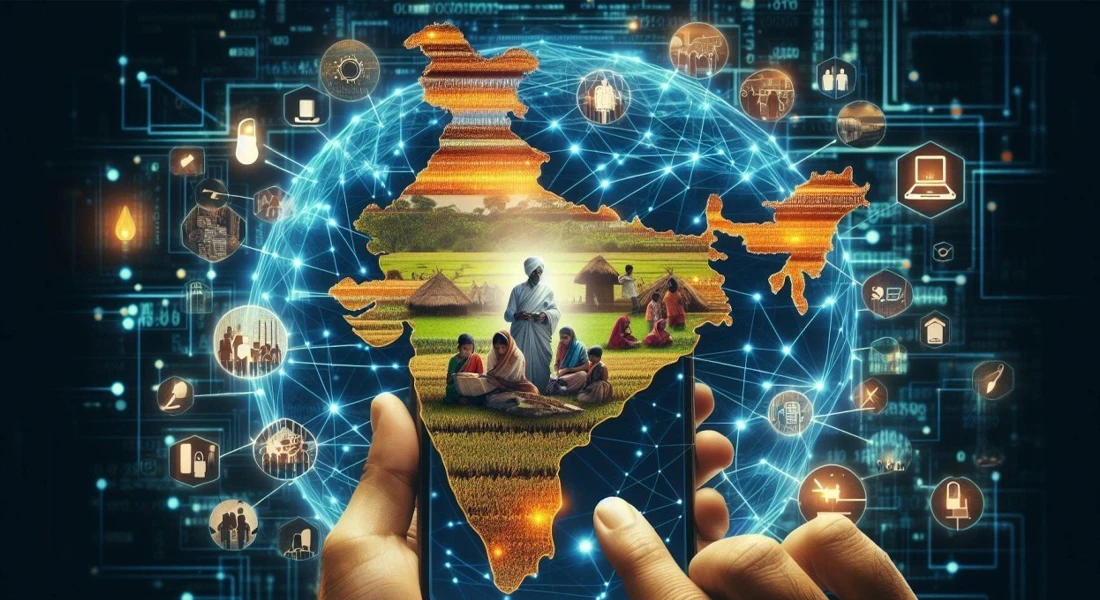
NEW DELHI: India’s digital transformation represents one of the largest populationscale expansions of connectivity and technology-enabled public service delivery globally. Anchored in the Digital India programme, launched in 2015, the country’s strategy has focused on building digital infrastructure as a core utility for every citizen, bridging the digital divide, delivering governance and services on demand, and empowering people through digital access.
A decade ago, the digital divide was visible and stark. High-speed internet was largely urban, rural connectivity was limited, and access to online services depended on location, income, and digital literacy. Over the years, sustained public investment has expanded broadband networks and transitioned towards extensive optical fibre infrastructure, improving both the reach and quality of connectivity across villages and remote regions.
Today, the divide is rapidly narrowing. Affordable data, assisted digital access points, and interoperable public platforms are enabling citizens to access welfare schemes, make digital payments, pursue online education, and participate in governance.
Universal connectivity
India’s digital backbone is the foundation of its effort to bridge the digital divide at population scale. It operates through three interlinked pillars: Universal Connectivity Infrastructure, Digital Public Infrastructure (DPI), and Computing Capacity. Together, these pillars ensure that access, services, and technological capability evolve in tandem.
Universal digital connectivity & affordability is the cornerstone of India’s digital revolution, powering inclusive growth, better governance, economic opportunities, and social empowerment for every citizen. At its heart lies massive optical fibre expansion under BharatNet (launched 2011), which extends highspeed internet to rural India.
As of early 2026, over 2.15 lakh Gram Panchayats are connected, with optical fibre cable deployment. Complementing fibre, India’s lightning-fast 5G rollout now covers 99.9 per cent of districts. Affordability has been a game-changer: data costs have plummeted from Rs 269 per GB in 2014 to roughly Rs 8-10 per GB in 2025-2026, making India one of the world’s cheapest data markets.
As digital connectivity reaches population scale, Digital Public Infrastructure (DPI) ensures that internet access translates into reliable, interoperable, and citizen-centric services – turning basic connectivity into real empowerment for governance, finance, and daily life. India’s fundamental DPI ecosystem provides foundational layers like universal digital identity, seamless payments, and secure document access, directly bridging the digital divide by making services inclusive for rural, low-income, and marginalized communities.
Aadhaar has issued over 143 crore unique digital IDs (as of February 2026), enabling targeted welfare delivery, direct benefit transfers, and easy access to Government and financial services – even for those previously excluded due to lack of formal ID.
Unified Payments Interface (UPI) handles nearly Rs 28.33 lakh crore in monthly transactions (January 2026 data, with 21.7 billion transactions), delivering affordable, real-time digital payments nationwide, fuelling financial inclusion across urban-rural and income divides through zero-cost transfers via mobile phones.
DigiLocker boasts over 62 crore registered users (as of February 2026), offering secure, paperless storage and sharing of official documents in sectors like health, education, agriculture, and welfare.
HPC, data centres
High-Performance Computing (HPC) and data centres are key enablers of India’s digital transformation, moving the country from basic connectivity to innovation-led inclusion. Under the National Supercomputing Mission (NSM), 38 supercomputers with a combined capacity of 44 Petaflops have been deployed across institutions nationwide. By extending advanced computing infrastructure beyond metropolitan hubs, HPC ensures equitable access to worldclass resources for universities, startups, researchers, and industry, supporting AI, climate modelling, biotechnology, and advanced manufacturing.
Complementing HPC, the country’s cloud and data centre ecosystem is also expanding rapidly to support digital governance and AI-ready infrastructure. Through MeghRaj (GI Cloud), over 2,170 ministries and departments are hosting applications on secure, scalable government cloud platforms. With a total data centre capacity of about 1,280 MW, it is projected to grow four-five times by 2030. India is aligning its digital infrastructure with global benchmarks, ensuring that high-end computing resources contribute directly to bridging the digital divide and enabling inclusive access to advanced technologies.