Deepak Dwivedi
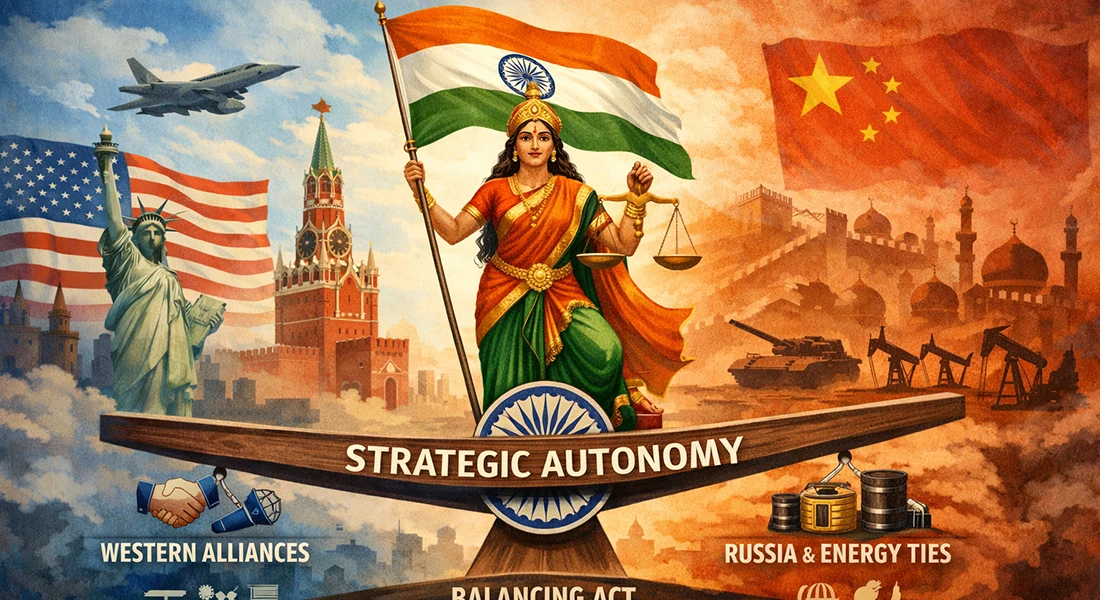
NEW DELHI: For much of its post-Independence history, India has relied on a carefully calibrated foreign policy doctrine – strategic autonomy. Born during the Cold War through the spirit of the Non-Aligned Movement, the idea was simple but powerful: India would not formally align with any major power bloc and instead preserve the freedom to take decisions based on its own national interests. In a deeply polarised world, this approach allowed New Delhi to maintain relations with competing powers without becoming a subordinate partner to any of them.
Today, however, the global environment is once again turning sharply polarised. Strategic rivalry between the United States and China is reshaping trade, technology and security alliances. Conflicts in Europe and West Asia have deepened global rivalries. In this landscape, the question arises: can India continue to remain effectively neutral?
So far, it has shown remarkable skill in navigating competing pressures. India has strengthened strategic partnerships with the US and other Western powers through groupings such as the Quadrilateral Security Dialogue, while maintaining long-standing defence and energy ties with Russia. It has also expanded economic engagement with both advanced and developing economies, positioning itself as a bridge between different geopolitical camps.
This balancing act reflects a clear strategic calculation. Formal alignment with any single bloc would reduce India’s diplomatic flexibility and could expose it to external pressures. Strategic autonomy allows India to diversify its partnerships, secure technology and energy from multiple sources, and avoid being drawn into conflicts that do not directly serve its interests.
In a sharply polarised world, can India continue to remain effectively neutral?
Yet the world India now faces is not the relatively fluid geopolitical landscape of earlier decades. Major powers are demanding clear political and economic alignment. Trade, technology supply chains and financial systems are becoming instruments of global competition.
In such an environment, the space for neutrality may gradually narrow. Critics of India’s approach argue that excessive caution could also carry risks. A strategy that emphasises equidistance may sometimes be interpreted as ambiguity. As rival blocs consolidate, countries may be expected to demonstrate greater commitment to shared security and economic frameworks. Sitting on the fence could eventually limit access to advanced technology partnerships or strategic cooperation.
At the same time, abandoning strategic autonomy entirely would be a mistake. India’s size, economic potential and geographic position demand an independent foreign policy voice. Becoming tightly aligned with any single power could constrain India’s long-term interests and undermine its ability to act as a credible representative of the developing world.
The challenge, therefore, is not whether India should abandon neutrality but how it should redefine it. Strategic autonomy today cannot mean passive non-alignment. It must evolve into what might be called ‘active multi-alignment’ – building deeper partnerships where interests converge while retaining the freedom to disagree where they do not. For policymakers, this requires a combination of diplomatic agility and economic strength. India must accelerate its economic growth, strengthen domestic technological capabilities and expand its network of strategic partnerships across regions.
For India, the real test is not whether it should abandon neutrality but whether it can sustain it from a position of strength. Strategic autonomy must rest on economic weight, technological capability and diplomatic agility. Only a stronger and more self-reliant India can preserve the freedom to choose its partners without being compelled to choose sides.