Blitz Bureau
NEW DELHI: World Television Day, observed globally on November 21 every year, recognies television as a vital medium in informing, educating, and influencing public opinion, and in fostering communication and global understanding.
In India, where over 230 million television households reach around 900 million viewers, the Day is observed under the aegis of the Ministry of Information and Broadcasting and its public broadcasting network, Prasar Bharati. Activities and outreach programmes by Doordarshan and All India Radio highlight television’s enduring role in public service communication, dissemination of development messages, and promotion of national integration.
Television in India has evolved from a limited experimental service to one of the world’s largest broadcasting networks, reflecting the country’s progress in communication technology, public outreach, and digital innovation. India’s TV journey mirrors the nation’s socio-economic development – from community education broadcasts in the 1950s to a fully digitised, multichannel environment today.
Transformation phases
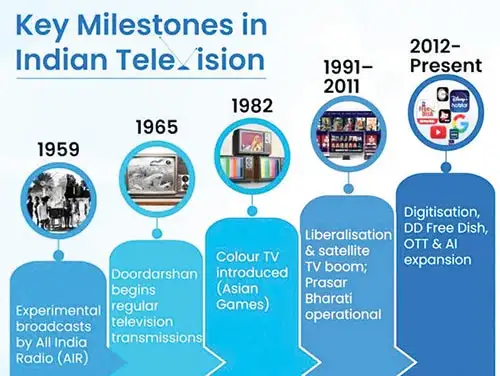
Television broadcasting in India began on an experimental basis on September 15, 1959, initiated by All India Radio. The service was launched in collaboration with Unesco to explore television’s role in education and community development. Initially, broadcasts were limited to a small radius around Delhi. Regular daily transmission began in 1965, marking the establishment of Doordarshan as a dedicated television service within All India Radio. During this period, television rapidly transitioned from a limited experiment into a growing public service medium.
New television centres were set up across major cities, including Mumbai (1972), Srinagar, Amritsar, and Calcutta (1973-75), and Chennai (1975), expanding coverage and strengthening the national broadcast infrastructure.
Doordarshan expanded its mandate beyond entertainment into news, public service broadcasting, community learning, and educational outreach. The network began structured broadcasts in school education, rural development, and awareness generation.
This period also marked Doordarshan’s growing role in delivering authentic, balanced news and public information across the country, as public broadcasting evolved beyond entertainment into a tool for social development.
By the early 1980s, the institutional foundations of Indian television were firmly established – a nationwide network, a development-oriented programming ethos, and growing technological capability. The introduction of colour television in 1982, coinciding with the Asian Games in New Delhi, was a landmark in India’s broadcasting history. This period saw rapid expansion of terrestrial transmitters under Doordarshan, extending reach to rural and remote areas.
By 1990, Doordarshan’s network covered nearly 70 per cent of the population and 80 pc of the geographical area. During the 1980s, Doordarshan also expanded the role of its regional broadcasting centres, known as Doordarshan Kendras. With the economic liberalisation of the early 1990s, India’s television landscape opened to private satellite broadcasters. Early private channels included Star TV (1991), Zee TV (1992) and Sony Entertainment Television (1995), which introduced new formats in entertainment, film, music, and news programming.
During this period, Doordarshan expanded and diversified its national and regional network. Channels such as DD National, DD Metro, DD News, DD India, and several DD Kendras continued to deliver public-service broadcasting and regional-language content, ensuring nationwide access as private networks grew.
India also transitioned to digital satellite broadcasting during this era. A major milestone was the launch of DD Direct Plus in December 2004, India’s first free-to-air Direct-to-Home (DTH) service.
Autonomous service
The Prasar Bharati Act, 1990 was enacted to establish an autonomous public service broadcaster for India. The Act came into effect on November 23, 1997, leading to the formation of the Prasar Bharati Corporation.
With its operationalisation, Doordarshan and AIR were brought under the corporation. The Act mandates Prasar Bharati to function independently and impartially, ensuring diverse broadcasting that serves the public interest. The Government implemented cable TV digitisation in four phases between 2012 and 2017, under the Cable Television Networks (Regulation) Act, 1995. DD Free Dish, India’s only free-to-air DTH service, emerged as a major vehicle for digital inclusion, reaching nearly 50 million households as of 2024.
Today, India’s vast television network serves hundreds of millions of viewers nationwide, making television the country’s most accessible mass communication platform and connecting urban and rural audiences alike.