


Blitz Bureau
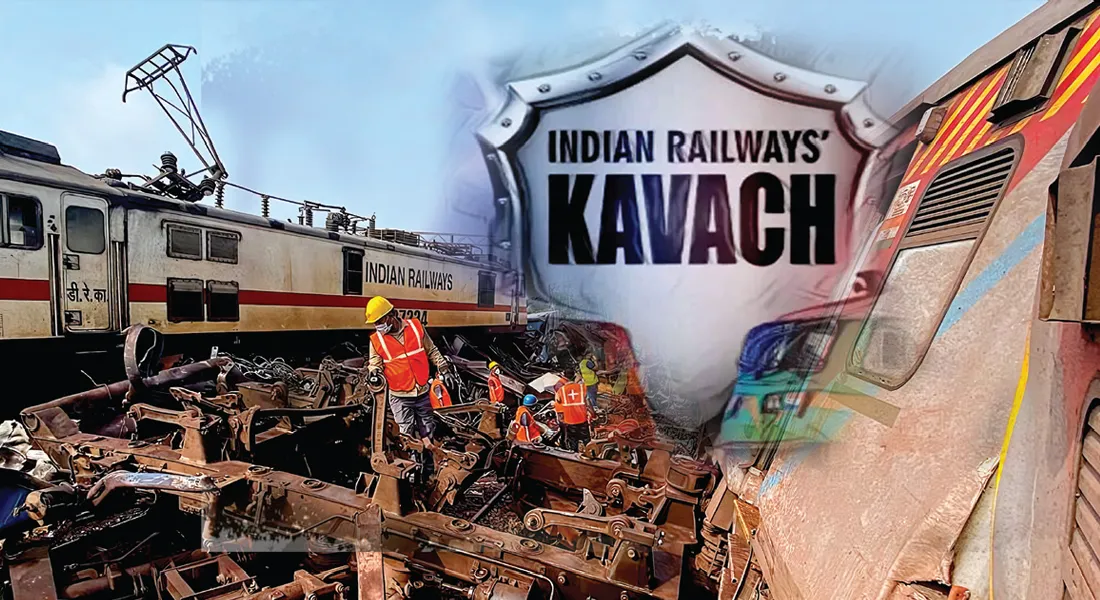
NEW DELHI: The development and deployment of Kavach have been undertaken in a phased and systematic manner. Initial field trials on passenger trains commenced in February 2016. Based on operational experience and the Independent Safety Assessment, three firms were approved during 2018–19 for the supply of Kavach Version 3.2.
With over 1,465 route km on South Central Railway and the experience gained therefrom, the system has continued to evolve through successive improvements and upgrades. Subsequently, Kavach was adopted as the National Automatic Train Protection (ATP) system in July 2020.
Continuous improvements based on operational experience and independent safety assessments led to the approval of Kavach Version 4.0 in July 2024. It is a significant milestone in railway safety.
The upcoming launch of Kavach 5.0 was announced in April 2025. It is expected to significantly reduce inter-train headway, enabling a higher frequency of train operations while maintaining safe and efficient movement.
Strategy and progress
Nearly 96 per cent of railway traffic is carried on the High-Density Network (HDN) and Highly Used Network (HUN) routes. To ensure safe transportation of this traffic, Kavach implementation is being undertaken in a focused manner based on priorities defined by the Railway Board:
After extensive trials, Kavach Version 4.0 was initially commissioned on 738 route km. In January this year, Indian Railways achieved a major milestone by installing the Kavach Version 4.0 safety system on 472.3 route km in a single day in a single month, the highest ever so far.
The system has been successfully tested through automatic braking trials. Further expansion is underway. Overall, Kavach has now been implemented on more than 2,200 route kilometres, reflecting a steady and accelerating expansion of India’s indigenous Automatic Train Protection system across the national rail network.
The AI leverage
To further enhance operational safety, improve communication reliability, and strengthen passenger information systems, Indian Railways is leveraging a range of Artificial Intelligence, telecom, and digital technologies across the railway network.
Alongside Kavach, these initiatives complement conventional safety systems by enabling real-time monitoring, predictive maintenance, automated alerts, reducing dependence on manual intervention and improving system responsiveness.
An AI-enabled Intrusion Detection System based on Distributed Acoustic Sensing (DAS) technology has been developed to detect the presence of elephants and other wild animals on railway tracks in vulnerable corridors.
To strengthen station-level security, Video Surveillance Systems (VSS) have been commissioned at 1,731 railway stations. These systems are equipped with AI-based Video Analytics for automated event detection such as intrusion and loitering.
Predictive maintenance
AI-based predictive maintenance of signaling systems is being piloted at select stations to develop standardized failure prediction logics and alerts mechanism.
Online Monitoring of Rolling Stock System (OMRS) and Wheel Impact Load Detectors (WILD) adopted for early detection of rolling stock defects and improved asset health monitoring.
Safe train operations depend on reliable voice communication between the Loco Pilot and Guard. The procurement of Digital 5W Very High Frequency (VHF) Walkie-Talkie sets has been standardized, replacing conventional analogue systems.
Alongside Kavach, the Indian Railways is leveraging a range of Artificial Intelligence, telecom, and digital technologies across the railway network