Blitz Bureau
NEW DELHI: Industrial parks have emerged as a principal vehicle for accelerating the country’s industry and innovation agenda. Developed in partnership with state governments and the private sector, these parks are reinforcing India’s industrial base by promoting investment, progress-driven development, and economic ascendancy. They stimulate employment generation while also encouraging sustainable development.
As the Government increasingly adopts the role of facilitator, rather than regulator, these parks are sculpting a globally competitive industrial economy in India. An industrial park refers to a planned tract of land that is subdivided and developed for industrial use, with or without ready-built factories, and supported by shared facilities for multiple industries.
Social responsibility
These parks balance economic growth with environmental and social responsibility. Their management ensures adherence to environmental laws, spreads awareness on standards, and rewards companies that follow eco-friendly practices.
These parks also strengthen social wellbeing. They provide social infrastructure for employees and nearby communities, along with safe accommodation where necessary. Security systems protect workers and assets across the industrial area. Health and safety are promoted through medical checks, protective equipment, and monitoring of exposure levels.
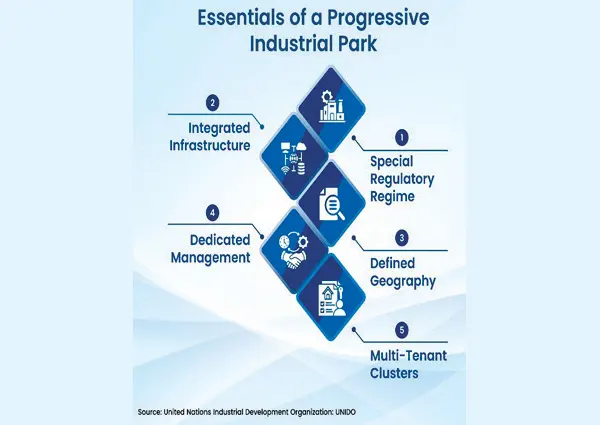
Industrial parks operate under liberal and incentive-based rules for labour, land use, and foreign investment. They offer shared hard and soft facilities such as utilities, telecom networks, waste systems, laboratories, internal roads, one-stop clearances, training centres, security, and emergency services.
Development takes place on clearly demarcated, master-planned land with uniform standards for buildings and facilities. A single authority oversees firm entry, ensures regulatory compliance, and drives long-term park development. Multiple firms operate within the park, collaborate, share resources, and enhance productivity through agglomeration and clustering effects.
Higher productivity
Industrial parks integrate scarce factors of production within defined geographic zones, generating higher productivity and operational efficiency. They create jobs, improve wages, and strengthen the local talent base.
These parks draw investment and advanced technologies while enabling technology and managerial knowledge transfer. Clustered industrial activity stimulates upgrading, enhances national competitiveness, and deepens global value chain integration.
Local, provincial, and national policies accelerate industrial growth and reinforce the gains generated by parks. They act as catalysts for economic expansion and sustainable progress in host cities and regions. The incorporation of Industrial Parks is undertaken based on a business case that outlines the need for serviced industrial land and the anticipated economic and developmental benefits upon project completion. Following the preparation of the business case, pre-feasibility studies are carried out to evaluate potential sites for establishing an industrial park.
Several initiatives and platforms are shaping India’s industrial parks’ growth and streamlining land access, accelerating industrial development, and supporting investor decision-making. Plug-and-play: By providing infrastructure that is precision-designed to industry needs, the plug-and-play parks enhance operational efficiency and sustainability. There are currently 306 plug-and-play industrial parks in India, and an additional 20 are being developed.
IILB: The Department for Promotion of Industry and Internal Trade developed the India Industrial Land Bank (IILB), a centralided Geographic Information System (GIS)-enabled platform that offers up-todate, spatial and non-spatial information on industrial land across the country. IPRS: The Industrial Park Rating System (IPRS) is a comprehensive framework for assessing the performance and quality of industrial parks and business districts. Built on four assessment pillars, it provides valuable insights to investors, developers, and policymakers.