Blitz Bureau
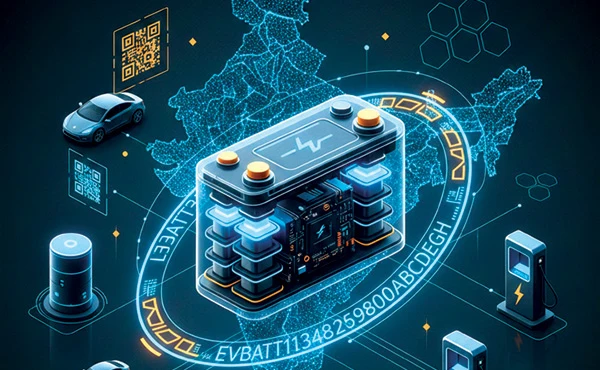
NEW DELHI: The Ministry of Road Transport has proposed a new system to identify and track electric vehicle (EV) batteries across their entire life cycle. Under the plan, every EV battery in India will be assigned a unique 21-digit identification number, called the Battery Pack Aadhaar Number (BPAN).
The BPAN will allow authorities to track a battery’s journey — from manufacturing and usage to degradation and recycling — through a single digital platform.
As per draft guidelines issued by the Ministry, it will be mandatory for battery manufacturers and importers to assign a 21-character BPAN to every battery pack.
The rule will apply not only to batteries sold commercially but also to those manufactured for internal or captive use by companies.
Non-removable and clearly visible
• The BPAN must be clearly displayed on the battery pack.
• Manufacturers must ensure the number cannot be erased, damaged, or tampered with.
• Companies will also be required to upload real-time battery data to the official BPAN portal.
A key feature of the system is full life-cycle monitoring. BPAN will store details related to raw material sourcing, manufacturing, usage, and end-of-life recycling.
If a battery is recycled or repurposed for another use, a new BPAN will be issued, ensuring transparency between the old and reused battery.
Since 80 per cent – 90 per cent of India’s lithium-ion battery demand comes from the EV sector, EV batteries will be covered in the initial phase.
However, the draft guidelines also propose extending BPAN rules to industrial batteries with a capacity exceeding 2 kWh.
The Automotive Industry Standard (AIS) framework will be used to implement BPAN. A dedicated committee, comprising battery manufacturers, automakers, recyclers, and government officials, will finalise technical standards and ensure uniform implementation.
Key benefits of BPAN
• Safety: Better monitoring of battery quality and performance
• Second Life Use: Easier identification of batteries suitable for reuse
• Environmental Protection: Ensures proper disposal and recycling
• Transparency: Buyers can access a battery’s complete history
What is ‘battery second Life’?
When an EV battery’s capacity drops to 70 per cent – 80 per cent, it is no longer ideal for vehicle use. However, it can still be reused for home inverters or solar energy storage. The BPAN system will help identify such batteries and enable their safe and efficient repurposing.