Blitz Bureau
NEW DELHI: Amid tensions on several other foreign policy fronts, German Chancellor Friedrich Merz was the first high-level visitor to New Delhi to strengthen IndiaEurope ties.
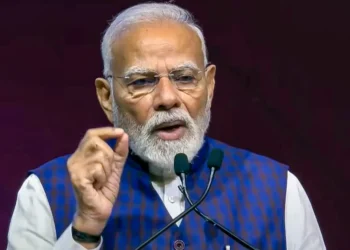
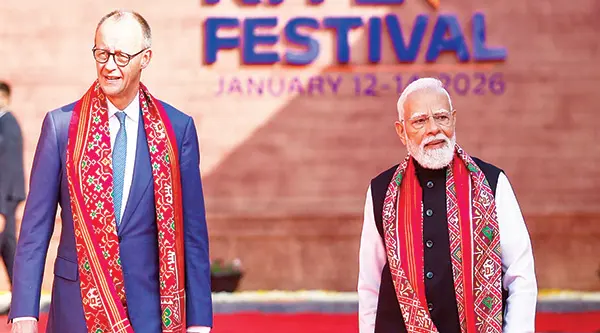
A meeting between Chancellor Merz and Prime Minister Narendra Modi, in Ahmedabad on January 12, was about more than bilateral relations. It was about reaffirming elements of talks with the EU to conclude a trade agreement, as Germany is its biggest economy, as well as exchanging notes on geopolitical turmoil.
Preparations are already on for the EU-India Summit later this month, when the Presidents of the European Commission and Council will attend the Republic Day Parade.
Plans for French President Emmanuel Macron’s visit – he will attend the AI Summit in February – are also being finalised.
Partner of choice
As PM Modi pointed out while addressing a joint press conference with German Chancellor in Gandhinagar, Merz’s choice of India as his first Asian destination underscored the importance Berlin attaches to the partnership. On his part, Merz described India as a “partner of choice” for Germany in ensuring a rule-based order in the Indo-Pacific.
The two leaders also attended a business council meeting, where they pitched more investments. With trade passing $50 billion in 2024- 25, Germany remains India’s largest trading partner in Europe. While the talks are understood to have been substantive, the outcomes were
in essence, a series of ‘Joint Declarations of Intent (JDI)’ and MoUs. Among the JDIs signed, several deal with cooperation on strategic issues, including a Defence Industrial Cooperation Roadmap to promote collaborations and technology partnerships in defence equipment. This is seen as a precursor to the enabling agreements for defence purchases that India and Germany have been discussing but have yet to sign.
While Germany and the EU are also hoping for a closer dialogue with India on the Indo-Pacific, Germany’s bilateral trade with China, pegged at $287 billion in 2024-25, has not diversified and China is Germany’s largest trading partner. It is therefore doubly significant that Chancellor Merz made India his first stop in Asia.
Joint statement
The joint statement issued after the Modi-Merz meeting promises a quantum leap in bilateral relations. The most promising area is technology-led collaboration. Germany’s strengths in engineering, hardware, precision manufacturing and industrial standards complement India’s capabilities in software, digital platforms, data, and scalable innovation.
Joint partnerships in microsystems, quantum technologies, semiconductors, and AI-enabled manufacturing could yield outsized gains. The two countries adopted JDIs on semiconductors, critical minerals and telecommunications, underlining shared priorities in securing critical and emerging technology ecosystems.
Green growth also featured prominently, with the two leaders announcing the establishment of an India-Germany Centre of Excellence in Renewable Energy. On the geopolitical front, PM Modi and Chancellor Merz shared commitment for a joint fight against terrorism and push for UN Security Council reform.