Blitz Bureau
NEW DELHI: India’s expanding network of Free Trade Agreements (FTAs) is quietly reshaping the country’s economic engagement with the world, lowering trade barriers, strengthening export competitiveness and positioning Indian businesses more firmly within global supply chains.
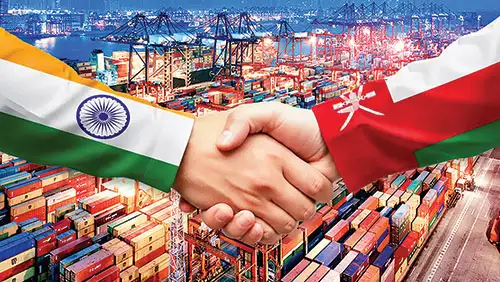
With the signing of the India-Oman Comprehensive Economic Partnership Agreement (CEPA) on December 18, India has taken another decisive step in using trade diplomacy as a tool for growth, jobs and long-term economic security.
What FTA delivers
At its core, a Free Trade Agreement provides preferential market access by reducing or eliminating customs duties between partner countries. This makes exports cheaper and more competitive, while also lowering the cost of imported raw materials, energy and intermediate goods for domestic industry.
Modern FTAs go well beyond tariffs. They increasingly cover services, investment protection, customs facilitation, intellectual property, logistics and supply-chain integration.
For India, FTAs serve multiple objectives at once: boosting exports, attracting foreign investment, integrating Indian firms into global value chains, and supporting national initiatives such as Make in India, Atmanirbhar Bharat and Viksit Bharat @2047.
A Gulf gateway
The India-Oman CEPA exemplifies this new, targeted approach. Under the agreement, Oman has offered zero-duty access on over 98 per cent of its tariff lines, covering almost the entire basket of Indian exports. India, in turn, has reduced tariffs on around 78 per cent of its tariff lines, accounting for about 95 per cent of Oman’s exports by value, while keeping sensitive sectors protected.
The timing is significant. Bilateral trade between the two countries already stands at about $10.6 billion, with India exporting around $4 billion worth of goods and importing mainly crude oil, LNG and fertilisers from Oman. The Government and industry estimates suggest that the agreement could add $2 billion to India’s exports within the next two to three years.
Sectors expected to gain the most include gems and jewellery, textiles, pharmaceuticals, automobiles and auto components, engineering goods, food processing and agrochemicals. Services also present a major opportunity.
India currently accounts for only a small share of Oman’s services imports, leaving ample scope for growth in professional services, healthcare, education, tourism and business support.
Renewed faith, energy
Beyond trade numbers, Oman’s strategic location makes it a natural logistics and re-export hub for the wider Gulf and West Asian region, offering Indian companies a springboard into neighbouring markets.
The agreement was signed in Muscat by Commerce and Industry Minister Piyush Goyal and Oman’s Minister of Commerce, Industry and Investment Promotion Qais bin Mohammed Al Yousef in the presence of Prime Minister Narendra Modi and Sultan Haitham bin Tarik.
“The CEPA will infuse the India-Oman partnership in the 21st century with renewed faith and energy,” PM Modi said earlier in the day while speaking at the India-Oman Business Forum. “This is a blueprint for our future. It will give our trade new vigour and new trust for investments and will open the doors of new opportunities in every sector.”
Trade push goes on
With the Oman agreement, India has now signed 17 comprehensive trade agreements, including FTAs, CEPAs and CECAs. These deals cover not just individual countries but also large regional blocs. Major partners include ASEAN (10 countries), EFTA (four countries), the UAE, Australia, Japan, South Korea, Singapore, Malaysia, Thailand, Sri Lanka, Bhutan and Mauritius.
Because several agreements are regional, the number of countries covered by India’s trade pacts is significantly higher than the number of agreements themselves, giving Indian exporters preferential access to a wide range of global markets.
India’s trade push is far from over. Negotiations are currently underway on nine major trade agreements, including those with the European Union, the United States, New Zealand, Chile, Peru and the Eurasian Economic Union, as well as upgrades to existing pacts with Australia and South Korea and a deeper economic agreement with Sri Lanka.
These talks reflect a more calibrated strategy – seeking deeper access in high-growth markets while safeguarding sensitive domestic sectors and ensuring that trade liberalisation translates into real gains for manufacturing, services and employment.
A central pillar
For businesses, FTAs translate into new markets, lower costs and greater certainty. For consumers, they can mean more choice and competitive prices. At a national level, they help diversify export destinations, reduce over-dependence on a few markets, and strengthen India’s role in global supply chains.
As India’s total trade moves steadily towards the $1 trillion mark, its growing FTA architecture is emerging as a central pillar of economic policy. The message is clear: trade agreements are no longer peripheral instruments. They are becoming strategic levers of growth, shaping how India produces, trades and competes in the global economy.
The India-Oman CEPA is not just another agreement – it is a signal of how India intends to engage the world in the years ahead.