Blitz Bureau
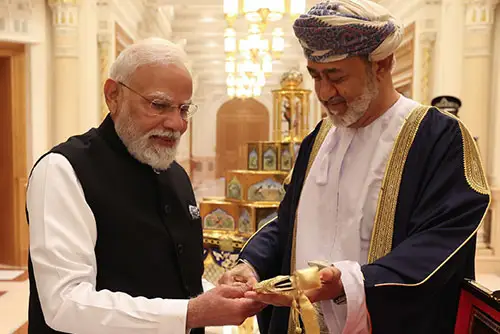
NEW DELHI:Prime Minister Narendra Modi’s visit to Jordan, Ethiopia and Oman on December 15-18 was not only a reiteration of India’s civilisational links with Africa and the Gulf but also an emphatic assertion of its strategic diplomacy in the fastchanging global scenario. India inked a Free Trade Agreement and adopted a Joint Vision Document on Maritime Cooperation with Oman, where PM Modi was awarded the country’s highest civilian honour by Sultan Haitham bin Tarik.
Earlier, in Jordan, the two countries inked five MoUs after extensive talks between PM Modi and King Abdullah II. The visit also underscored India’s growing engagement with West Asia, with Jordan emerging as a key partner linking regional connectivity, trade and people-to-people exchanges.
PM Modi’s maiden bilateral visit to Addis Ababa, marked a significant moment of diplomatic elevation and India and Ethiopia upgraded their engagement to a ‘strategic partnership’. Here, too, the PM was awarded the country’s highest civilian title, The Great Honour Nishan of Ethiopia. The long-awaited Comprehensive Economic Partnership Agreement (CEPA) with Oman is a major milestone in India’s expanding presence in the Gulf region. At its core, the CEPA is a free-trade framework designed to cut or eliminate tariffs, making it easier for businesses and exporters on both sides to trade goods and services.
The pact not only opens doors for tariff-free exports such as textiles, chemicals, and engineering goods, which together represent billions in trade, but also strengthens India’s longer-term strategic engagement in the Gulf – including deeper cooperation on energy security, port connectivity and Indian investments in Oman’s logistics and industrial hubs.
Beyond tariff cuts, the CEPA aims to facilitate cooperation in logistics, infrastructure, energy, and technology, aligning with Oman’s role as a gateway to markets in the Gulf, East Africa and beyond. A strategic win For India, the CEPA with Oman is a strategic win that follows earlier trade deals with other Gulf partners and reflects an ongoing push to diversify export markets and integrate more deeply into global supply chains.
The fact that PM Modi visited the three countries amid the winter session of Parliament is significant. He is travelling the world at a time when the world itself is coming apart at the seams. The liberal order that once promised stability has fractured. The West is inward-looking and divided. Multilateral institutions are paralysed. In this unsettled landscape, PM Modi’s diplomacy reflects a state acutely aware that standing still is not an option – and that moral clarity, once prized, has become diplomatically inconvenient.