PRABHU CHAWLA
NEW DELHI: In the blaze of diplomatic theatre that gripped New Delhi and Washington, the India-US trade agreement was unveiled as a geopolitical spectacle destined to reshape global commerce.
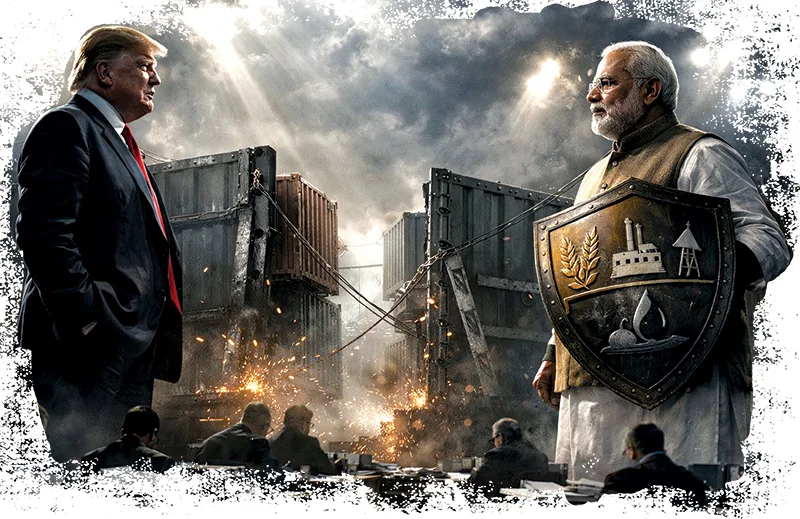
President Donald Trump and Prime Minister Narendra Modi projected unstoppable momentum, promising the demolition of punitive barriers and an era of cascading prosperity across the Indo-Pacific. The imagery was potent and cleverly choreographed. Two nationalist leaders forged a bilateral pact through social media posts to unlock hundreds of billions in trade.
Yet, this triumphalist narrative concealed a murkier reality. Its bold declarations were masked by institutional ambiguity, where tariff reductions were announced but not legislated. Its supposed market openings remained theatrical projections rather than negotiated facts.
The truth lies not in sweeping rhetoric of limitless access, but in the grinding bureaucratic calibration that must still unfold to prevent this moment from dissolving into diplomatic mirage. Even a belated joint statement on the deal raised more questions than the answers it was expected to deliver.
The American narrative was audacious. Trump declared that punitive tariffs ratcheted to roughly 50 per cent amid disputes over India’s Russian oil purchases would be slashed to an 18 per cent ceiling. In exchange, he claimed India had committed to eliminating tariffs on American goods and services entirely.
What was celebrated as a historic deal was, in fact, a preliminary framework – a political commitment to de-escalate tariff hostilities rather than a finalised architecture of a bilateral trade edifice
He majestically announced that India would grant unfettered access for US agricultural products and move immediately from Russian oil toward US and Venezuelan supplies. India would also purchase over $500 billion in American products in the coming years.
Trump’s postulation, reinforced by the White House and the US Secretary of Agriculture, painted India as capitulating to American commercial might, transforming its trade surplus into a tributary flow of US exports. It was a narrative designed for domestic consumption, promising to rectify a goods trade deficit that had swollen to approximately $53.5 billion in 2025, with American exports to India stagnating around $42 billion while Indian shipments to the US surged past $95 billion.
The Indian response systematically deflated this hyperbole. Modi welcomed the agreement as a pathway to new opportunities. But he conspicuously avoided endorsing Trump’s specific claims regarding oil embargoes, agricultural access, or blanket tariff abolition.
Commerce Minister Piyush Goyal a c k n o w l e d g e d only a tentative understanding on the reciprocal 18 per cent tariff ceiling and expressed willingness to increase imports of American energy and advanced technologies over the next decade. However, he differed with the emphatic caveat that India’s vulnerable agricultural sector and sensitive industries would remain shielded.
President Donald Trump and Prime Minister Narendra Modi projected unstoppable momentum, promising the demolition of punitive barriers and an era of cascading prosperity across the Indo-Pacific
The institutional reality further exposed the gap between announcement and implementation. The Union Commerce Secretary Rajesh Agrawal conceded that no formal, legally binding documentation existed yet to codify the understanding, pointing to structural hurdles that make sudden tariff transformations impossible in the Indian system.
Labyrinthine process
Unlike the American executive, which wields tariff authority with sweeping discretion, any permanent reduction in Indian import duties requires navigation through labyrinthine legal processes, including World Trade Organisation notifications and adherence to most-favourednation principles mandating equal treatment for all trading partners. External Affairs Minister S Jaishankar, when pressed in Washington, diplomatically deflected specific questions back to the Commerce Ministry.
What was celebrated as a historic deal was, in fact, a preliminary framework – a political commitment to de-escalate tariff hostilities rather than a finalised architecture of a bilateral trade edifice.
Nowhere does the chasm between American claims and Indian reality yawn wider than in energy security. Trump’s categorical assertion that Modi had agreed to terminate Russian oil imports and reorient supply chains towards American and Venezuelan sources was echoed by senior US officials speaking of rerouted shipping lanes. Yet, Indian officials maintained with quiet firmness that energy procurement decisions would continue to be governed by the immutable calculus of price, supply reliability and strategic diversification, and not by diplomatic pressure from any capital.
Illusory construct
Russian diplomats confirmed receiving no formal notification from New Delhi regarding cessation of crude purchases. In practice, India has adjusted the proportion of Russian crude in its import basket, responding to shifting market conditions and sanctionsinduced discounts.
Similarly, the agricultural dimension exists more in aspiration than accomplished fact. The American projections imagined transformative penetration of India’s agricultural defences, promising American farmers access to a consumer market of nearly 1.4 billion people and generating billions in new exports across commodities ranging from almonds to dairy. This illusory construct ignored the political economy of rural India, where agriculture sustains hundreds of millions and foreign encroachment triggers volatile backlash. The notion of India unilaterally eliminating duties on all American agricultural goods, a central plank of Trump’s announcement, found no resonance in official Indian communications.
The political choreography reveals divergent national imperatives. For Modi, the deal provides an optic of strength. He was projected as leader who forced an American President to roll back punitive tariffs while extracting praise for India’s strategic importance.
Political crosswinds
Ruling party circles celebrated this as vindication of ‘huglomacy’, that blend of personal warmth and firm negotiation skills which Modi possesses. Yet, this celebrity chorus faces ferocious opposition leaders like Rahul Gandhi who decry the agreement as a strategic surrender masquerading as victory. They have demanded parliamentary scrutiny of the full text, warning against mortgaging agricultural and energy security for flattering optics and eroding the Atmanirbhar Bharat ethos of indigenous resilience. Despite these political crosswinds, Indian equity markets responded with cautious optimism, driving the Sensex and Nifty upwards on expectations that stabilised tariff regimes would benefit exportoriented sectors.
Ultimately, this agreement stands a s testament to the Trumpian method of international dealmaking: deploy tariffs as instruments of coercion, announce breakthroughs through spectacular media events and delegate complex legal codification to subsequent bureaucratic sessions. Whether this would yield substantive restructuring of India-US trade or merely temporary détente would depend on arduous negotiations still to come.
A fragile gambit
The potential exists for genuine stabilisation. A reciprocal 18 per cent tariff ceiling could inject predictability into a relationship historically plagued by volatility. Even structured energy cooperation might support India’s diversification without rupturing strategic autonomy. Realising this potential demands both nations to move beyond the performative phase towards meticulous legal drafting, transparent parliamentary ratification and systematic protection of vulnerable domestic constituencies.
The deal blazoned with such fanfare is neither the miracle of unrestricted commerce Trump proclaimed, nor the catastrophe of capitulation Indian opposition figures fear. Rather, it’s a fragile opening gambit in a longer contest to balance economic integration with sovereign resilience. Whether it becomes the foundation of a transformed bilateral association between two equals or dissolves into footnotes of diplomatic history will be determined not by the enthusiasm of this moment, but by the painstaking integrity of the implementation that would follow.