Prabhu Chawla
INTRO BLURB: By striking the very nations harbouring US bases that facilitate Israeli and American air operations, Tehran seeks to impose intolerable economic and political burdens
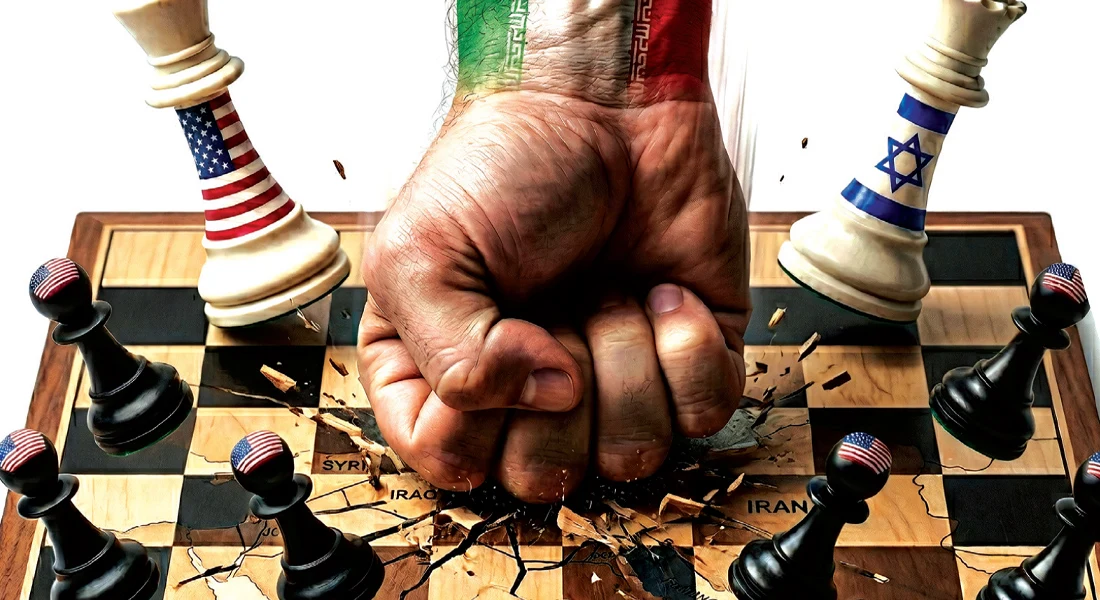
History’s wisest voices have always warned of war’s hidden poison. “War is hell,” American General William Sherman declared; yet, leaders still chase glory in its flames. Today, in the smoke of the West Asian cataclysm, those ancient cautions resonate with chilling urgency. As the US-Israeli campaign against Iran enters its third week, one unyielding verity emerges with stark clarity. Tehran has deliberately chosen restraint toward Israel and ferocity towards its Arab neighbours.
This calculated asymmetry is no mere tactical footnote. It unveils the regime’s authentic objective. Rather than matching Israel strike for strike in pursuit of decisive military damage, Iran has unleashed thousands of missiles and drones upon the United Arab Emirates, Saudi Arabia, Qatar, Kuwait and Bahrain. Only a modest fraction has been directed at the Jewish state.
This stark disparity has ignited profound interrogations about Iran’s genuine strategic aim. Is Tehran truly fixated on Israel? Or does its intent lie in eviscerating the Sunni Arab economies that sustain America’s regional dominance?
The Shia-Sunni schism, carved deep by decades of rivalry, may illuminate the choice. And why have the Arab states, despite enduring the brunt of this onslaught, refrained from direct retaliation? Ramadan has now concluded. Some analysts speculate whether a post-Eid counter-offensive might yet materialise. The war’s inaugural salvos proved mercilessly effective. On February 28, the US and Israeli forces eliminated Supreme Leader Ayatollah Ali Khamenei along with Iran’s political-military aristocracy.
Yet the regime endured. Khamenei’s second son Mojtaba, a 56-year-old hardliner forged in the crucible of the Iran-Iraq war, was elected Supreme Leader. This meticulously pre-planned succession granted Iran temporary operational continuity far beyond the expectations of most Western analysts.
Iran’s Operation True Promise IV, initiated in the first week of March, has so far discharged roughly 220 ballistic missiles and at least 110 drones against Israel in successive salvos as part of a cumulative total that remains confined to the low-to-mid hundreds of ballistic missiles and drones. The civilian casualties in Israel range between 12 and 24 dead, with impacts registered in Tel Aviv, Haifa, Beit Shemesh, Ramat Gan, Holon and surrounding locales. The physical destruction has remained symbolic. Critical military installations have sustained only negligible impairment; the airbases continued full operations.
On the contrary, the Gulf narrative unfolds on an altogether different scale. The UAE alone has endured 314 ballistic missiles, 1,672 drones and 15 cruise missiles by mid-March. Kuwait documented over 120 missiles and 308 drones. Qatar confronted 127 missiles, 63 drones plus two Su-24 aircraft incidents. Bahrain absorbed 105 missiles and 176 drones. Saudi Arabia and other Gulf states registered dozens more apiece. In the conflict’s early phase, approximately 60 per cent of Iran’s ordnance targeted US bases and Gulf infrastructure rather than Israel.
Drone, missile barrages
The human and economic devastation inflicted upon the Arab world has proven incomparably more profound. Iranian drone and missile barrages have repeatedly assailed Dubai International Airport, the planet’s busiest international gateway. Fuel depots were ignited. Flights were suspended or massively diverted. Luxury hotels and energy complexes sustained direct hits.
Qatar’s Ras Laffan LNG facility suffered extensive destruction, Saudi Arabia’s Yanbu refinery and various Kuwaiti installations were deliberately targeted, along with luxury hotels across all states. Global oil prices have rocketed beyond $110. Tourism, a cornerstone of the UAE and other Gulf economies, has haemorrhaged an estimated $550-650 million daily, with projections forecasting aggregate regional losses surpassing $40-56 billion annually.
By striking the very nations harbouring US bases that facilitate Israeli and American air operations, Tehran seeks to impose intolerable economic and political burdens. It expects that it would compel the Gulf rulers to pressure Washington into cessation. The doctrine is anything but arbitrary. Strategists identify this as textbook asymmetric doctrine. It aims to inflate the cost of American entanglement by bleeding its Sunni Arab proxies rather than pursuing outright military supremacy over the far more robustly defended Israeli heartland.
This reality compels an even more disquieting inquiry. Is Iran’s ultimate objective mere regime preservation through economic attrition? Or does an underlying sectarian calculus animate the disparity? Iran stands as the pre-eminent Shia power in the region. The Gulf monarchies remain overwhelmingly Sunni. For generations, Tehran has regarded these Sunni Arab states – above all Saudi Arabia and the UAE – as existential ideological and geopolitical adversaries. The enduring legacy of the Iran-Iraq War, proxy conflicts in Yemen, Syria and Lebanon, and the Islamic republic’s self-styled ‘axis of resistance’ have all been indelibly coloured by this primordial Shia-Sunni divide.
Valiant guardian
By systematically punishing the Sunni Gulf economies that normalised relations with Israel through the Abraham Accords, Tehran simultaneously undermines America’s Sunni bulwarks and positions itself as the valiant guardian of the broader Muslim ummah against ‘Zionist-American aggression’. Iran’s capacity to sustain this campaign notwithstanding decapitation strikes is nothing short of remarkable.
Arab restraint, meanwhile, continues to perplex observers. Despite absorbing the campaign’s most punishing blows, the UAE, Saudi Arabia, Qatar and others have refrained from direct counter-strikes against Iranian soil. The imperatives transcend seasonal considerations. These nations remain profoundly dependent upon the US security umbrella; their military doctrines prioritise interception over deep offensive projection across the Gulf.
Direct confrontation with Iran would court catastrophic escalation, annihilation of oil infrastructure and economic self-immolation. Ramadan’s emphasis on restraint infused an additional layer of diplomatic delicacy; Gulf statements invoked Muslim solidarity. Arab Foreign Ministers convened in Riyadh, issued strong condemnations of the Iranian attacks and demanded immediate cessation. However, it stopped short of belligerent participation.
Talk of a post-Ramadan Arab offensive to “finish Iran” remains a speculation. Gulf leadership recognises that only American and Israeli power can meaningfully degrade Tehran’s capabilities. They, therefore, absorb the punishment, rely upon US interceptors, and permit Washington to shoulder the offensive burden while their economies continue to bleed.
Unambiguous ultimatum
Yet, the UAE has now issued an unambiguous ultimatum. The UAE leadership, in concert with Saudi Crown Prince Mohammed bin Salman, has declared that sustained strikes imperil full-scale regional conflagration. Should Iran refuse to relent, the UAE retains the prerogative to strike back. Meanwhile, Iran has successfully paralysed vital installations, propelled oil prices into the stratosphere and compelled global scrutiny of the human and financial torment inflicted upon its Sunni neighbours.
The strategy harbours existential peril. It risks alienating potential Arab public sympathy and inviting deeper international ostracism as Trump’s core alliance endures. As Mojtaba’s inner circle entrenches itself behind the ‘mosaic defence’ doctrine, and as the Gulf tallies its escalating billions in losses, Tehran is not destroying itself in this conflict. It is devouring the very economic architecture that keeps the Islamic republic afloat – global energy flows. War is never the right tool to save an identity. It becomes the tool that finally inhales it.
Arab restraint continues to perplex observers. Despite absorbing the campaign’s most punishing blows, the UAE, Saudi Arabia, Qatar and others have refrained from direct counter-strikes against Iranian soil