Blitz Bureau
NEW DELHI: India’s emergence as a global digital power now hinges on its ability to build Artificial Intelligence systems that are indigenous, inclusive, and aligned with national priorities. As AI increasingly shapes governance, public services, industry, and citizen engagement, the need for homegrown foundational models has become important.
These models must be trained on Indian languages, local data, and real-world contexts to ensure relevance and effectiveness.
Built with the vision of creating AI systems specifically for India, Sarvam AI is an organisation that is developing Artificial Intelligence tailored to India’s needs by building foundational components and applying them to the country’s unique linguistic, enterprise, and governance requirements.
The company has built a full-stack AI platform, with everything developed, deployed, and governed entirely in India. These enterprise grade platforms reflect the country’s linguistic diversity and are designed to support public service delivery. Its work directly addresses long-standing barriers in accessibility, multilingual communication, and dependence on foreign AI infrastructure.
Indigenous AI infra
Strengthening indigenous AI infrastructure is central to India’s vision of technological sovereignty, digital self-reliance, and inclusive growth. In an era where AI shapes governance, economic competitiveness, and citizen services, building AI systems rooted in local languages, datasets, and regulatory frameworks ensures that innovation aligns with national priorities and societal needs.
In this context, Sarvam AI stands out as one of the 12 organisations selected under the Innovation Centre pillar of the IndiaAI Mission to develop indigenous foundational models, with financial and compute support amounting to Rs 246.72 crore. The company is building large language and speech models (LLMs) tailored for Indian languages and public service delivery, with capabilities such as voice-based interfaces, document processing, and citizen-centric applications.
Sarvam AI’s models include: Bulbul (Text-to-Speech): Available in 11 Indian languages with 39 distinct speaker voices; Saaras (Speech-to-Text): Supports all 22 scheduled languages, 8kHz telephony audio, and code-mixed speech; and Vision (Document Understanding): Tailored for 22+ Indian languages, mixed scripts, and handwritten text.
Sovereign ecosystem
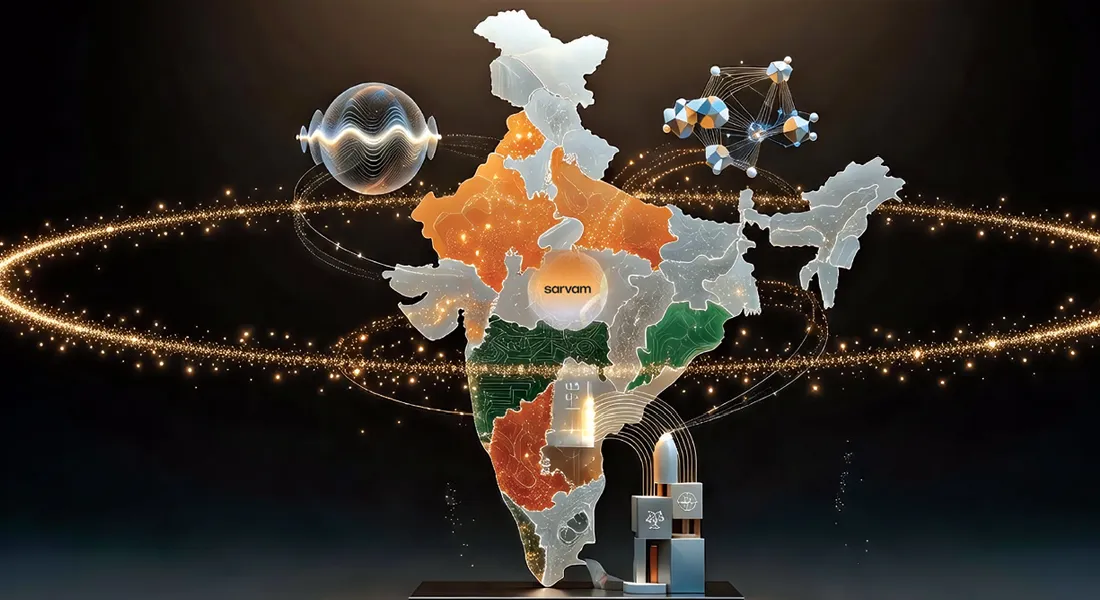
Sarvam AI has built a comprehensive, full-stack sovereign AI ecosystem designed to serve enterprises, governments, developers, and creators across the country.
The Sarvam AI ecosystem consists of: Sarvam for Conversations; Sarvam for Work; Sarvam AI for Content; and Sarvam AI for Edge Intelligence. Through this integrated architecture, Sarvam AI is not merely building applications but establishing a scalable digital backbone for India’s AI future.
By converging infrastructure, language intelligence, enterprise capability, and edge deployment into one sovereign ecosystem, it positions India to innovate independently, deploy responsibly, and compete globally, while ensuring that advanced AI remains accessible, secure, and aligned with national development priorities.
Strategic partnerships
Sarvam AI’s institutional collaborations are transforming indigenous innovation into measurable public value across India. By working closely with national and state governments, the company is embedding advanced AI capabilities into critical service delivery systems.
UIDAI (Unique Identification Authority of India) partnered with Sarvam AI to enhance Aadhaar services using AI-driven voice interaction, real-time fraud detection, and multilingual support.
The Government of Odisha in collaboration with Sarvam AI is establishing a 50MW AI-optimised Sovereign AI Capacity Hub to serve as a national compute backbone. The Government of Tamil Nadu and IIT Madras, in collaboration with Sarvam, are developing Digital Sangam, India’s first Sovereign AI Research Park.
Collectively, these initiatives demonstrate how coordinated public partnerships can deploy homegrown AI infrastructure at population scale.