Rajeshwar Prasad
NEW DELHI: India is scaling up exploration of critical minerals, fostering a startup-driven mining ecosystem and building strong domestic value chains to reduce import dependence. The Government is also focusing on improving project timelines by simplifying approval processes and addressing issues such as forest clearances, which often delay exploration work.
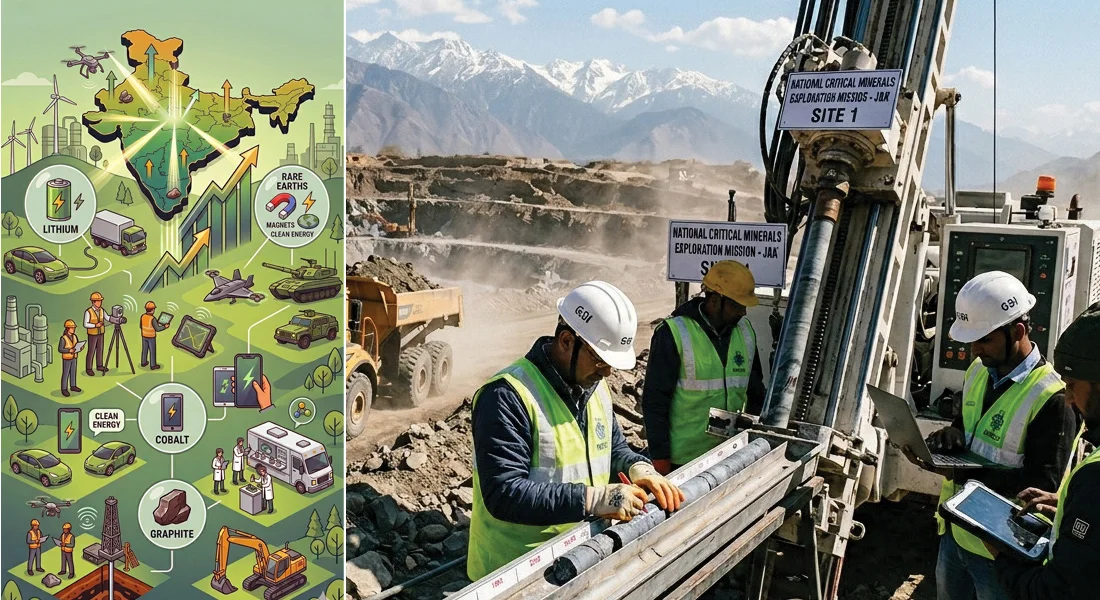
In 2025, the Government had launched the National Critical Mineral Mission (NCMM) with a Rs34,300 crore outlay over seven years. The mission aims to secure India’s supply of 21 critical minerals (lithium, cobalt, nickel) by accelerating domestic exploration, mining, recycling, and international acquisition. It aims for 1,000 patents by 2030 to bolster clean energy, tech, and defence sectors.
Union Minister of Science and Technology Jitendra Singh recently said that the pace of exploration, particularly for lithium and other critical minerals, must align with global demand and India’s strategic needs.
Addressing the Governing Body meeting of the National Mineral Exploration and Development Trust in New Delhi, the Minister outlined key priorities to accelerate exploration, strengthen domestic capacity and expand participation in the critical minerals sector. Ongoing work in regions such as the Siwana belt in Rajasthan and the Salal–Haimna block in Jammu and Kashmir was mentioned as examples, with a push to expand such efforts to more potential areas.
“India must create a conducive environment for Indian companies and startups to enter the mining and critical minerals sector,” he said and added that reducing import dependence requires end-to-end domestic supply chains, including processing and value addition.
Referring to the success of the biotechnology startup ecosystem, Singh added that similar institutional support, targeted incentives, and handholding mechanisms can enable innovation in mining technologies and exploration methods.