Blitz Bureau
Top developments
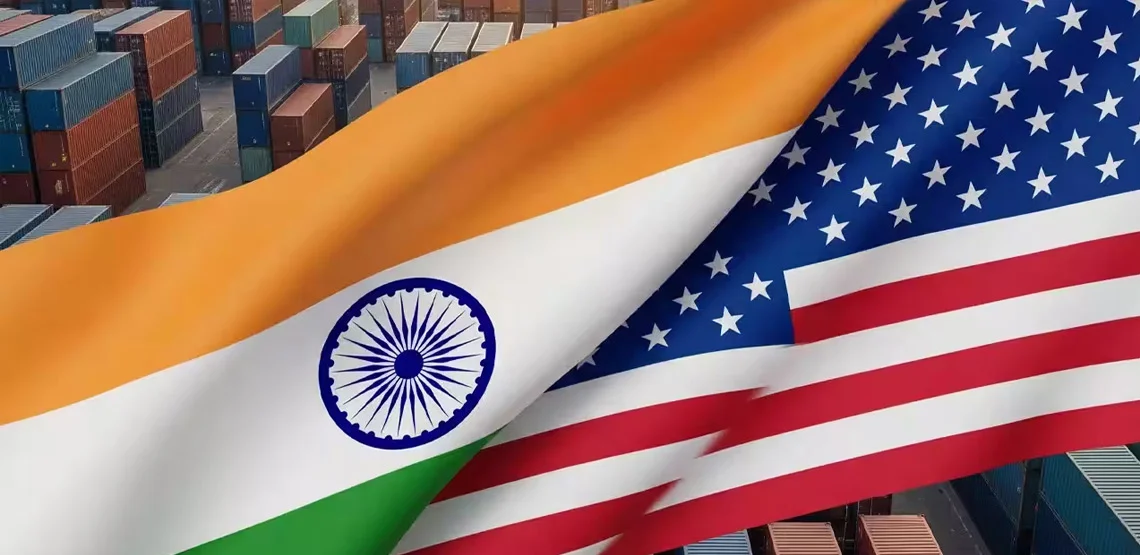
- Thirteen days to the tariff cliff — and still no signature. The first-phase India–US Bilateral Trade Agreement remains parked at the “last 1 per cent” of legal text, with no signed pact and no published document, as the interim US tariff arrangement counts down to its 24 July expiry. The on-record framing from Ambassador Sergio Gor (“last 1 per cent”) and Commerce Minister Piyush Goyal (“very close”) is unchanged from last week. Recurring “already signed” chatter is still unconfirmed by any sourced report — treat as rumour until a text appears.
- The education corridor starts running both ways. Illinois Institute of Technology has become the first US university cleared by the UGC to open an independent, degree-granting campus in India — Illinois Tech–Mumbai, at Vikhroli, opening Fall 2026. Travelling the other way, IIT Bombay and SUNY Old Westbury announced a partnership (26 June) that seeds IIT Bombay’s first US sub-campus, pencilled for 2027. For the first time the flagship institutions are building on each other’s soil, not just exchanging students.
- Pharma moves from trade file to diplomatic priority. US envoy Sergio Gor has publicly elevated drug-supply-chain resilience and FDA–CDSCO regulatory convergence as a bilateral priority — even as Indian pharma exports to the US contracted about 11.5% on tariff-driven inventory effects. India still supplies roughly 40% of US generics; New Delhi is now hedging with a $130 billion export target by 2030 and deliberate market diversification.
United States — trade & economy
The dominant story is holding, not moving. The February framework set the reciprocal US tariff at 18% (down from a peak near 50% that had bundled a 25% reciprocal and 25% punitive duty), and the shared “Mission 500” ambition — roughly $500 billion in two-way trade by 2030 — remains the headline. India continues to negotiate for terms rather than to the calendar, pressing for an edge over Asian competitors rather than a rushed close before 24 July, when the temporary arrangement (including the additional 10% levy) lapses toward MFN rates. Leader-level intent is intact: Modi and Trump directed officials at the June G-7 pull-aside in France to fast-track the deal, and Modi’s 4 July message marking the US 250th anniversary kept the mood warm.
Flag: any “interim deal signed” claim remains unverified and conflicts with the on-record “last 1%” framing — do not run as fact. Tariff baselines, energy-purchase pledges and any Russian-oil provisions stay provisional until an interim text is published.
United States — education (fresh)
This is the day’s genuinely new pillar. Illinois Tech is the first American university to win UGC approval for a standalone Indian campus — Illinois Tech–Mumbai opens in Fall 2026 with undergraduate and graduate programmes in computer science, engineering and business at Vikhroli. In the reverse direction, the IIT Bombay–SUNY Old Westbury tie-up announced 26 June (in the presence of India’s Education Minister) sets up certificate courses from 2027 in AI, engineering, sustainability and clean technology — the vehicle for IIT Bombay’s first overseas sub-campus on Long Island. With roughly 360,000 Indian students enrolled in the US in 2024–25 (India remains the largest source country), the shift from mobility to a two-way institutional presence is the structural story to track.
United States — health & pharmaceuticals (fresh)
Pharma is being reframed as strategic diplomacy. Ambassador Gor has put supply-chain security, manufacturing-site oversight and FDA–CDSCO regulatory harmonisation near the centre of the bilateral agenda — “trust between regulators” cast as economic statecraft. The backdrop is mixed: India’s pharma exports topped $31 billion in FY26 even as US shipments fell about 11.5%, an inventory build-up attributed to tariffs rather than lost competitiveness. India supplies close to 40% of US generic demand, and the US remains its single largest market (~34% of outbound shipments) — but New Delhi is now explicitly de-risking, chasing a $130 billion export goal by 2030 and diversifying beyond US dependence.
United States — technology, space & critical minerals
No new signing since the 26 May Bilateral Critical Minerals Framework, still the operational core of the TRUST initiative (AI, semiconductors, quantum, biotech, energy, space, critical minerals). The lithium-and-rare-earths framework carries $30 billion-plus in US letters of interest aimed at de-risking supply chains from China; the next test is the first funded projects. On the civil-tech side, NISAR — the $1.5 bn NASA–ISRO radar satellite, the largest US–India space collaboration — remains fully operational, with its calibrated global data products the flagship working deliverable of the partnership.
United States — defence, energy & mobility
Defence architecture is intact: the 10-year Major Defence Partnership framework (signed by Rajnath Singh and US War Secretary Pete Hegseth at the ADMM-Plus in Kuala Lumpur), a near-final Reciprocal Defense Procurement Agreement, and Jaishankar’s insistence that “Make in India” stays central. The GE F414 co-production commercials (Tejas Mk-2) remain the live variable, pencilled toward a December signature. Energy is the steady outperformer — crude, LNG, LPG and civil-nuclear the four named tracks, hydrocarbon trade near $14.4 billion, and India’s SHANTI civil-nuclear legislation opening commercial space discussed by Energy Secretary Chris Wright and Ambassador Kwatra. On mobility, the standing risk is the Trump administration’s mooted tightening of H-1B, OPT and student-visa rules, flagged as possibly effective from August — proposals, not law, and still facing public consultation; consulates continue to drip H-1B and F-1 slots for the Fall 2026 intake.
Canada — the reset keeps its machinery running
The thaw stays on its institutional track. The next Comprehensive Economic Partnership Agreement (CEPA) round is due in Ottawa this month, following two completed rounds, with the conclusion target held at end-2026 and a $50 billion two-way trade goal for 2030. The relationship’s plumbing is now in place: new High Commissioners exchanged (Dinesh K. Patnaik to Ottawa, Christopher Cooter to New Delhi), a General Security of Information Agreement (GSOIA) under negotiation for intelligence-sharing, and an energy leg spanning LNG, LPG and metallurgical coal plus the $2.6 billion Cameco uranium supply deal. Modi has accepted Carney’s invitation to visit Canada later this year — the marker that would confirm the reset has moved from repair to routine.