Blitz Bureau
NEW DELHI: A fortnight after a Hyderabad start-up put India into the small club of nations with a private rocket in orbit, the country’s space agency has laid out an ambition of its own: a year of seven launches, back to back, that would make this one of the most crowded flight calendars in ISRO’s history. Speaking this month, ISRO Chairman V. Narayanan said the agency is targeting seven missions across the current financial year, with the next flight expected within about two months — a cadence that turns India’s space programme from a series of set-piece events into something closer to a production line.
The manifest reads like a tour of everything a modern space power tries to do at once. There is a heavy communication satellite of about 6,500 kilograms, built in the United States, that ISRO has agreed to loft in the coming months — a commercial mandate that signals global trust in Indian launch. There are earth-observation satellites that watch monsoons, coastlines and farms; there is continued groundwork for Gaganyaan, India’s first human spaceflight; and there is the steady business of restoring a full launch tempo after an earlier setback. Each is a different rung on the same ladder.
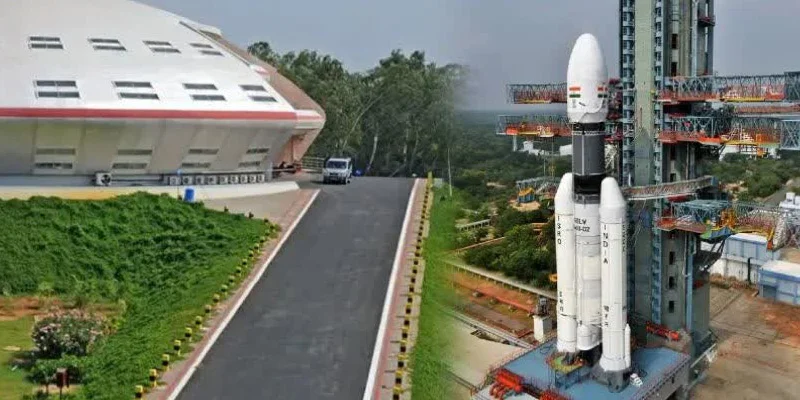
From set-pieces to a schedule: ISRO has set out a seven-launch year, with the next mission due within about two months and a 6,500 kg US-built communication satellite among the payloads ahead — a step change in launch cadence.
A space programme is measured not only by how high it reaches, but by how often. Cadence is what turns a national achievement into a national capability.
At a Glance
• Plan: ISRO targets seven launches this financial year (Chairman V. Narayanan)
• Next up: the following mission expected within roughly two months
• Commercial: a ~6,500 kg US-built communication satellite to be launched in coming months
• Ahead: earth-observation satellites and Gaganyaan human-spaceflight groundwork
Why does the tempo matter as much as any single mission? Because frequency is where a space economy is built. A dependable, repeatable launch schedule lets Indian and foreign customers plan satellites around known slots, lowers the effective cost of reaching orbit, and keeps skilled hands busy between headline flights. The same rhythm that carries a foreign communication satellite also lifts the earth-observation spacecraft that map floods and guide farmers, and steadily de-risks the systems that will one day carry Indian astronauts. Seen together with this month’s first private orbital launch, the picture is of a sector maturing on two tracks at once — a public agency raising its output, and a young private industry finding its feet alongside it.
The honest account is that ambition on paper meets weather, physics and the unforgiving margins of rocketry; a seven-launch year is a target to be earned flight by flight, not a promise already kept. The constructive way forward is exactly the discipline ISRO is signalling — a full test-and-fly calendar that rebuilds tempo after a setback, commercial mandates that bring in revenue and confidence, and a partnership in which private launchers take on the smaller, high-frequency work while the agency concentrates on the hardest missions. Handled that way, a crowded manifest becomes the most valuable thing a space power can own: the habit of getting to orbit, again and again.