Blitz Bureau
NEW DELHI: Every year, the same drama plays out: a nation of 1.4 billion people holds its breath through June and July, watching the sky. This season’s late monsoon and its scramble of delayed sowing are only the latest reminder of a deeper, structural truth — that too much of India still lives at the mercy of a few weeks of rain. The question that outlasts any single season is not whether the monsoon will be kind this year, but how India can make its farms, cities and industries less dependent on whether it is.
The stakes are enormous and widely shared. Agriculture supports roughly half of India’s workforce, yet a large share of its cropland is still rain-fed rather than irrigated; the country holds a small fraction of the world’s freshwater for a sixth of its people; and groundwater, the invisible reserve that has quietly underwritten decades of harvests, is being drawn down faster than it refills across large stretches of the north and west. Add a warming climate that makes each monsoon more erratic — longer dry spells punctuated by fiercer bursts — and water security stops being an agricultural footnote and becomes a first-order national priority.
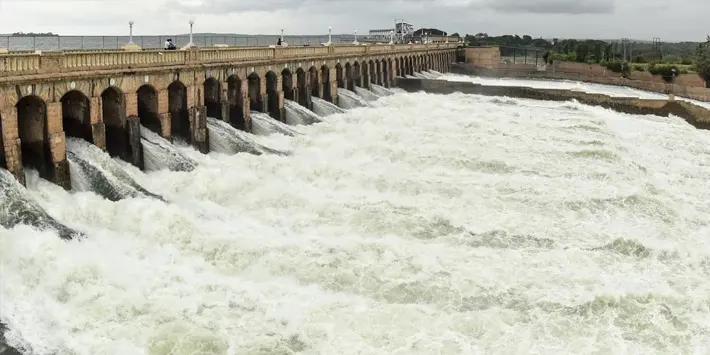
Storing the good years for the bad: Reservoirs, canals and recharged aquifers are how a country turns an unpredictable monsoon into a dependable water supply — the quiet infrastructure behind food and water security.
A country cannot control the monsoon, but it can decide how much its future depends on it. Water security is that decision, made in canals, aquifers and the choice of what to plant.
The Long View
• The dependence: much of India’s cropland is still rain-fed, not irrigated
• The reserve: groundwater is being drawn down faster than it recharges in many regions
• The pressure: a warming climate is making each monsoon more erratic
• The tools: efficient irrigation, water storage, recharge and smarter cropping
The encouraging part is that these are problems of practice, not of knowledge — and India already has the pieces. Micro-irrigation and drip systems can grow more crop per drop; the revival of tanks, ponds and check-dams can capture the monsoon’s bursts for the dry months; recharging aquifers turns floodwater into a savings account rather than a hazard; and pricing water and power to reward efficiency can nudge farmers gently away from the thirstiest crops in the driest districts. None of this requires a miracle; it requires patience, investment and the will to treat every drop as the asset it is.
The constructive, long-view way forward is to make water security a permanent priority rather than a seasonal panic. That means widening irrigation coverage so fewer farmers depend on a timely first rain; matching crops to the water each region actually has, backed by fair support for growers who switch; building and maintaining the storage that banks the wet years against the dry; and giving India’s water managers the data and authority to plan decades ahead. Do that, and the annual vigil over the clouds becomes a little less anxious each year — not because the monsoon has become reliable, but because India has become resilient to it. That is a prize worth planting for.