Deepak Dwivedi
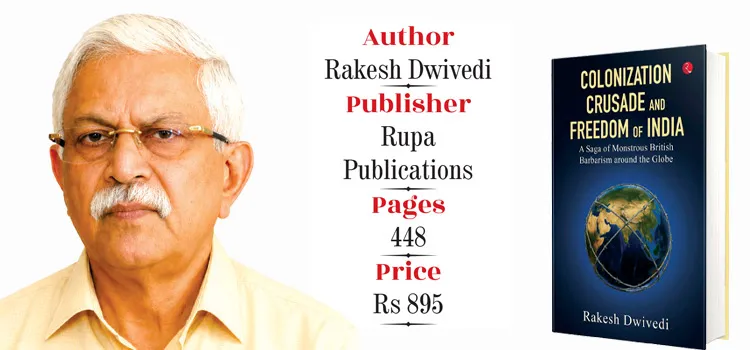
NEW DELHI: Some way into his introduction, Rakesh Dwivedi stops to explain why a Senior Advocate of the Supreme Court has written a 433-page history of the Raj. “I am no historian,” he says. “I am a professional lawyer.”
It reads like an apology. It turns out to be the book’s method — and, more often than not, its advantage. What a lawyer brings to a crowded shelf is not new archives but a different habit of attention. Historians read documents for what they say; advocates read them for what they were drafted to do. Dwivedi’s real contribution is not a new thesis but a new pair of eyes: he cross-examines the empire’s own paperwork, and the paperwork does not always survive it.
The finest passages
That advocate’s instinct produces the finest passages in the book. Dwivedi takes the East India Company’s charter of 1600 and works through it as he would a contested instrument, and notices something most narrative accounts glide past: the charter forbids trading in the territory of a Christian prince without permission, and imposes no such restriction anywhere else. Fortifications, settlements, force – all licenced, but only against the non-Christian world. “That was the Crusade,” he writes, and for once the rhetoric is doing less work than the evidence.
He handles Hugo Grotius and John Selden the same way, treating Mare Liberum and Mare Clausum not as philosophy but as briefs written for clients: “Grotius’s theory of the freedom of the seas remained a good logic for the Dutch. Selden’s logic was good for the British to grab the gains from the Dutch.”
The organising idea is that India’s colonisation and its Partition cannot be read as Indian events. They were episodes in a global contest, and the men who decided them were reasoning about the Urals and Abadan, not about Lahore. It is a corrective worth making. Two-thirds of the book sits in the twentieth century, and the further it travels from the papal bulls, the more the frame earns its keep.
He is unexpectedly moving on Ambedkar, calling Gandhi’s Yerawada fast a coercion that “could have been avoided”, and observing that a Dalit leader could hardly be expected to trust a movement led by “unwilling uppercaste leaders
Its best stretch is the least trodden. Dwivedi came to the subject sideways – reading Peter Hopkirk, then Algernon Durand’s The Making of a Frontier, then Major WA Brown’s memoir of the Gilgit rebellion – and the northern frontier remains where he writes with most authority and least strain. He is right, and usefully insistent, that the Gilgit Scouts who seized the Agency in November 1947 were a British-officered force and not tribal raiders; the elision has served Pakistani accounts well for 80 years.
Fairer than subtitle
He notices that the 60-year lease of Gilgit, taken in 1935, was surrendered 48 years early on August 1, 1947, and asks why. He sets General Douglas Gracey’s instruction of April 20, 1948 – that the Indian Army must not be allowed past “the general line Uri-Poonch-Nowshera” – against the ceasefire line eight months later, and lets the reader draw the inference. And he observes, with a novelist’s timing, that the ceasefire was signed by Gracey for Pakistan and General Roy Bucher for India, both of them British.
He is also a fairer writer than his subtitle suggests. He declines the easy charge that Cyril Radcliffe’s boundary was rushed and careless: “This may not be true. They knew Punjab well.” He locates the Punjab massacres in the fall of the Unionist Ministry rather than in the award. He is unexpectedly moving on BR Ambedkar, calling Mahatma Gandhi’s Yerawada fast a coercion that “could have been avoided”, and observing that a Dalit leader could hardly be expected to trust a movement led by “unwilling upper-caste leaders”.
And he heads off the factional use to which his own Sardar Patel chapter might be put: “No one person should be recognized alone as the father of any nation — not even Gandhi.” The headline claim – that Britain, not Muhammad Ali Jinnah, baked the cake of Pakistan – is where readers will divide.
Dwivedi assembles genuinely uncomfortable material for the standard account of a reluctant, improvising Britain: India Office officials urging London in 1946 to “cease chasing the mirage of unity and range ourselves behind Pakistan and make it viable”; a Governor advising that Muslim loyalty must be kept “if we are to remain World Power”; British planners recording that “the area of Pakistan is strategically the most important in India”.
Quieter and better
That Britain preferred a friendly north-west, and shaped the successor states accordingly, is well supported here. That Britain authored Pakistan is a longer stride, and the book takes it with more confidence than its own narrative supplies. Dwivedi ends not with the jacket’s claim but with a quieter and better one: that the Cold War “led UK-US to create Pakistan in the manner it is today”. Shape, not existence. That is the argument this book actually proves, and for a first book by a working advocate, written in the margins of a Supreme Court practice, it is more than enough.
The frontier chapters alone earn it a place on the shelf, and they raise a question the Indian state has still not answered: Dwivedi’s own call, in the book, for the release of the top secret cables that passed between the British Missions in India and Pakistan in 1947 and 1948. “We the People,” he writes, “are entitled to know.”