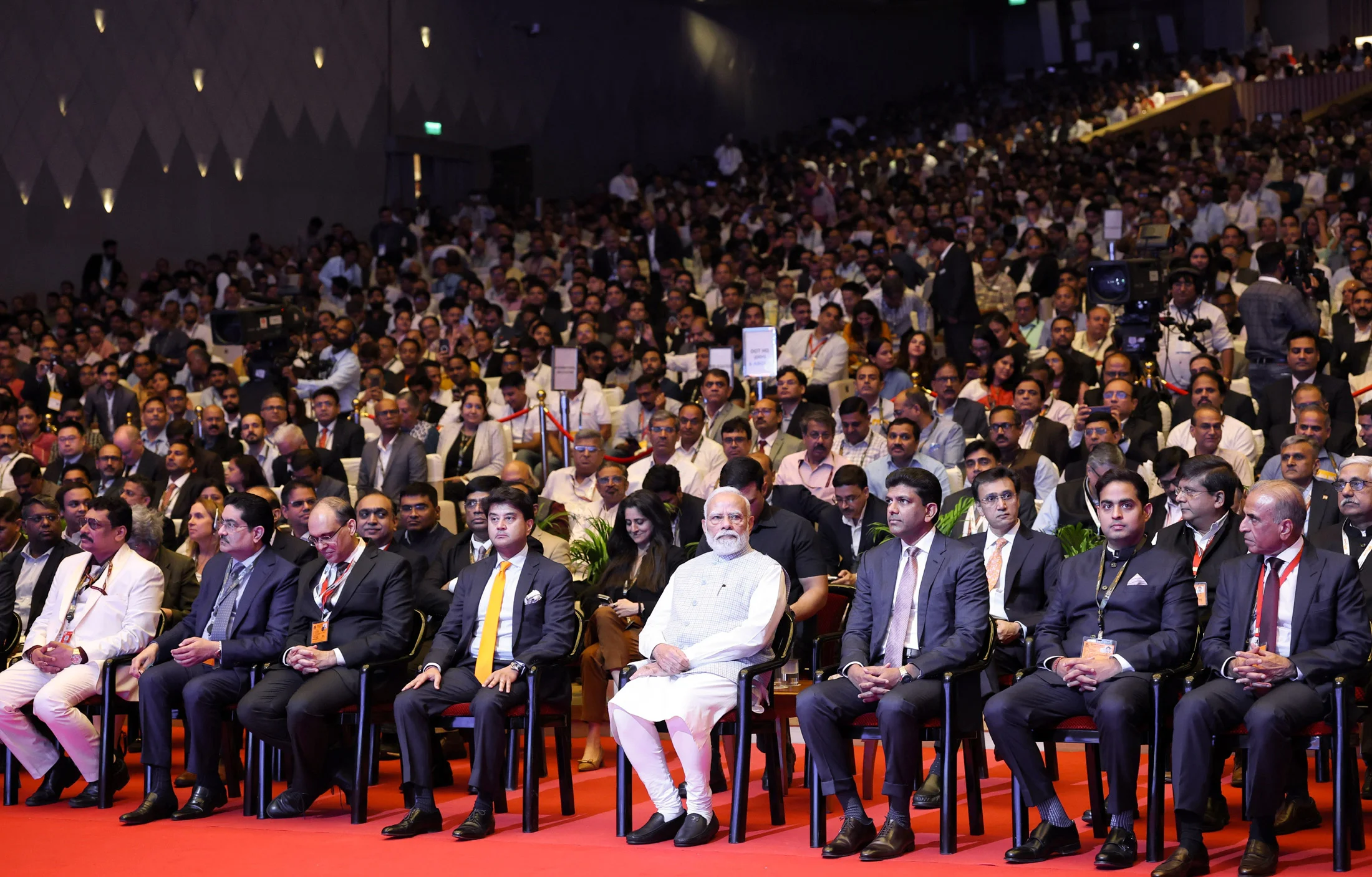
NEW DELHI, 8 October — A farmer in Barabanki knows the PM-KISAN instalment has landed because the phone in his pocket says so. That, more than any speed test, was the Prime Minister’s argument when he inaugurated the 10th India Mobile Congress at Yashobhoomi in New Delhi on 8 October 2026. By the DD News account of the address, he put the money moved through Direct Benefit Transfer at ₹50 lakh crore, paid into accounts linked to beneficiaries’ mobile phones, and the leakage prevented at about ₹5 lakh crore. PM-KISAN alone, he said, has carried more than ₹4 lakh crore to farmers’ accounts.
At a glance
5G base stations in service: more than 5.5 lakh (PM’s address, 8 October 2026)
Districts with 5G: all (PM’s address, 8 October 2026)
Direct Benefit Transfer paid to mobile-linked accounts: ₹50 lakh crore; leakage prevented: about ₹5 lakh crore
PM-KISAN transferred to farmers: more than ₹4 lakh crore
India Mobile Congress 2026: 7–10 October, Yashobhoomi; 100+ countries, 500+ partners, 600+ start-ups, 120+ sessions (PMO, 7 October 2026)
What India gains
A 5G network in every district, a welfare pipe that pays the farmer and tells him so on his phone, and a trade fair where 600 Indian start-ups meet buyers from 100 countries.
RBI signals more tightening by raising repo rate
MUMBAI, 8 October: The Monetary Policy Committee of the Reserve Bank of India, meeting from 5 to 7 October 2026 under Governor Sanjay Malhotra, voted unanimously to raise the policy repo rate by 25 basis points to 5.50%. The standing deposit facility rate moves to 5.25% and the marginal standing facility and Bank Rate to 5.75%. The committee also changed its stance from neutral to “calibrated tightening”; two members, Nagesh Kumar and Ram Singh, would have kept it neutral.
The Governor’s statement of the same date carries the sentence that matters to anyone with a floating-rate loan: “rate cuts are off the table in the near term.” The next move, it says, will be a hike or a pause.
At a glance
Policy repo rate: 5.50%, up 25 basis points (MPC resolution, 7 October 2026)
Stance: calibrated tightening, from neutral; vote on the rate unanimous
CPI inflation, August 2026: 4.8%; projection 2026-27: 5.2% (Q3 6.0%)
Real GDP growth, Q1 2026-27: 7.8%; projection 2026-27: 7.1%
Bank credit growth, 15 September 2026: 18.1%; a year earlier 10.4%
Foreign exchange reserves, 2 October 2026: $734.6 billion
What India gains
An inflation target defended early, with $734.6 billion of reserves and a kharif crop at 101% of normal behind it.
India puts climate finance at heart of COP31 negotiations
NADI (FIJI), 8 October Environment, Forest and Climate Change Minister Bhupender Yadav used the plenary on “political landing zones and outcomes” at the Pre-COP31 meeting in Nadi to set out India’s terms for Antalya. The shared ground among parties, he said, is “far greater than our divisions”, and “the time has come to demonstrate flexibility on all sides”. What India wants in return is specific: climate finance scaled up to match the ambition being asked of developing countries, with technology transfer and capacity-building alongside it, and a formal discussion of Article 9.1 — the clause under which developed countries are to provide finance — which sits on the provisional agenda.

What India gains
If Antalya follows Nadi: a finance discussion held under the Article that obliges developed countries to pay, a carbon market India has already begun to use through its Japan credit mechanism, and a transition clock set in New Delhi rather than Brussels.
World leaders hail PM Modi’s 25 years in public office
NEW DELHI, 8 October — The Prime Minister’s Office published ten notes on 7 October and nine of them were thank-you messages. By the PMO’s own listing, Narendra Modi thanked President Droupadi Murmu and the Vice President, former President Ram Nath Kovind, and the leaders of South Korea, Japan, Serbia, Botswana, Bhutan, the Philippines, Belgium and Dominica for their wishes on 25 years of service as head of government — a span that began with his first oath as Chief Minister of Gujarat in October 2001. In the note to President Lee Jae-myung he recalled the Korean leader’s visit to India in April; in the note to Prime Minister Sanae Takaichi, her visit in July. The tenth note records that he called on L.K. Advani at his residence and sought his blessings.

Eight foreign heads of state or government writing on one day is the measure of standing the PMO chose to publish. Count them by region and the spread is the point: two from East Asia, two from Europe, one each from Southern Africa, the Himalaya, South-East Asia and the Caribbean.
India salutes its air warriors on 94th Air Force Day
NEW DELHI, 8 October — “India is proud of our Air Warriors,” the Prime Minister wrote on Air Force Day, 8 October 2026, by the Press Information Bureau release of that morning. “On Air Force Day, we salute their courage and commitment to protect our skies!” The force raised on 8 October 1932 turns 94 this year; its anniversary parade and aerial display are the one day the country sees its aircraft in formation.
Aerosols improve Chennai flood prediction by 50pc
CHENNAI, 8 October — Chennai’s flood of December 2015 has been reproduced this time with the atmosphere’s aerosols — the airborne particles on which cloud droplets form. According to a IIT Madras press release , the simulated rainfall over the Adyar basin improved by about 22% against a control run. When that rainfall was passed down the chain into hydrological and hydraulic models, the accuracy of the simulated flood inundation improved by about 50%. The paper, in Natural Hazards and Earth System Sciences (doi 10.5194/nhess-26-3749-2026), is by Chandan Sarangi, N. Nithila Devi, Soumendra Nath Kuiry and Oscar Paul of the Department of Civil Engineering at IIT Madras, with Rakesh Teja Konduru of the Japan Aerospace Exploration Agency, Kundan Lal Shrestha of Kathmandu University and the hydrology section of the GFZ Helmholtz Centre for Geosciences, Germany. The Asia-Pacific Network for Global Change Research funded it.
The method chained three models: the Weather Research and Forecasting model for the atmosphere under different aerosol conditions, HEC-HMS for runoff and reservoir inflows, and HEC-RAS for the flood map. “Urban flood forecasting is often treated primarily as a rainfall-to-runoff problem,” Sarangi said; the point of the study is that what happens in the air before the rain shapes where the rain falls. Kuiry put the use plainly: for Chennai, rainfall forecasting “cannot be considered in isolation from water-resources management” — the reservoir operator’s decision to release or hold during a storm is the one this would inform.