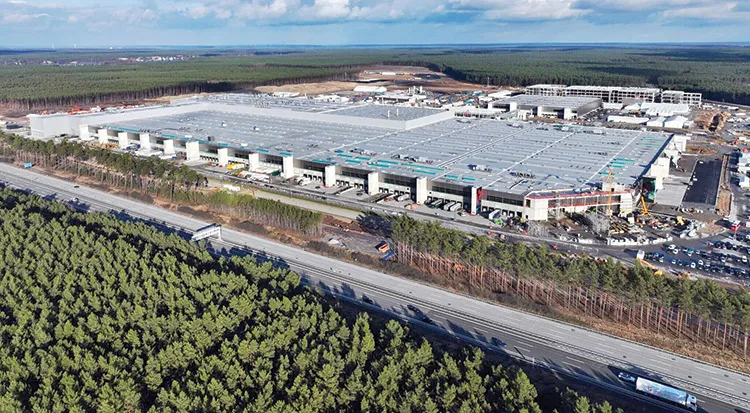
The European Union is offering 10 billion euros ($11.4 billion) in funding for firms to erect seven AI gigafactories as it seeks to close the AI gap with the US and China, the 27-nation bloc’s executive said on July 30, according to an AP report.
The European Commission said it would like the public financing to draw an additional 20 billion euros ($22.8 billion) in private investment. “Access to the raw scale of computing power within AI gigafactories is a strategic necessity for Europe as AI development accelerates,” said Henna Virkkunen, the Commission executive vice president overseeing tech sovereignty.
The efforts by Brussels to establish “tech sovereignty ” have gained urgency as leaders worry about dependence on technologies from foreign providers, which they say could be “weaponized” against Europeans.
US President Donald Trump has railed against the EU over its tech regulations and China has limited the supply of minerals critical to the sector. Firms can now bid for contracts to build gigafactories that are planned to have at least 100,000 cutting-edge AI chips, making them roughly four times more powerful than the data centers currently running in the EU.
The EU’s current computing power — delivered by a network of 19 AI data centers from Finland to Spain — will more than double when these seven gigafactories come online. Europe lags far behind the US and China in crucial sectors for the development of AI, according to a 2025 assessment by the US Federal Reserve. China has an enormous electrical power capacity for data centers while the US bags the lion’s share of private AI investment.
Europe doesn’t manufacture many of the millions of components needed for data centers, and electricity in the EU can cost double or triple what it does in the US and China, according to a Commission report presented to the European Parliament in June.
The EU’s current computing power — delivered by a network of 19 AI data centers from Finland to Spain— will more than double when these seven gigafactories come online.
France’s Mistral now runs the one of the largest AI data centres in the EU so far at its campus in Paris. Mistral makes the Le Chat chatbot but it hasn’t kept pace with American AI companies like OpenAI, maker of ChatGPT, and Chinese rivals like DeepSeek.
While political leaders like French President Emmanuel Macron have raised the alarm about Europe lacking homegrown AI companies, deep anxieties run rife across the continent about the economic disruption and privacy implications of the nascent technology.
Data centers
The Commission said AI products developed with the growing network of data centers will “follow EU standards on data protection, safety, security and ethics,” perhaps referring to the bloc’s Digital Services Act and its Digital Market Act. In June, 40 mayors around the world signed a pact to curtail the negative impact of the construction of AI data centers on the natural resources, energy prices or climate targets of cities from Phoenix to Melbourne
Inside a gigafactory
An AI gigafactory is a very large, purpose-built computing facility designed to develop, train, fine-tune, and run advanced artificial intelligence models at an industrial scale. Instead of manufacturing physical goods, its “product” is AI models and AI services. It typically includes hundreds of thousands of AI chips (GPUs or AI accelerators), often from companies like NVIDIA, AMD, or others.
Gigafactories require high-performance servers connected by ultra-fast networks, massive data storage systems, secure cloud infrastructure so researchers and companies can use the computing power remotely.
One of the increasingly controversial requirements is enormous electrical power and cooling systems, because AI computing consumes huge amounts of energy and generates significant heat.