• About us
  • Team
  • Privacy Policy
  • Contact
Wednesday, October 14, 2026
  • Login
No Result
View All Result
World's first weekly chronicle of development news
  • Blitz Highlights
    • Special
    • Spotlight
    • Insight
    • Entertainment
    • Sports
  • Opinion
  • Legal
  • Perspective
  • Nation
    • East
    • West
    • North
    • South
  • Business & Economy
  • World
  • Hindi Edition
  • International Editions
    • Dubai
    • Tanzania
    • United Kingdom
    • USA
  • Blitz India Business
  • Blitz Highlights
    • Special
    • Spotlight
    • Insight
    • Entertainment
    • Sports
  • Opinion
  • Legal
  • Perspective
  • Nation
    • East
    • West
    • North
    • South
  • Business & Economy
  • World
  • Hindi Edition
  • International Editions
    • Dubai
    • Tanzania
    • United Kingdom
    • USA
  • Blitz India Business
No Result
View All Result
World's first weekly chronicle of development news
No Result
View All Result

The Rice Road TO EUROPE

How 70 Square Metres in Frankfurt Became a Continent's Gateway to Bharat

by Blitz India Media
August 10, 2026
in United Kingdom
0
The Rice Road TO EUROPE

Blitz Bureau

NEW DELHI:It measured 70 square metres — smaller than many Indian drawing rooms. It stood on a Frankfurt street where nobody spoke his language. And on its shelves sat the things Indians abroad ache for and cannot find: the right dal, the right masala, rice that fills a kitchen with the smell of home the moment the lid comes off.

The year was 1980. Pawan Kumar Bhandari had just arrived in Germany. He had no inherited wealth, no distribution network, no market survey telling him that Europe would one day want what he was selling. He had a shopfront and a belief that the taste of a country travels with its people.

Forty-six years later, that shopfront has become a continental enterprise. GFT Group — Global Foods Trading — supplies more than 9,800 businesses in 29 European countries. It moves over 10,000 containers a year. It runs 38 lorries of its own from eight distribution centres in six nations, carries a catalogue of more than 4,000 products and employs a team of over 300. It sources through an office in Gurugram and stores 30,000 tonnes of rice in a purposebuilt centre in Hesse. Today it ranks among Europe’s foremost importers of South and Southeast Asian foods.

Twenty-One Years, Four Buildings By 1983 the shop had outgrown itself and become a 320 square metre warehouse at MörfeldenWalldorf. Two years later Bhandari took the decision that changed the shape of the business. He stopped buying through middlemen and began importing directly from India, Sri Lanka and Thailand.

Direct import meant carrying the cost of a full container long before a single sack was sold. It also opened a phase of 40 per cent growth a year. In 1991 the operation moved again, to a 520 square metre warehouse in Mörfelden fitted with high-rack storage. Ten years on came the leap that altered every dimension of the business. In 2001, GFT built a purposedesigned 15,000 square metre warehouse at Biebesheim am Rhein, and took its place among the largest Asian wholesalers in Germany. Twenty-one years. Four buildings. Each one larger than the last.

With the German base secure, the map began to widen. Spain came first. In 2004 a subsidiary opened at Barcelona, covering Spain, Portugal, southern France and the Balearics. France followed in 2013, with a Paris distribution centre running its own fleet of lorries. In 2014 the group entered the United Kingdom, the largest Indian market on the continent. In 2017 it acquired Sidhu Foods in the Netherlands, adding a Benelux platform.

The network today runs through Riedstadt, Munich, Berlin, Orly, NieuwVennep, London Southall, Barcelona and Palmela. Holding it together is the Gurugram office, which keeps the entire chain anchored to Indian soil.
The Rice Road TO EUROPE

In 1993 he launched SCHANI, the group’s own label, and began production in-house — spice blends, sauces, chutneys, and later a frozen convenience range. Three decades on, Schani stands among the most trusted Indian food brands in Europe. Others followed. Around these own labels sit more than 40 partner brands, held on exclusive or priority European distribution.

In 2026 the headquarters formally shifted from Biebesheim am Rhein to Riedstadt-Wolfskehlen — the fourth home in 46 years.

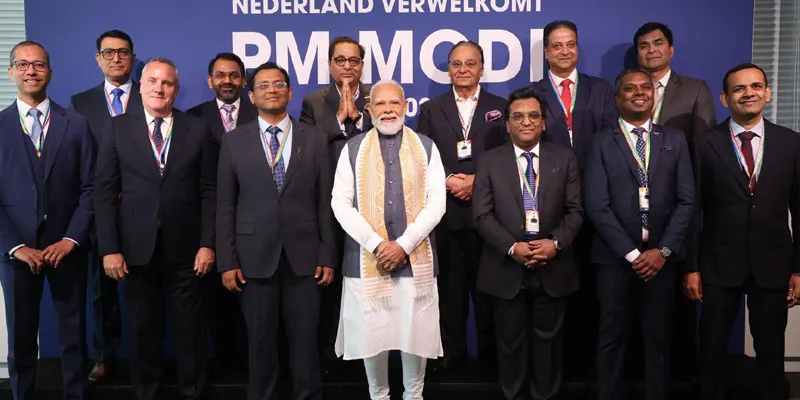
On 16 May, Prime Minister Narendra Modi was in The Hague, on the second leg of a five-nation European tour and his second visit to the Netherlands. He also addressed a large gathering of the Indian community. PM Modi set the community’s achievements inside the larger national project — India’s journey towards becoming a developed nation, Viksit Bharat, by 2047.

Bhandari was in that hall. At the World Forum, The Hague, he joined fellow business leaders in discussions on cross-border partnership and sustainable growth, and met the PM Modi briefly during the programme. A man who left India in 1980 with a shopkeeper’s ambition stood, 46 years later, before the Prime Minister of the country he had left — not as a petitioner, but as one of the builders of the very bridge the Prime Minister was describing.

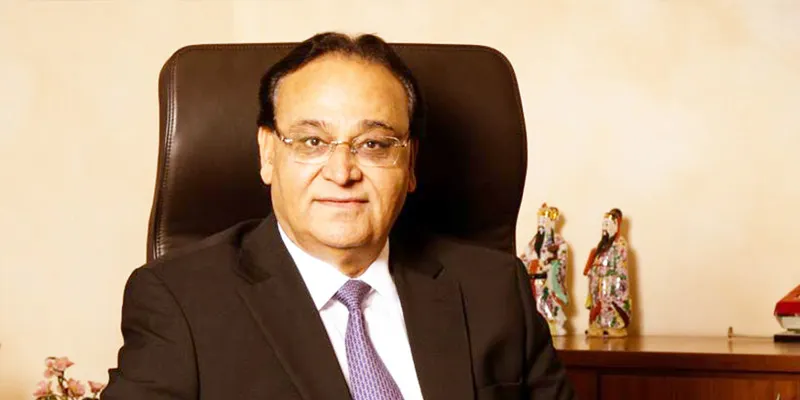
Enterprises built by one person usually end with that person. This one has not. Manav Bhandari, the founder’s son, joined the business in 2010 and now leads it as chief executive. Parul Saigal, the founder’s daughter, returned in 2020 after 13 years in the fast-moving consumer goods industry, having gone out to learn the trade elsewhere before bringing it home. The founder remains at the head of the group he made.

Related Posts

Brexit Debate
United Kingdom

Burnham opens Brexit debate

October 5, 2026
Dementia Testing
United Kingdom

UK commits £80 million for dementia DIAGNOSIS

October 5, 2026
RAF Fairford
United Kingdom

RAF plot: Man freed on bail

October 5, 2026
Shared-concerns
United Kingdom

Shared concerns

September 21, 2026
Foreign Office gets first female head
United Kingdom

Foreign Office gets first female head

September 21, 2026
UK inflation August 2026
United Kingdom

Will take tough decisions: Burnham

September 21, 2026
Load More
Next Post
India Steps Up Safety Measures for Gulf Seafarers

Indian missions in Gulf providing full s

Recent News

Rajnath Singh
News

India offers ASEAN joint manufacture of defence systems

by Blitz India Media
October 14, 2026
0

NEW DELHI, 14 October— India is ready to explore building patrol vessels, radars, air-defence systems, helicopters and drones together with...

Read moreDetails
India Canada diplomatic ties

India News: Canada Ties, Ports, Minerals and Stubble Fires

October 14, 2026
Asian Champions Trophy 2026

Pathak returns as India names squad for Asian Champions Trophy

October 13, 2026
Electronics production grows seven-fold : MeitY

New Delhi, 13 October : India’s fintech sector raised $2.2 billion in the first nine months of 2026 (January 1, 2026–September 30, 2026), up 14 per cent from $1.9 billion in the same period a year earlier, a report said. The report from data intelligence platform Tracxn Technologies Limited said funding rounds dipped from 260 to 153, adding that the funding was concentrated in a smaller number of large late‑stage rounds, with five mega‑rounds of $100 million or more accounting for $1.1 billion or 48 per cent of total capital. The report said in the first nine months of 2026, digital lending and payments topped the category rankings, while Bengaluru accounts for over three-fifths of all capital raised. On the exit side, IPOs saw a 50 per cent uptick while overall acquisitions slowed. As many as 30 companies raised their first funding round, down 49 per cent from 59 in the previous year. Series A and later rounds totalled 77, down 31 per cent from 112. Late-stage funding (Series C+, PE, and pre-IPO) led the mix, rising 95 per cent to $1.5 billion in the first nine months of 2026 — up from $751 million during the same period in the previous year. This capital surge pushed late-stage investments to 67 per cent of total market funding, the report noted. Earlier stages experienced contractions in capital and deal counts. Early-stage funding fell 33 per cent to $668 million across 52 rounds, compared to $1 billion across 82 rounds in nine months of 2025. Seed funding fell 57 per cent to $73.8 million across 76 rounds, down from $173 million across 148 rounds. New unicorns crossed the billion-dollar threshold in an average of 7.1 years after their Series A funding. Moreover, the industry saw 3 IPOs in nine months of 2026, up 50 per cent from 2 in the previous year, alongside 11 acquisitions, down 45 per cent from 20.

October 13, 2026
Indian stock market

IBM and MeitY Startup Hub partner to support India’s deep-tech startups with AI, cloud, quantum computing and mentorship.

October 13, 2026

Blitz Highlights

  • Special
  • Spotlight
  • Insight
  • Entertainment
  • Health

International Editions

  • US (New York)
  • UK (London)
  • Middle East (Dubai)
  • Tanzania (Africa)

Nation

  • East
  • West
  • South
  • North
  • Hindi Edition

E-paper

  • India
  • Hindi E-paper
  • Dubai E-Paper
  • USA E-Paper
  • UK-Epaper
  • Tanzania E-paper

Useful Links

  • About us
  • Team
  • Privacy Policy
  • Contact

©2024 Blitz India Media -Building A New Nation

Welcome Back!

Login to your account below

Forgotten Password?

Retrieve your password

Please enter your username or email address to reset your password.

Log In

    No Result
    View All Result
    • Blitz Highlights
      • Special
      • Spotlight
      • Insight
      • Entertainment
      • Sports
    • Opinion
    • Legal
    • Perspective
    • Nation
      • East
      • West
      • North
      • South
    • Business & Economy
    • World
    • Hindi Edition
    • International Editions
      • Dubai
      • Tanzania
      • United Kingdom
      • USA
    • Blitz India Business

    ©2024 Blitz India Media -Building A New Nation