Blitz Bureau
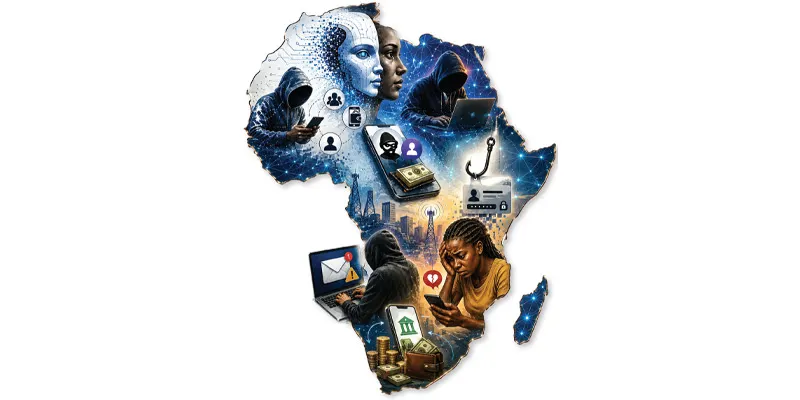
NEW DELHI:Artificial intelligence is now powering more than half of reported cybercrime across Africa, allowing criminals to launch faster, more convincing and larger-scale attacks, according to INTERPOL’s African Cyberthreat Assessment Report 2026.
Released on August 3, the report found that 55 per cent of cybercrime cases recorded across the continent involve the use of AI, raising concerns as Africa’s digital economy continues to expand. With more than 1.1 billion mobile subscribers in 2025, millions of people are relying on digital services, creating new opportunities for both innovation and cybercriminals.
Based on data from 36 African countries, the 40-page assessment says cybercrime has evolved into a highly organised, cross-border industry that is becoming harder for authorities to detect and stop. Online scams remain Africa’s biggest cyber threat According to the report, online scams remained the most common form of cybercrime in 2025. Criminals increasingly used artificial intelligence alongside social media platforms and mobile money services to target victims. INTERPOL said cybercrime-related financial losses have risen sharply over the past year, climbing from $192 million in 2024 to $484 million. Investigators attribute the increase to AI-powered fraud, stolen login credentials and sophisticated social engineering attacks.
The report also found that 72% of surveyed countries identified scam centres operating within their borders, with the highest concentration in West and Southern Africa.
The report highlights distinct cybercrime trends across the continent. In East Africa, mobile money fraud and ransomware attacks targeting critical infrastructure are among the biggest threats.
West and Central Africa continue to experience high levels of business email compromise and romance scams affecting both companies and individuals.
Southern Africa’s advanced digital connectivity has made the region an attractive target for international cybercriminal networks seeking to maximise disruption. Deepfake technology and AI-generated content are increasingly being used in digital sextortion and online harassment campaigns. One of INTERPOL’s technology partners, TrendAI, detected around 600,000 sextortion cases linked to these tactics.
Synthetic identities Another growing concern is the use of synthetic identities. Rather than simply stealing personal information, cybercriminals are combining genuine data with fabricated details to create entirely new digital identities.