Blitz Bureau
NEW DELHI: India has already built more than 200 compressed biogas plants. The reason there are not two thousand was never the technology. Read the GOBARdhan approval closely and the fix is not a machine — it is a price.
The Union Cabinet has approved GOBARdhan, the National Unified Scheme for Compressed Biogas, with an outlay of ₹23,731 crore running from FY27 to FY36 — a full ten years. It is administered by the Ministry of Petroleum and Natural Gas, and its stated ambition is to raise domestic compressed biogas production roughly ten-fold by turning agricultural residue, cattle dung, municipal organic waste and press mud into fuel, into organic manure, and into money that stays in a village.
Almost every account of the decision leads with the outlay. The more useful sentence sits further down the approval, and it lists what the scheme actually supplies: assured demand, remunerative and stable pricing, capital assistance, pipeline infrastructure, credit support and technology development. Four of those six are not subsidies at all. They are answers to a banker’s questions. A compressed biogas plant is a fifteen-year asset built to process a feedstock nobody had previously priced, selling a gas whose buyer, volume and rate were all negotiable each year. No lender funds that comfortably. India has had the digesters, the feedstock and the engineering for a decade; what it has not had is a contract a district cooperative could take to a bank.
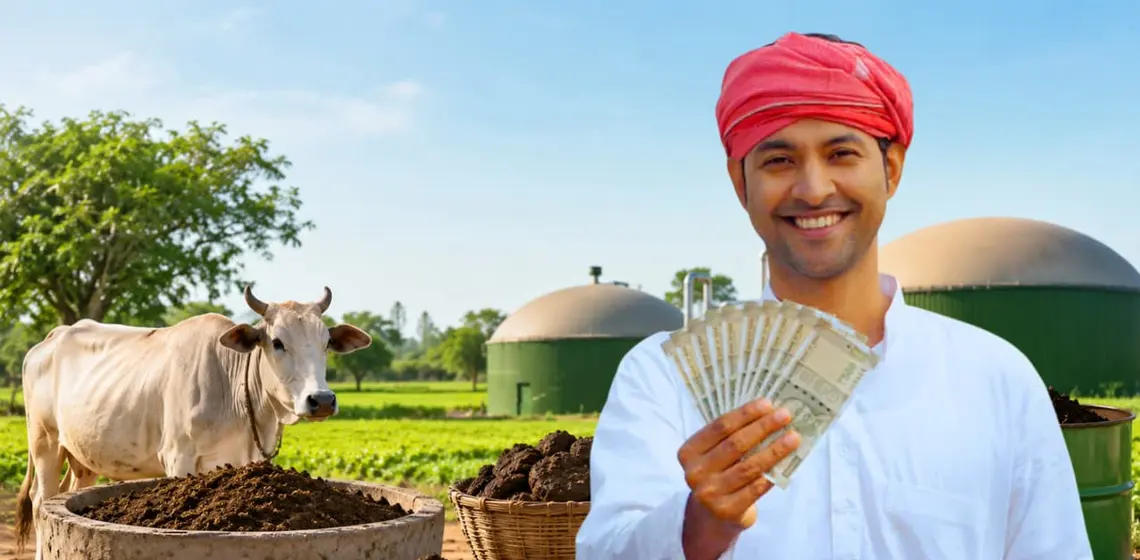
The feedstock was never scarce: cattle dung, crop residue, press mud and municipal organic waste are the inputs GOBARdhan is designed to convert into compressed biogas and organic manure over the decade to FY36.
India did not lack the digester. It lacked a buyer who would still be there in year nine.
At a Glance
• Scheme: GOBARdhan — National Unified Scheme for Compressed Biogas
• Outlay: ₹23,731 crore
• Period: FY27 to FY36 — a ten-year window
• Administered by: Ministry of Petroleum and Natural Gas
• Target: roughly ten-fold rise in domestic CBG production
• Feedstock: agricultural residue, cattle dung, municipal organic waste, press mud, other biomass
• Support offered: assured demand, stable pricing, capital assistance, pipeline infrastructure, credit support, technology development
• Built on: SATAT, the MDA, BAM and DPI schemes, and central financial assistance for CBG plants
• Already commissioned: more than 200 CBG plants
• Approved by: the Union Cabinet, chaired by the Prime Minister
Follow the feedstock and the second story appears. Every tonne of paddy straw that reaches a digester is a tonne that does not burn in a field in October, and every tonne of dung that reaches one comes back to the same farmer as fermented organic manure. That closes a loop Indian agriculture has been opening for fifty years: nutrients left the soil as grain and came back as urea bought with a subsidy. A working CBG plant reverses part of that trade at the village level, and it pays a farmer for material he currently gives away or sets alight. The scheme’s own framing — circular bioenergy — is precise rather than decorative.
The honest caution is about the collection, not the chemistry. A CBG plant needs feedstock arriving every day, from hundreds of small holdings, at a cost that does not eat the margin — and rural aggregation is where good bioenergy schemes have historically thinned out, in India and elsewhere. The three things worth watching over the next two years are therefore practical ones: whether the offtake price is notified early enough for a promoter to close financing before a construction season is lost; whether farmer-producer organisations are brought in as aggregators rather than leaving each plant to build its own supply chain; and whether the manure that comes out the far end finds a market at a price that makes the second revenue line real. Get those right and ₹23,731 crore buys something more durable than gas — it buys a rural industry with a ten-year price list.