Blitz Bureau
NEW DELHI: India’s non-fossil generating capacity crossed 300 GW on 31 July. The milestone is real. The number that tells you what it is worth is a different one, and it is rising faster.
As on 31 July 2026, India’s installed non-fossil-fuel electricity generation capacity stood at 300.50 GW — more than 54 per cent of a total installed base of roughly 552 GW, and past 60 per cent of the 500 GW target set for 2030. Solar accounts for 164.59 GW of it, against 2.8 GW in 2014. Wind stands at 58.14 GW, against about 21 GW in the same year. Measured as capacity, the transition is no longer a plan; it is the larger half of the fleet.
Capacity, though, is a statement about what is built, not about what is delivered. A solar panel with no sun and a turbine with no wind both count in the 300.50 GW. The figure that answers the harder question is generation: renewable output rose from 190.96 billion units in 2014-15 to 477.79 billion units in 2025-26. That is a two-and-a-half-fold rise in electricity actually supplied, and it is the number a distribution company plans around. Read together, the two series say something precise — India has been building faster than it has been generating, which is exactly what an early transition looks like, and exactly the phase in which the next constraint arrives.
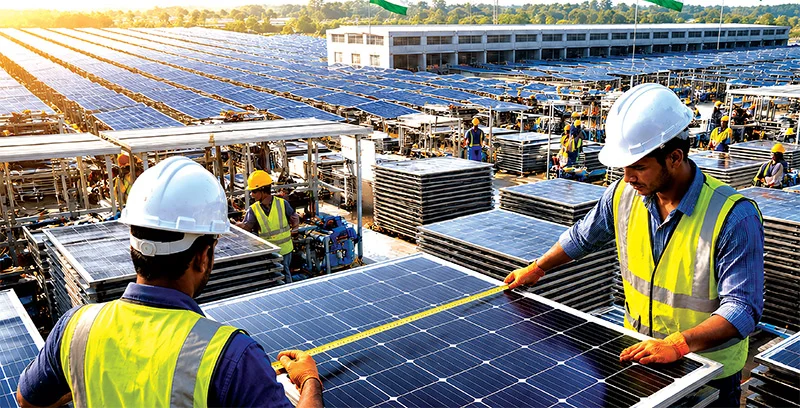
164.59 GW of it is solar: India’s non-fossil capacity reached 300.50 GW on 31 July 2026, more than 54 per cent of a total installed base of about 552 GW.
Building capacity is an engineering problem. Delivering it at seven in the evening is an economics problem.
At a Glance
• Non-fossil capacity: 300.50 GW as on 31 July 2026
• Share of total: more than 54 per cent of about 552 GW installed
• Against the 2030 target: past 60 per cent of 500 GW
• Solar: 164.59 GW, from 2.8 GW in 2014
• Wind: 58.14 GW, from about 21 GW in 2014
• Renewable generation: 477.79 billion units in 2025-26
• Comparison: 190.96 billion units in 2014-15
• Global rank: third in installed renewable energy capacity
That next constraint is timing. India’s demand peak is in the evening, when solar output has gone and household load is climbing; the gap between a sunny afternoon and a hot 8 pm is the whole remaining problem of the transition. This is why the shape of new procurement has been changing — round-the-clock tenders, storage-linked contracts, pumped hydro at older reservoir sites. None of it makes a headline the way a gigawatt milestone does, because storage is measured in hours rather than in capacity, and hours photograph badly.
Stated plainly, India has done the hard part first and done it at a speed few large economies have matched: 2.8 GW of solar to 164.59 GW inside twelve years is not an incremental record. The work from here is less about panels and more about the grid that carries them and the batteries that hold them — transmission built ahead of generation rather than behind it, storage procured as a service rather than as a subsidy, and distribution companies healthy enough to sign fifteen-year contracts. Get those three right and the 500 GW target for 2030 stops being a stretch and becomes arithmetic.