• About us
  • Team
  • Privacy Policy
  • Contact
Thursday, August 20, 2026
  • Login
No Result
View All Result
World's first weekly chronicle of development news
  • Blitz Highlights
    • Special
    • Spotlight
    • Insight
    • Entertainment
    • Sports
  • Opinion
  • Legal
  • Perspective
  • Nation
    • East
    • West
    • North
    • South
  • Business & Economy
  • World
  • Hindi Edition
  • International Editions
    • Dubai
    • Tanzania
    • United Kingdom
    • USA
  • Blitz India Business
  • Blitz Highlights
    • Special
    • Spotlight
    • Insight
    • Entertainment
    • Sports
  • Opinion
  • Legal
  • Perspective
  • Nation
    • East
    • West
    • North
    • South
  • Business & Economy
  • World
  • Hindi Edition
  • International Editions
    • Dubai
    • Tanzania
    • United Kingdom
    • USA
  • Blitz India Business
No Result
View All Result
World's first weekly chronicle of development news
No Result
View All Result

A Camera in Geostationary Orbit Ends a Seven-Month Pause

by Blitz India Media
August 20, 2026
in News, Science
0
ISRO plans seven space missions this financial year while advancing Gaganyaan with key crew-module qualification tests and new space technologies.

Blitz Bureau

NEW DELHI: ISRO returns to the launch pad in the first week of September with GISAT-1A. The satellite is unusual, and the reason it is unusual is exactly the reason it is worth waiting for.

GISAT-1A, also designated EOS-05, is scheduled to fly on the Geosynchronous Satellite Launch Vehicle in early September. It will be the organisation’s first launch since the PSLV-C62/EOS-N1 mission failed on 12 January 2026 — a gap of close to seven months, which follows the PSLV-C61/EOS-09 failure of 2025 caused by an anomaly in the vehicle’s third stage. Two consecutive setbacks on the same workhorse launcher is a hard sequence for any space agency, and the deliberate pace of the return is a sign of review discipline rather than of hesitation.

What makes GISAT different from almost every other Earth-observation satellite India operates is where it sits. Conventional imaging satellites fly in low Earth orbit, sweeping past a given place perhaps once or twice a day at a fixed local time. A geostationary imaging satellite hangs above the same longitude and turns with the planet, which means it can look at the same stretch of ground again and again through the day. For mapping a static feature, low orbit is better. For watching something change — a cyclone tightening, a river rising, a fire front moving, cloud clearing over a flooded district — revisit rate beats resolution, and geostationary is the only way to get it.

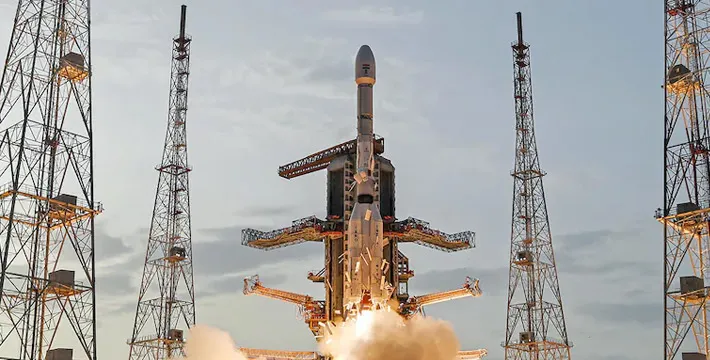
Back to the pad: A GSLV on the launch pad at Satish Dhawan Space Centre, Sriharikota. GISAT-1A, also designated EOS-05, is scheduled to fly on the GSLV in the first week of September 2026.

For mapping a place, low orbit wins. For watching a place change — a cyclone, a flood, a fire front — only geostationary gives you the same ground, hour after hour.

At a Glance

• Mission: GISAT-1A, also designated EOS-05
• Launcher: Geosynchronous Satellite Launch Vehicle (GSLV)
• Window: first week of September 2026
• Previous ISRO launch: PSLV-C62/EOS-N1, failed 12 January 2026
• Gap: close to seven months
• Earlier setback: PSLV-C61/EOS-09, 2025, third-stage anomaly
• Orbit advantage: repeated same-day imaging of the same ground
• Applications named: disaster monitoring, agriculture, forestry

The practical applications named for the satellite are disaster monitoring, agriculture and forestry. Each of these is a change-detection problem rather than a mapping problem. A district administration deciding when to move people out of a flood plain needs images hours apart, not days apart. A crop insurance assessment after unseasonal rain needs to establish what the field looked like before and immediately after. India has built substantial ground capability for both — the question has been how often the picture refreshes.

The launcher choice matters too. The GSLV, with its indigenous cryogenic upper stage, is the vehicle that carries India’s heavier payloads to higher orbits, and returning to flight on it rather than on the smaller PSLV puts the more demanding capability back in service first. The cryogenic engine is among the small number of technologies no country has ever transferred to another; India built it after being refused it.

The constructive way to read a seven-month gap is as the cost of a review done properly. Two failures in successive years on the same class of vehicle would justify a long, unglamorous look at process, and an agency that takes that time is protecting a launch record that other countries buy services against. India’s commercial launch business, the Gaganyaan human spaceflight programme and the Bharatiya Antariksh Station all rest on the same reliability. September’s window is worth watching not only for the satellite it carries but for what a clean flight would restore.


Related Posts

Renewables in the reckoning
Energy

211 Gigawatts, and Four and a Half Years to Build Them

August 20, 2026
gale-cricket stedium
News

India Take Galle by 165, and a Spinner Takes Ten

August 20, 2026
Makhana
News

Nine Per Cent of India’s Makhana Actually Leaves the Country

August 20, 2026
Centre seeks inputs on proposed IT rules and forms
Diplomacy

One Country Sends a Third of India’s Foreign Investment

August 20, 2026
export
News

Eighteen Per Cent, and the Sectors That Felt It First

August 20, 2026
blitzindia-daily-news
News

India Economy: Markets, Exports, Inflation & Growth

August 20, 2026
Load More
Next Post
Makhana

Nine Per Cent of India’s Makhana Actually Leaves the Country

Recent News

Renewables in the reckoning
Energy

211 Gigawatts, and Four and a Half Years to Build Them

by Blitz India Media
August 20, 2026
0

Blitz Bureau NEW DELHI: India has the world’s third-largest renewable fleet and a 2030 target it can still reach. The...

Read moreDetails
gale-cricket stedium

India Take Galle by 165, and a Spinner Takes Ten

August 20, 2026
Makhana

Nine Per Cent of India’s Makhana Actually Leaves the Country

August 20, 2026
ISRO plans seven space missions this financial year while advancing Gaganyaan with key crew-module qualification tests and new space technologies.

A Camera in Geostationary Orbit Ends a Seven-Month Pause

August 20, 2026
Centre seeks inputs on proposed IT rules and forms

One Country Sends a Third of India’s Foreign Investment

August 20, 2026

Blitz Highlights

  • Special
  • Spotlight
  • Insight
  • Entertainment
  • Health

International Editions

  • US (New York)
  • UK (London)
  • Middle East (Dubai)
  • Tanzania (Africa)

Nation

  • East
  • West
  • South
  • North
  • Hindi Edition

E-paper

  • India
  • Hindi E-paper
  • Dubai E-Paper
  • USA E-Paper
  • UK-Epaper
  • Tanzania E-paper

Useful Links

  • About us
  • Team
  • Privacy Policy
  • Contact

©2024 Blitz India Media -Building A New Nation

Welcome Back!

Login to your account below

Forgotten Password?

Retrieve your password

Please enter your username or email address to reset your password.

Log In

    No Result
    View All Result
    • Blitz Highlights
      • Special
      • Spotlight
      • Insight
      • Entertainment
      • Sports
    • Opinion
    • Legal
    • Perspective
    • Nation
      • East
      • West
      • North
      • South
    • Business & Economy
    • World
    • Hindi Edition
    • International Editions
      • Dubai
      • Tanzania
      • United Kingdom
      • USA
    • Blitz India Business

    ©2024 Blitz India Media -Building A New Nation