Blitz Bureau
NEW DELHI:The GOBARdhan scheme has been read everywhere as a clean-energy announcement. Read the components instead, and it is a price guarantee — and that is a different kind of policy altogether.
The Union Cabinet approved GOBARdhan, the National Circular Bioenergy Scheme, on 6 August 2026, with an outlay of ₹23,731 crore running from FY 2026-27 to FY 2035-36. Administered by the Ministry of Petroleum and Natural Gas, it brings compressed biogas — CBG, the fuel made by digesting cattle dung, crop residue, press mud and municipal organic waste — under a single national framework. The stated aim is a near ten-fold rise in domestic CBG output. Spread evenly, the outlay is about ₹2,373 crore a year for a decade, which is modest for a scheme meant to build an industry. The leverage is not in the money. It is in what the money guarantees.
Three of the six components decide everything. Component 1 creates an offtake assurance: city gas distribution companies must blend CBG into what they sell, on a notified obligation trajectory of 3 per cent in FY 2026-27, 4 per cent in FY 2027-28 and 5 per cent from FY 2028-29, in CNG for transport and piped gas for homes. Component 2 fixes an administered price of ₹2,110 per Metric Million British Thermal Unit, backed by government support and a market cost-sharing mechanism, with a horizon of at least ten years. Component 3 pays capital assistance of up to ₹2 crore per tonne per day of installed capacity, for greenfield plants and for brownfield expansion, and it covers not just the digester but feedstock aggregation and organic-manure processing.
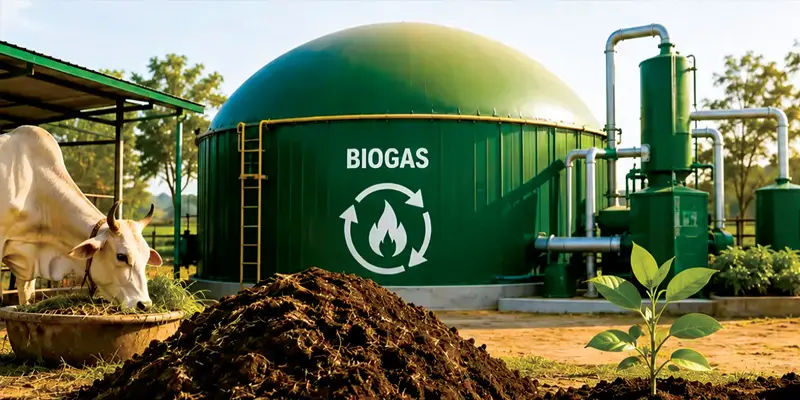
The plant is the easy part. An anaerobic digestion facility of the kind GOBARdhan is designed to finance. India already has more than 200 CBG plants commissioned under earlier programmes; what they lacked was an assured buyer and a fixed price, which is what the new scheme supplies.
Two hundred plants were built without a guaranteed buyer. The scheme’s real product is the buyer.
At a Glance
• Scheme: GOBARdhan, National Circular Bioenergy Scheme; approved 6 August 2026
• Outlay: ₹23,731 crore, FY 2026-27 to FY 2035-36
• Administered by: Ministry of Petroleum and Natural Gas
• Administered CBG price: ₹2,110 per MMBTU, minimum ten-year horizon
• Blending obligation: 3% FY27, 4% FY28, 5% from FY29 in CNG and domestic PNG
• Capital assistance: up to ₹2 crore per tonne per day of installed capacity
• Also included: pipeline connectivity, a credit guarantee for MSME projects, an ecosystem challenge fund
• Base to build on: over 200 CBG plants already commissioned
Who this is actually for is the question a reader should ask, and the answer sits in components 3 and 5. Capital assistance is open to private developers, MSMEs, cooperatives and rural entrepreneurs, and a dedicated credit guarantee shares lending risk on MSME-based projects, which is the standard remedy for the standard problem: a small developer with a viable plant and no collateral a bank will accept. A dairy cooperative sitting on a daily dung stream, a sugar mill with press mud it currently pays to remove, a municipal body with wet waste it currently landfills — each of these is now looking at an input it was treating as a disposal cost and a buyer obliged to purchase the output. That inversion, from waste-handling expense to feedstock revenue, is the scheme’s mechanism.
The honest challenge is aggregation, and it should be named rather than glossed. A CBG plant does not fail on technology; it fails when the feedstock does not arrive in the volume and at the moisture content the digester was designed for. Cattle dung is dispersed across small holdings, crop residue is seasonal, and the transport radius that makes economic sense is short. This is precisely what Component 6, the CBG Ecosystem Challenge Fund, is meant to address through feedstock mapping, aggregation infrastructure and district-level planning — and it is where the scheme will be won or lost. The measure of success ten years out will not be the number of plants commissioned. It will be plant utilisation, the price a farmer is actually paid per tonne of residue, and whether the organic manure that comes out of the far end finds a market as reliably as the gas does.