NEW DELHI: There is a sentence that does not appear in the National Statistics Office press note of 31 August 2026, and it is the most important sentence in it. Here it is. In the April–June quarter of 2026-27, the Indian economy grew by ₹5,89,923 crore in real terms. Of that increase, ₹2,98,325 crore came from Gross Fixed Capital Formation — investment — and ₹2,98,094 crore from private final consumption. Two hundred and thirty-one crore rupees separate them. For practical purposes, the half of the economy that builds drew level with the half that buys, and edged fractionally ahead.
That is a small number carrying a large history. For most of the last fifteen years India has grown by consuming: a young country with rising incomes buying more, and an investment rate that drifted down from the highs of the late 2000s and then sat there. Economists wrote about it in a tone of resignation. The standard counsel — that a country which wants to grow at eight per cent for a decade must first put a third of its output back into the ground, into machines, into rail and wire and warehouse — was repeated so often that it stopped being heard. This quarter, the investment rate reached 34.28 per cent of nominal GDP, against 31.41 per cent a year earlier. That is a movement of 2.87 percentage points in twelve months, and it is not a rounding error.
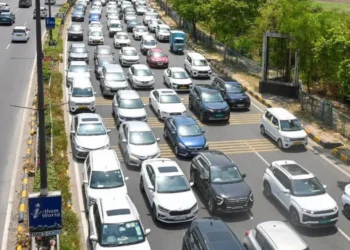
Look underneath and the composition is reassuring, because it is boring. Construction value added grew 7.7 per cent in real terms. The cement production index rose 8.9 per cent, finished steel consumption 8.3 per cent, and the Index of Industrial Production for infrastructure and construction goods 7.2 per cent. Capital goods output rose 15.2 per cent and electrical equipment 27.0 per cent. Registrations of goods transport vehicles rose 20.1 per cent and sales of commercial vehicles 18.3 per cent. None of those are financial-market numbers; every one of them is a thing that has to be manufactured, driven somewhere and installed by somebody. Investment booms that are real look like this. Investment booms that are not tend to show up first in asset prices, and this week the asset prices fell about one per cent.
The logistics half of the story is more mixed, and Blitz will not smooth it over. Railway passenger kilometres grew 8.3 per cent, and cargo handled at major ports grew 6.2 per cent. But railway net tonne kilometres — freight, the thing the dedicated freight corridors were built for — fell 0.7 per cent, and cargo at minor ports slipped 0.6 per cent. Air cargo and passenger traffic on scheduled international services fell 19.5 per cent. A quarter in which the country is buying more trucks while moving marginally less freight by rail is a quarter in which the road is winning a competition that, on cost and on carbon, the rail ought to win. That is not a criticism of anyone; it is an operating question, and it belongs on the desk of the Ministry of Railways and the Ministry of Road Transport and Highways together, because neither can answer it alone.
There is a second caution, and the statisticians raised it themselves. The new national accounts series with base year 2022-23 applies double deflation to manufacturing — deflating output and intermediate consumption separately, using the new Producer Price Index. The press note says plainly that under this method the implicit price deflator for manufacturing can fall, or turn negative, when input prices rise faster than output prices. In a quarter when the PPI for crude petroleum and natural gas rose 58.0 per cent and the PPI for mining and quarrying 19.5 per cent, that caveat is live. It does not undo the investment figure, which is measured on the expenditure side. It does mean that anyone modelling Indian manufacturing off the old series is now quoting the wrong series, and should stop.
What India gains from this quarter is not the headline rate. Growth rates rise and fall and the next print will be argued about as this one was. What India gains is a change in the composition of its growth — and composition, unlike rate, compounds. A rupee spent on consumption is spent. A rupee put into a port crane, a substation, a fabrication plant or a freight terminal produces for twenty years and lowers the cost of everything that passes through it. The same week that produced this number also produced the Semicon 2.0 notification at ₹1,27,500 crore and a record $740.8 billion of reserves to pay for the imported half of any capital-goods cycle. A country that is investing, that has the foreign exchange to import what it cannot yet build, and that is simultaneously funding the capacity to build it — that is a country with a decade in front of it, provided the freight moves.
Of every hundred rupees by which India’s economy grew this quarter, fifty came from what the country built and fifty from what it bought. It has been a long time since those two were level.
Why It Matters
• Investment supplied 50.6 per cent of the quarter’s real GDP increase, consumption 50.5 per cent — a Blitz calculation from Statement 2 of the press note.
• The investment rate rose to 34.28 per cent of nominal GDP from 31.41 per cent, up 2.87 percentage points.
• What India gains: capacity that produces for twenty years, and a lower unit cost for every firm that uses it — the difference between growing fast for a quarter and growing fast for a decade.
• The open question: rail freight fell 0.7 per cent while goods-vehicle registrations rose 20.1 per cent. The corridors need the traffic they were built for.
•
BLITZ INDIA DATA CARD : New Delhi · 6 September 2026
| Indicator | Value |
|---|---|
| Real GDP, Q1 FY 2026-27 | ₹81,36,153 cr |
| Real GDP, Q1 FY 2025-26 | ₹75,46,230 cr |
| Real GFCF growth, Q1 FY 2026-27 (y-o-y) | 11.9% |
| Real PFCE growth, Q1 FY 2026-27 (y-o-y) | 7.1% |
| Investment rate, nominal GFCF / GDP, Q1 FY 2026-27 | 34.28% |
| Investment rate, nominal GFCF / GDP, Q1 FY 2025-26 | 31.41% |
The Comparison — share of the quarter’s real GDP increase
Investment (GFCF) — ₹2,98,325 crore : 50.6%
Household consumption (PFCE) — ₹2,98,094 crore : 50.5%
Total real GDP increase — ₹5,89,923 crore : 100%
Blitz Calculation
Derived by this desk from Statement 2 of the press note, and absent from the release itself: the real GDP increase of ₹5,89,923 crore splits into ₹2,98,325 crore from Gross Fixed Capital Formation and ₹2,98,094 crore from private final consumption — 50.6 per cent against 50.5 per cent, a gap of ₹231 crore. Separately, from Statement 4: the investment rate rose from 31.41 per cent to 34.28 per cent of nominal GDP, +2.87 percentage points. Investment grew 1.67 times as fast as consumption. Implied whole-economy deflator: 2.33 per cent.
What India Gains
A change in the composition of growth, not merely its speed: capacity — ports, power, plant, freight terminals, fabrication — that produces for twenty years and lowers the unit cost for every Indian firm and household downstream of it, which is the only foundation on which a decade of eight per cent has ever been built anywhere.
Primary Source
Ministry of Statistics and Programme Implementation, National Statistics Office, Press Note on Quarterly Estimates of Gross Domestic Product for the First Quarter (April–June) of 2026-27, dated 31 August 2026 — Statements 1 to 4 and the Annexure. Read in full by this desk. All figures on this card are from that document.
The Week Ahead
• Monday 7 September — The Women’s T20 Asia Cup enters its closing phase in the United Arab Emirates; the tournament runs to 13 September 2026 and India are through to the semi-finals.
• Around 12 September — Consumer Price Index inflation for August 2026, due from the National Statistics Office. The Q1 national accounts put the implied whole-economy deflator at about 2.3 per cent; the CPI print is the first monthly test of whether that calm holds.
• Around 15 September — Merchandise trade data for August 2026 from the Ministry of Commerce and Industry. Q1 showed imports of machinery and equipment up 51.5 per cent; whether the capital-goods pull continued is the number to find.
• 20 September — The rebased Index of Core Industries for August, on the new nine-industry series, now lands on the twentieth of the month rather than the last working day.
• 21 September — The Ministry of Health and Family Welfare is scheduled to release the 7th National Formulary of India.
• 30 November — The next quarterly GDP estimate, for July–September 2026, as stated in the 31 August press note.