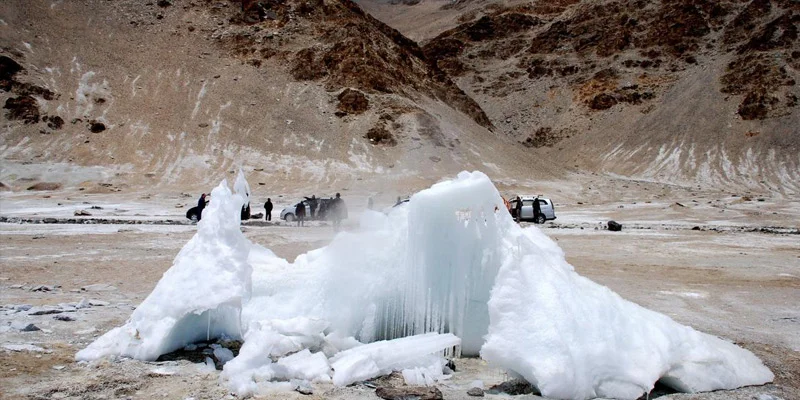
NEW DELHI: Puga Valley is a wide, cold, treeless basin in eastern Ladakh where the ground steams. Villagers have known about the hot springs for as long as there have been villagers. What has changed is that there are now two holes in it, each a kilometre deep, and the country has its first direct measurement of what is down there.
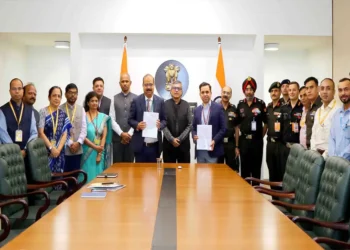
The commissioning at Puga Valley, 17 July 2026. Photograph: Administration of the Union Territory of Ladakh, from its own press page, hosted on the Government of India’s S3WaaS service. Not an agency photograph. The render could not be verified here — curl is proxied in this sandbox — and the address is reproduced exactly as the Administration’s own page prints it.
The two wells were commissioned on 17 July 2026 by the Lieutenant Governor of Ladakh, Shri V. K. Saxena, and executed by ONGC Energy Centre. Each was drilled to 1,000 metres. The site sits above 14,000 feet, which is 4,267 metres — the conversion is this desk’s, and it is worth making, because at that altitude every piece of equipment, every engine and every man on the rig is working on roughly six-tenths of the oxygen available at sea level.
What the wells actually found
Project engineers recorded a maximum temperature of 135°C at a depth of 400 metres. Testing continues and the engineers say they hope for higher. That single figure is the whole point of the exercise: a geothermal power plant is, in the end, a machine for turning a temperature difference into electricity, and 135°C at 400 metres is a resource, not a curiosity. The two wells are the input to reservoir evaluation — how much heat, how fast it can be drawn, and for how long before the reservoir cools — and that evaluation is what decides whether the 1 MW pilot plant at Puga becomes India’s first demonstration-scale geothermal power project or stays a plan.
The number the release does not print
The Administration’s account gives two dates for the second well and no rate. The well was spudded on 3 June 2026 and completed to 1,000 metres on 8 July 2026. That is thirty-five days, and it works out at an average of 28.6 metres a day — the arithmetic is this desk’s. It is a plain figure and it carries more than it looks. Drilling a kilometre in five weeks is unremarkable on a plain. Doing it at 4,267 metres, in a valley with a working season measured in months rather than years, through what the Administration describes as complex sub-surface conditions and active geothermal ground, is the reason the Lieutenant Governor singled out the engineers rather than the equipment.
Blitz Data Card
Puga Valley: the first measurements
| Parameter / Metric | Details / Value |
|---|---|
| Wells commissioned | 2 |
| Depth, each | 1,000 m |
| Site altitude | >14,000 ft |
| Maximum temperature recorded | 135°C at 400 m |
| Pilot plant to be fed | 1 MW |
| Well 2: spudded 3 Jun → completed 8 Jul 2026 | 35 days |
| Blitz calculation: 1,000 m ÷ 35 days | 28.6 m/day |
| Blitz calculation: 14,000 ft × 0.3048 | 4,267 m |
| Comparison, to scale: well 1 reached depth 22 May; well 2, 8 Jul | two wells, one season |
| Cost of the wells | NOT STATED |
| What India gains | A fourth firm renewable |
What India gains: solar and wind stop at night and in still air; hydro depends on the monsoon. Geothermal runs at a steady output around the clock, and India has never had a working one. If Puga’s reservoir holds, the country adds a firm renewable to its grid and, as importantly, adds Indian engineers who have drilled a high-altitude geothermal well — a skill exportable to every mountain economy that has hot ground and no power.
What obstructed it, in the Administration’s own words
The account is unusually frank about a delay, and Blitz prints it as the Administration wrote it because the record is more useful than a smooth story. The tripartite memorandum of understanding between the Ladakh Administration, the Ladakh Autonomous Hill Development Council, Leh, and ONGC Energy Centre expired, and the project lost several months. The Lieutenant Governor intervened personally to get it renewed for a further five years in June 2026, after which work resumed and both wells were finished. That is the sequence on the record: an instrument lapsed, a project stopped, an office acted, and the drilling restarted. It is worth noticing that the whole of the second well — spud to completion — happened inside the five weeks that followed.
Appreciation is due where it is plainly earned, and the Administration’s own account earns it twice over: to the engineers and technicians of ONGC Energy Centre, whom the Lieutenant Governor described as among the best in the world, and to Shri V. K. Saxena, whose intervention on the memorandum is the reason there is anything to commission. The Prime Minister’s call for a carbon-neutral Ladakh gave the project its frame; the drilling crew gave it its metres.
What this piece does not claim
No power has been generated at Puga. The wells are wells. The 1 MW plant is described on the record as proposed, and the reservoir evaluation that would justify it is described as under way. Blitz says so plainly, because a demonstration project written up as a power station is the commonest failure in energy reporting and this desk will not commit it. The temperature is measured; the electricity is not.