Coal auctions triple states’ mining revenue
New Delhi, 14 September A coal block used to be something a government handed out. Since the commercial auctions Prime Minister Narendra Modi launched on 18 June 2020, it has been something a company has to win in public, on a screen, with its bid opened live in front of everyone else bidding. The Ministry of Coal, in a release issued on 14 September 2026, put six years of that change into figures: 147 mines auctioned across nine States, 44 of them won by companies that had never held one before, and a revenue design that has left States with roughly three times the coal money they were collecting a decade ago.
The reform has a date of birth that is not 2020. It is 2014, when the Supreme Court cancelled 204 coal blocks and the old allocation system ceased to exist overnight. What replaced it took six years to reach its present shape, and the shape matters more than the announcement.
How the bidding works
Two stages, online, on the MSTC platform. The bid documents are decrypted and opened in front of the bidders themselves — the detail that does the work, because a sealed envelope opened in a room is a different thing from a number appearing on everyone’s screen at once. There is no restriction on what the coal is used for. Foreign investment goes in at 100% through the automatic route. The upfront payment is deliberately small and can be set off against the revenue share that follows.
That last clause is the one a small bidder reads twice. A low entry cost is what lets a company without a balance sheet built on decades of mining put in a serious bid, and 44 first-time winners is the evidence that it worked.
The more telling arrival is at the other end. Western Coalfields Limited and Northern Coalfields Limited — both subsidiaries of Coal India, both accustomed to being given coal to produce and sell — have entered recent rounds as bidders, on the same terms as everyone else. A State-owned miner bidding for a block rather than receiving it is not a small adjustment of habit.
What a State actually collects
Five streams, and only one of them is the auction premium the headlines usually carry. There is the competitively bid revenue share, which sits on top of royalty rather than replacing it. There is royalty itself, the statutory payment. There is the District Mineral Foundation contribution, which is spent inside the mining district through the Pradhan Mantri Khanij Kshetra Kalyan Yojana. There is the National Mineral Exploration Trust contribution, which pays for finding the next deposit. And there is GST.
Stacked, those five are what the Ministry means when it says States’ coal revenue has nearly tripled in a decade. The 147 blocks are projected to generate about ₹47,500 crore a year, ₹55,000 crore of capital investment and 4.9 lakh jobs. Divide those across the blocks, as this desk has, and the average block carries roughly ₹323 crore of annual revenue, ₹374 crore of investment and about 3,333 jobs. The DMF stream is the one worth watching: it is money that cannot leave the district it came from.
Against those projections, the actual collection so far is modest and the Ministry says so plainly. Upfront and premium payments from allotted commercial mines came to about ₹3,090 crore in 2025-26 — some 6.5% of the projected annual figure, on this desk’s arithmetic. The gap is not a discrepancy. It is the ordinary distance between a mine that has been auctioned and a mine that has begun to produce.
The tonnes behind the money
Production from commercial mines alone rose from 12.55 million tonnes in 2023-24 to 23.51 million tonnes in 2024-25 — an increase of 10.96 million tonnes, or 87%. Captive and commercial blocks together produced about 210 million tonnes in 2025-26, past 200 million for the first time. A decade earlier the same category produced 28.8 million tonnes.
The Ministry describes that as compound annual growth of about 22%. This desk recomputed it: 210 divided by 28.8, taken to the power of one-tenth, gives 21.98%. The figure holds, and it is worth saying so, because a ratio that survives being checked is itself a finding.
The sentence that matters for India is the one the release states without elaboration. Every additional tonne mined here is a tonne not bought abroad. India is producing 181.2 million tonnes a year more from these blocks than it was ten years ago, and that tonnage is the difference between an import bill and a district’s DMF account.
Blitz Data Card
New DelhiAt a glance 147 coal mines auctioned since 2020 across nine States · 44 first-time winners · ₹47,500 crore projected annual revenue · ₹55,000 crore projected capital investment · 4.9 lakh projected jobs · ₹3,090 crore actually collected from upfront and premium payments in 2025-26 · commercial-mine output 12.55 MT (2023-24) to 23.51 MT (2024-25) · captive and commercial together about 210 MT in 2025-26, against 28.8 MT a decade earlier.
What India gains
181.2 million tonnes of coal a year that need not be imported, and a district-level fund — DMF through PMKKKY — that keeps a share of the money where the mine is.
India’s data centre boom hits 1.5 GW milestone
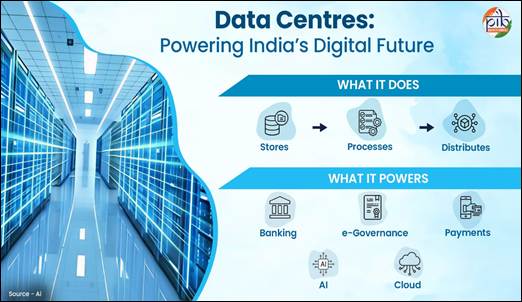
New Delhi, 14 September India’s data centres had about 375 MW of installed power capacity in 2020. By August 2026 they had 1.57 GW — four times as much in six years, a compound rate of roughly 27% a year on this desk’s calculation. The projection for 2030 is about 8 GW, which would need another fivefold rise in four years.
The figures come from a Press Information Bureau backgrounder issued on 14 September 2026, prepared by PIB Research. It also carries the Central Electricity Authority’s estimate that data-centre demand could reach 17 GW by 2031-32 — close to eleven times today’s capacity.
Two policy dates explain much of the money. The Union Budget of 2022-23 put data centres on the harmonised list of infrastructure, which lets them borrow long and cheap in the way a highway or an airport does. The Union Budget of 2026-27 added a tax holiday to 2047 for eligible foreign cloud service providers using India-based data centre infrastructure — a 21-year window, from tax year 2026-27 to 2046-47. About $70 billion is already going in, with a further $90 billion of projects announced.
The National Informatics Centre runs the government’s own share: national data centres at Delhi, Pune, Hyderabad and Bhubaneswar, and 37 smaller centres in State capitals.
Rajbhasha Awards celebrate India’s language mission
Navi Mumbai, 14 September The Rajbhasha Gaurav and Rajbhasha Kirti Awards for 2025-26 were presented at the sixth All India Official Language Conference in Navi Mumbai on 14 September. The two-day conference is organised by the Department of Official Language under the Ministry of Home Affairs.
Its stated theme is the relationship between Hindi and Maharashtra’s own literary and linguistic traditions — a framing that treats the host State’s languages as company rather than competition. A session on the national song, Vande Mataram, is among the listed items, and institutions, banks and ministries have taken stalls at an accompanying exhibition. Chief Minister Devendra Fadnavis, Deputy Chief Ministers Eknath Shinde and Sunetra Pawar, Members of Parliament, scholars and educationists were present.
ISRO completes EOS-05 orbit raising mission
Bengaluru, 14 September The Indian Space Research Organisation records on its own mission pages, read on 14 September 2026, that GSLV-F17 lifted off with EOS-05 at 02:55 AM IST on 4 September 2026 and placed the satellite in its intended orbit. Three orbit-raising manoeuvres followed; the agency has posted the third and final one as complete.
Separately, ISRO has released NISAR S-band SAR data products — the Indian half of the radar payload on the satellite it built jointly with NASA, which the two agencies marked as completing one year in orbit. S-band radar sees through cloud and works at night, which is what makes it useful to an agricultural economy in a monsoon country: a field flooded in July can be measured in July, not in October when the sky clears.
What ISRO has not yet published is the access route and pricing for those products, and that is the number this desk would want next. A data release becomes a capability only when an agricultural university in Parbhani can get at it as easily as a laboratory in Bengaluru.
Five CAG reports put Tamil Nadu schemes under lens
Chennai, 14 September Five reports of the Comptroller and Auditor General of India were tabled on 8 September 2026 in Tamil Nadu, according to the audit report list on cag.gov.in as it stood on 14 September 2026. Four of the five are performance audits.
They cover educational scholarship schemes for students of the Scheduled Castes, Scheduled Tribes and other scheduled categories; the implementation of the Smart City Mission in Tamil Nadu; and the Jal Jeevan Mission in the State. The remaining two are the report on State Revenues for the period ended March 2024 and the report on State Finances for 2024-25. Each performance audit is published in English and in Tamil — a practice worth naming, because an audit a citizen cannot read is an audit performed for somebody else.
This desk has not yet opened the reports themselves, and carries no finding from them here. What is on the record today is that they exist, where they sit and what they examine. The findings, the departmental replies and the Public Accounts Committee’s treatment of them are a separate piece of work, and Blitz will carry them with the replies attached, as the rule requires.