Modi asks BRICS to keep its own promises
New Delhi, 12 September
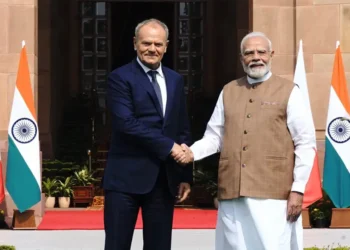
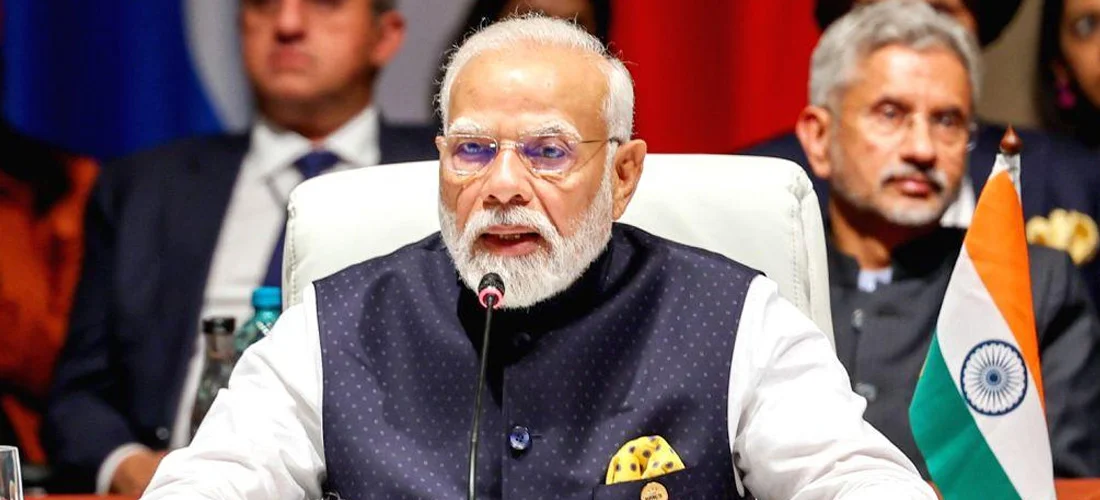
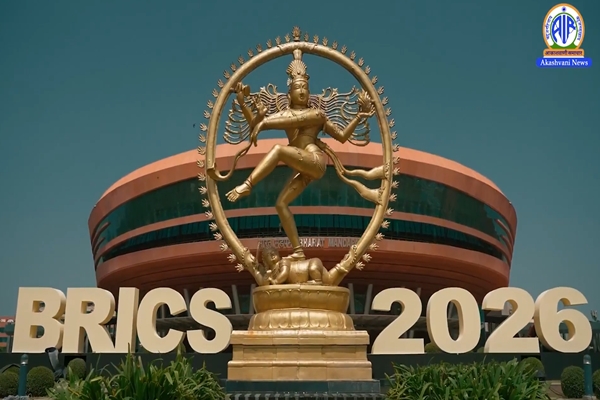
A grouping that changes its chair every year has a memory problem. Each presidency arrives with its own priorities, and the decisions of the last one drift. The Prime Minister put that problem on the table at Bharat Mandapam on 12 September 2026, in his opening remarks to the summit session on inclusive global governance, and offered a fix: a BRICS Continuity and Implementation Mechanism, run through the Troika of past, present and next chairs, with a secure digital repository recording a nodal point, a deadline and an implementation status against every decision the grouping takes.
The text of the remarks, released by the Press Information Bureau on runs to three proposals. The second is a BRICS Reform Roadmap: ten proposals for global governance reform, to be drafted jointly and given final shape by the next summit, built on what the Prime Minister called the three Rs — representation, responsiveness and rule-making. Under representation he said reform of the UN Security Council could no longer be postponed and that text-based negotiations should be tied to a fixed timeline and a stated outcome; the same, he said, applied to voting power and leadership positions in the international financial institutions. The third proposal is smaller and more concrete: a Seafarers Emergency Support Network linking the maritime authorities and missions of member countries for distress alerts, medical help, information to families and evacuation.
What India gains is the thing a chair gains only if the grouping follows through: a framework, proposed from New Delhi, under which the summit’s own outcomes are tracked after the Indian presidency ends. If the repository is built, the fourth Indian chairship will be the one that gave BRICS a memory.
UAE brings $11.5 billion to Odisha aluminium
New Delhi, 12 September Odisha has the bauxite; what it has lacked is capital on this scale. According to the Press Information Bureau release of 12 September, on the Prime Minister’s meeting with Sheikh Khaled bin Mohamed, Crown Prince of Abu Dhabi, on the sidelines of the BRICS Summit, the two leaders welcomed the announcement by the UAE’s International Holding Company that it will invest $11.5 billion in an integrated greenfield aluminium project in Odisha. The release describes it as the largest integrated investment in the aluminium sector in India so far and says the project is expected to help establish Odisha as a global aluminium manufacturing hub.
The word that matters in that sentence is integrated. An integrated aluminium project runs the chain from bauxite mining through alumina refining to smelting, and the smelter is where most of the money and most of the electricity goes; a $11.5 billion commitment is consistent with a project of that full length rather than a refinery alone. The release does not give a tonnage, a site or a timeline, and this desk has not found them elsewhere; the figure stands on its own until the company files its plans.
The same release records that the leaders saw a role for L’Emad, described as the UAE’s newest sovereign investment fund, in deepening the partnership, and that they discussed cooperation in defence, space, nuclear energy, technology and innovation. The Crown Prince’s visit follows the UAE President’s visit to India in January 2026 and the Prime Minister’s visit to the UAE in May 2026, both recalled in the release.
What India gains is a Gulf anchor investment in eastern India’s metals belt, and for Odisha the prospect of value being added to its ore within the State rather than shipped out as alumina.
India to open consulate in Kota Kinabalu
New Delhi Sabah, on the northern coast of Borneo, is about to get an Indian consulate. According to the Press Information Bureau release of 12 September 2026, 11:32 AM, Prime Minister Anwar Ibrahim of Malaysia conveyed Malaysia’s consent for the establishment of a Consulate General of India at Kota Kinabalu during his bilateral meeting with the Prime Minister on the sidelines of the 18th BRICS Summit, in which Malaysia is taking part as a partner country.
The two leaders reviewed the outcomes of the Prime Minister’s visit to Malaysia in February 2026 and, the release says, took stock of progress in trade and investment, defence and security, semiconductors, infrastructure, the digital economy, energy, fintech, education and tourism. The Prime Minister thanked Malaysia for its support in strengthening ASEAN–India relations, and both sides reaffirmed the India–Malaysia Comprehensive Strategic Partnership.
What India gains is a consular post in East Malaysia, where Indian workers and businesses have until now been served from Kuala Lumpur, on the far side of the South China Sea.
Vietnam’s Prime Minister meets Modi in Delhi
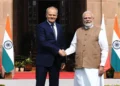
New Delhi, 12 September Prime Minister Narendera Modi met Le Minh Hung, Prime Minister of Vietnam, on 12 September during the BRICS Summit. The release records that the leaders reviewed progress in bilateral ties since the visit to India in May 2026 of To Lam, General Secretary of the Communist Party of Vietnam and President of the country, during which the relationship was elevated to an Enhanced Comprehensive Strategic Partnership. Vietnam is at the summit as a partner country.
The release calls Vietnam a key pillar of India’s Act East policy. What India gains from the meeting is continuity: a relationship upgraded four months ago now has a head-of-government follow-up on the record.
Eight countries sign Kathmandu wildlife pledge
Kathmandu, 12 September Eight South Asian countries, India among them, have pledged coordinated action against illegal wildlife trade under the Kathmandu Declaration, adopted at the first General Assembly of the South Asia Wildlife Enforcement Network held in Kathmandu on 10 and 11 September 2026.

The declaration commits the members to intelligence-led and financial investigations, anti-money-laundering action, asset recovery and prosecution of organised networks operating across borders, and backs regional and global efforts to have serious wildlife crime recognised as transnational organised crime. What India gains is a shared enforcement frame with every neighbour along the routes on which wildlife products leave the subcontinent.
Junior women reach third straight Asia final
Moqi, 12 SeptemberIndia beat South Korea 5–1 in Moqi, China, on 12 September to reach the final of the Women’s Junior Asia Cup. Supriya scored a hat-trick, with Madhu Sidar and Sukhveer Kaur adding a goal each. India, which won the title in 2023 and 2024, faces host China in the final; it had topped a group containing Japan, Malaysia and South Korea and beaten Pakistan 19–0 in the quarter-final.
What India gains is the chance of a third consecutive continental junior title, from a squad that is the feeder for the senior side.
A Badri calf, born in a Sahiwal cow
Karnal, 12 SeptemberThe calf was born on 11 September 2026 at the academic dairy farm of ICAR-National Dairy Research Institute in Karnal. Genetically she is Badri, the small hill breed that Uttarakhand has declared its state animal. The cow that carried her is Sahiwal. According to the Press Information Bureau release of 12 September, the embryo was produced by ovum pick-up and in-vitro fertilisation, OPU-IVF, and transferred into the Sahiwal recipient; a second recipient is expected to deliver a Badri calf within five to seven days.
The method is worth explaining, because it is what the story is about. A Badri cow bred naturally gives one calf a year. Under OPU-IVF, ultrasound-guided needles collect eggs from a selected donor cow, the eggs are matured and fertilised in the laboratory with semen from a superior Badri bull supplied by the Uttarakhand Livestock Development Board, and the embryos are grown under controlled conditions before being placed in surrogate cows — Sahiwal or crossbred animals with no Badri genetics of their own. One elite cow can therefore mother many calves in a year, carried by others. That is the multiplication the release describes.
What India gains is a way to conserve a low-yield hill breed without asking hill farmers to keep more animals than their terraces can feed: the genetics are multiplied in Karnal and the calves go back to the hills.
Bamboo counts its jobs, and its classrooms
New Delhi, 12 September Until 2017, a farmer who grew bamboo on his own land needed a forest permit to cut it, because a colonial-era law classed bamboo as a tree. The amendment that removed it from that definition is the hinge of a Press Information Bureau research backgrounder published on 12 September 2026, 10:55 AM, which sets out what has grown on the other side of it.

The backgrounder’s largest figures come from the North East Centre for Technology Application and Reach, NECTAR, under the Department of Science and Technology. The schemes it supports, the backgrounder says, generate about three crore person-days of employment a year and have raised value addition on bamboo products from 10% to 70%.
More than 42 lakh square feet of engineered-bamboo structures have been built for disaster relief and rehabilitation, and in Chhattisgarh 576 school classrooms have been built of engineered bamboo for about 20,000 children. This desk has divided those two figures: roughly 35 children to a classroom, which is a working school, not a showpiece.
What India gains is a raw material it already grows, principally in the North East, turned into a manufacturing input — and a working demonstration that a single change in a legal definition can be worth more than a subsidy.