Waste to wealth, India leads the way
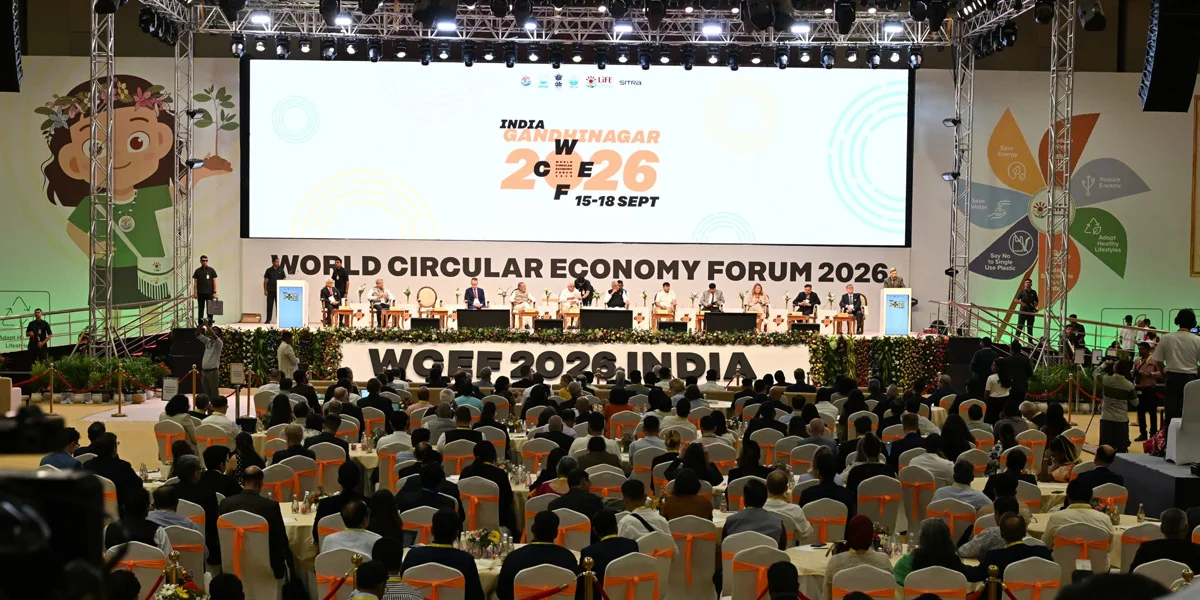
GANDHINAGAR, 15 September A convention hall in Gandhinagar on 15 September with people who make money out of what other people throw away. Recyclers, plastics processors, battery firms, start-ups with sorting machines, officials from sixty-two countries. The tenth World Circular Economy Forum opened at the Mahatma Mandir, and for the first time in its ten years it opened outside its usual latitudes.
Union Minister for Environment, Forest and Climate Change Bhupender Yadav and Gujarat Chief Minister Bhupendrabhai Patel inaugurated it. The theme is Circular Economy: Transition for People and Prosperity, and the forum runs to 18 September.
The Chief Minister said the first hosting of the forum in South Asia reflects India’s growing global leadership under the vision of Prime Minister Narendra Modi. Then he told the hall about Somnath.
Offerings left at the Somnath temple, he said, are recycled into reusable resources, and the recycling generates livelihoods for local communities. It is the kind of example that does not appear in a circular economy briefing paper. The culture of reuse and the idea of turning waste into wealth, he said, have long been part of Indian traditions.
The figures behind the speeches
The numbers the Environment Minister gave are the most useful thing said in the session. As of August 2026, according to his keynote address at the inaugural session, more than 83,000 producers and 4,802 recyclers stood registered under the various Extended Producer Responsibility frameworks, and nearly 482.24 lakh metric tonnes of waste had been processed across the regulated waste streams.
That last figure is 4.82 crore tonnes. Set against the 4,802 registered recyclers, it works out at roughly 10,043 tonnes of regulated waste for every recycler on the rolls — a derivation this desk made from the Minister’s own two figures, and one the release does not carry. It is also, on the same arithmetic, about 17 producers for every recycler registered to take their material back.
That ratio is the whole architecture in one number. Extended Producer Responsibility puts the obligation on whoever makes the thing; the recycler is the machinery that discharges it. Seventeen to one says the machinery is thinner than the obligation, and that is where the next five years of this policy will be decided.
Repair before replace
Bhupender Yadav’s own framing was less statistical. For India, he said, the circular economy is “not a new destination; it is a new way of looking at an old wisdom”. What policy language now calls circularity, he said, “was once simply common sense in everyday Indian life — repair before replace, reuse before discard, and recover before waste”.
He put the measure of success somewhere unusual. “The true measure of a circular economy will not be how much waste we recycle, but how little value we allow to be wasted,” he said.
He also placed the subject inside two chairs India has held. The Resource Efficiency and Circular Economy Industry Coalition was launched during India’s G20 Presidency. India’s BRICS Chairship, he said, has put the circular economy alongside sustainable lifestyles, ecosystem restoration and adaptation as interconnected priorities.
What the visitors brought
Finland’s Ambassador to India, Mikko Kivikoski, said circularity has become an integral part of Finland’s national policy, and that his country intends to hold resource consumption below 2015 levels by 2035. More than 100 Finnish companies operating in India, he said, are working with sustainable technologies and circular principles. His line was the sharpest of the morning: “the best waste is that which is never created.”
Marieke Spijkerboer, Deputy Director General for Circular Economy at the Netherlands Ministry of Economic Affairs and Climate, said her country aspires to become fully circular by 2050, and noted that more than 20 Dutch companies and organisations are at the forum.
The exhibition carries 135 national and international exhibitors. More than 3,600 stakeholders from 62 countries are taking part. Two publications were released at the inaugural session: Best Practices for Reuse of Treated Sewage and Driving Sustainability — A Guide to India’s Circular Economy and EPR Initiatives.
The forum is organised jointly by the Central Pollution Control Board, the Finnish Innovation Fund Sitra, the Government of Finland, the Ministry of Environment, Forest and Climate Change, the Government of Gujarat and the Gujarat Pollution Control Board.
Blitz Data Card
Gandhinagar : At a glance
Producers registered under EPR frameworks: more than 83,000, as of August 2026
Recyclers registered under EPR frameworks: 4,802, as of August 2026
Waste processed across regulated streams: 482.24 lakh metric tonnes
Countries at the forum: 62
Exhibitors at the forum: 135
What India gains
A seat at the head of the table on a subject where Indian practice runs ahead of Indian policy, and where the rules being written now will govern what Indian exporters must prove about their materials.
From Jan Dhan to pension plan
NEW DELHI, 15 September 2026 There is a gap in rural finance that nobody talks about because it does not look like a gap. A household has a bank account. It has a phone. It has a Jan Dhan balance and a subsidy that lands on time. And it has no idea what it will live on at sixty-five.
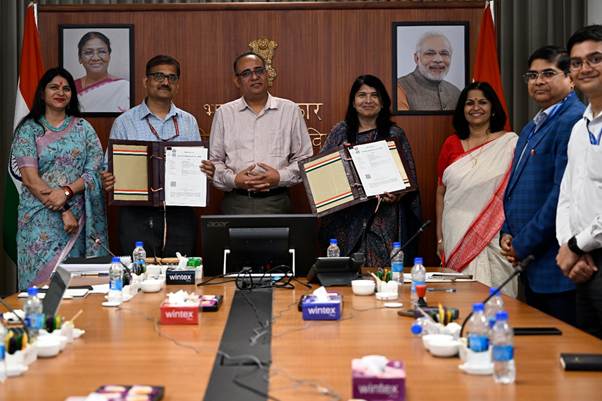
The Department of Rural Development and the Pension Fund Regulatory and Development Authority signed a Memorandum of Understanding on 14 September 2026 to build a cadre against exactly that gap. They are to be called Pension Sakhis.
The signatories were Joint Secretary, Department of Rural Development, Amit Shukla and Executive Director, PFRDA, Sumeet Kaur Kapoor, in the presence of Secretary, Department of Rural Development, Rohit Kansal.
The cadre is not being built from nothing. It sits on the community network already created under the Deendayal Antyodaya Yojana–National Rural Livelihoods Mission, including its Banking Correspondent Sakhis and other trained community resource persons. Those women already move money in villages. The MoU asks them to move information about money that will not be needed for thirty years.
Trust is the working capital
Rohit Kansal put the reason plainly. Social security, he said, “is not only about protection against vulnerability; it is also about giving households the confidence and resilience to pursue sustained economic advancement.” He also said pension awareness must be built on honesty, transparency and trust — a point worth noticing, because a doorstep cadre selling a financial product is exactly where trust is easiest to spend and hardest to rebuild.
Tracked on the Department’s own system
Outreach and enrolment are to be tracked through digital dashboards and mobile and web solutions, including the Department’s own LoKoS system. The target group named in the document is specific: self-help group members, rural women, Lakhpati Didis and other rural participants.
What Indians gain here is a second chapter to financial inclusion. The first chapter opened accounts. This one asks what is in them thirty years out, and puts the question in the mouth of somebody the household already knows.
Varuna Corridor to rewrite Varanasi’s commute
VARANASI, 15 September The Varuna Elevated Corridor is costed at 10,998 crore rupees and measured at 43.218 km. Divide one by the other and the corridor runs at about 254.5 crore rupees a kilometre — a figure this desk derived from the two the Ministry of Road Transport and Highways published, and a useful one to hold on to, because elevated urban highway in a built-up heritage city is among the most expensive road India builds.
The Union Cabinet approved it in July. The National Highways Authority of India will develop a predominantly elevated 6/4-lane corridor connecting NH-31 with the Varanasi Ring Road along the river, with flyovers, loops, ramps and service roads, an iconic cable-stayed bridge and an extradosed foot over bridge-cum-major bridge.
The travel-time claims are the part a Varanasi resident will test. NH-31 to Kashi Railway Station is to fall from about 40 minutes to nearly 20 — a halving. Varanasi Junction to Lal Bahadur Shastri International Airport is to fall from nearly an hour to around 20 minutes, which is a cut of about two-thirds. The corridor is designed for 80–100 kmph.
The ministry’s release itemises 4,565.33 crore rupees for civil construction and 934.91 crore rupees for land acquisition. Those two add to 5,500.24 crore — 50.01% of the sanctioned figure, almost exactly half. The balance of 5,497.76 crore covers the remainder of the project cost, which the release does not break up.
The corridor is aligned with the PM Gati Shakti National Master Plan and is to improve access to the Chandauli Socio-Economic Zone and six major logistics nodes. For eastern Uttar Pradesh, what India gains is a freight route that does not have to pass a pilgrimage crowd to reach a railhead.
Blitz Data Card
Varanasi : At a glance
Sanctioned cost: 10,998 crore rupees
Length: 43.218 km, predominantly elevated, 6/4-lane
Civil construction: 4,565.33 crore rupees
Land acquisition: 934.91 crore rupees
Design speed: 80–100 kmph
What the numbers add up to
10,998 crore rupees divided by 43.218 km is 254.48 crore rupees a kilometre. Civil construction and land acquisition together come to 5,500.24 crore, which is 50.01% of the sanctioned cost; the remaining 5,497.76 crore is not itemised in the release. Both figures were derived here from the ministry’s own numbers.
What India gains
A freight and pilgrimage city whose goods no longer have to cross its crowds, and a template for adding road capacity to a heritage town without widening its old streets.
India’s coalfields enter the AI era
NEW DELHI, 15 September Of 92 planned First Mile Connectivity projects, 46 are commissioned. That is exactly half, and it has created about 432 MTPA of capacity against a programme target of 994 MTY of mechanical loading capacity by FY 2029-30 — 43.5% of the target, on this desk’s own division of the Ministry of Coal’s two figures. The programme is costed at about 27,800 crore rupees.
Four of seven critical railway projects, together about 23,465 crore rupees, are commissioned, with the rest targeted by FY 2027-28. High-angle and sandwich conveyors are replacing heavy earth-moving machinery for in-pit transport.
The exploration end has changed more quietly. Non-invasive 2D and 3D seismic survey reduces boreholes by up to 50%, and machine-learning methods — support vector machines, decision trees, random forests, multilayer perceptrons and XGBoost — now read banded coal seams off gamma-ray, density and resistivity logs. Coal India has signed an MoU with the National Remote Sensing Centre for an artificial-intelligence-driven satellite dashboard for mine monitoring and environmental auditing.
Electric detonators were phased out in 2024-25 for electronic ones. Operator fatigue monitoring, proximity warning, 360-degree cameras and automatic fire detection are being fitted to major equipment. Underground, the company is working towards about 100 MT of production using continuous miner, longwall and highwall technology.
Research money follows: 1,900 crore rupees by FY30 across three Centres of Excellence at IIT Hyderabad, IIT Madras and IIT-ISM Dhanbad, carrying 24 projects between them. India gains a mining industry whose safety improvements arrive as engineering rather than as circulars.
Blitz Data Card
New Delhi : At a glance
First Mile Connectivity projects planned: 92
Commissioned: 46
Capacity created: about 432 MTPA
Programme cost: about 27,800 crore rupees
Target: 994 MTY of mechanical loading capacity by FY 2029-30
Critical railway projects commissioned: 4 of 7, about 23,465 crore rupees
Research spend planned: 1,900 crore rupees by FY30
What India gains
Coal that leaves the pit on a conveyor instead of a truck, which is fewer road accidents, less dust on village roads and a lower delivered cost of power.
When research starts talking
NEW DELHI, 15 September
The CSIR-National Institute of Science Communication and Policy Research has begun converting research published in its journals into short videos, using SARAL AI, a tool of the Anusandhan National Research Foundation.
The institute held a hands-on workshop on the tool with more than 90 participants, including journal editors and researchers. The videos are being put out through a dedicated playlist.
Director, CSIR-NIScPR, Geetha Vani Rayasam said scientific knowledge “creates greater value when it reaches beyond the research community”. Chief Executive Officer, ANRF, Shivkumar Kalyanaraman put it more bluntly: “Research should not stop with publication.”
What this is worth is hard to measure and easy to underrate. A paper in an Indian journal is read by a few hundred people. The constraint has never been the quality of the work; it has been that nobody outside the field ever finds out it happened. India gains when a student in a district college can watch four minutes of what a national laboratory did last month.
The 163-day audit trail
SHIMLA, 15 September Report No. 1 of 2026 of the Comptroller and Auditor General of India, the Composite Audit Report for the period ended March 2023 on the Government of Himachal Pradesh, was tabled in the State Assembly on 3 September 2026. The Comptroller and Auditor General’s own report page records that it was sent to the Government on 24 March 2026.
Between those two dates lie 163 days — about five and a half months. This desk computed the interval from the two dates the auditor himself publishes, and it is worth recording because the interval, not the finding, is what decides whether an audit reaches a legislator while the money is still recoverable.
Four strands, one report
The report carries four strands: an information technology audit on e-procurement in Himachal Pradesh; a performance audit on the E-Way Bill System; a subject-specific compliance audit on the department’s oversight of Goods and Services Tax payments and returns filing for 2018-19 to 2020-21; and a review of the financial performance of State Public Sector Enterprises.
That combination is a useful one. Three of the four strands are about whether a digital system built to collect revenue is actually collecting it, and the fourth is about whether the State’s own companies are solvent. Read together they describe the two halves of a State’s finances — what comes in, and what is tied up.
Blitz is reading the tabled report itself, paragraph by paragraph, and will carry its findings with the department’s replies and the committee’s position beside them, as the standing practice of this desk requires. India gains most from an audit when the recommendation, not the lapse, is the thing that gets printed.
BLITZ DATA CARD
Shimla : At a glance
Report: Composite Audit Report for the period ended March 2023, Report No. 1 of 2026
Sent to the Government: 24 March 2026
Tabled in the Assembly: 3 September 2026
Strands: information technology audit, performance audit, subject-specific compliance audit, and a review of State Public Sector Enterprises
Years covered by the tax compliance strand: 2018-19 to 2020-21
What India gains
A public record of how long an audit takes to reach the legislators who can act on it — the one measure that decides whether a finding is a correction or a history lesson.