Kishau breakthrough ends decades of water politics
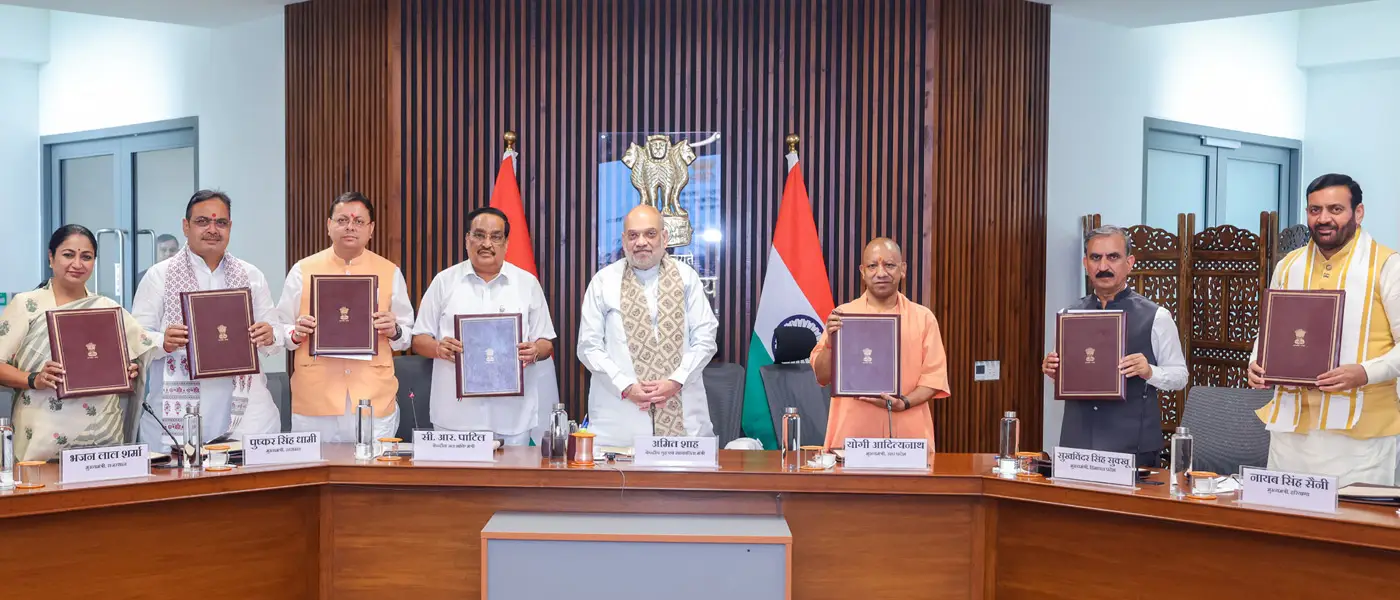
New Delhi, 16 September The Chief Ministers of Uttar Pradesh, Uttarakhand, Himachal Pradesh, Rajasthan, Delhi and Haryana put their names to the Kishau Multipurpose Project agreement in New Delhi, in the presence of the Union Home Minister and Minister of Cooperation, Amit Shah, and the Union Jal Shakti Minister, C. R. Patil. Six signatures on one page closed a file that had been open since the 1970s.
According to the Ministry of Home Affairs release of 15 September 2026, the project will build a concrete gravity dam 232.6 metres high on the Tons, the river that runs along the border of Uttarakhand and Himachal Pradesh, with a live storage capacity of 1,562 million cubic metres. It will irrigate 97,000 hectares and generate 1,476 million units of hydropower a year. The project has been declared a national project, which means the Government of India carries about 90% of the financial burden and the six partner states the remaining 10%.
Blitz recomputed the storage against the command area, and the scale becomes easier to hold in the head: about 16,100 cubic metres of water impounded behind the wall for every hectare the project will eventually irrigate. That is a reservoir built for a dry year, not an average one.
Ten disputes, ninety-seven months
The Home Minister told the meeting that this is the tenth water dispute to be settled since 2014, and he listed the road to it: Lakhwar in August 2018, Shahpur Kandi in the same month, Renukaji in the Upper Yamuna basin in 2019, an agreement between Madhya Pradesh and Uttar Pradesh in 2021. From August 2018 to September 2026 is ninety-seven months. Ten settlements in ninety-seven months is one about every nine and a half months — a rate at which a category of dispute that used to be measured in decades is now being cleared in seasons.
Shah said the most important aspect was that all six states had given their consent and signed. He described the period from 2018 to 2026 as the era in which North India’s water disputes were resolved by mutual consensus, and said Delhi would gain most from the agreement, with the Yamuna and the environment of the basin gaining alongside it.
What consent buys that an order cannot
The number that is missing from the release is the project cost, and with it the rupee value of the Centre’s 90%. Until that is published the per-hectare and per-unit cost of this water and this power cannot be worked out, and Blitz has not worked it out.
What India gains
A dam settled by agreement starts construction; a dam settled by order starts appeals. Six states that have signed have also accepted a share of the cost and a share of the water, and that is the part of the arrangement that survives a change of government in any one of them.
India-US war games expand through Yudh Abhyas
Auli, September 16 — The 22nd edition of the India-US joint military exercise Yudh Abhyas opened at the Auli Foreign Training Node in Chamoli district of Uttarakhand, with 600 personnel from each army taking part. The Ministry of Defence release states that Major General Amaresh Gunjan, General Officer Commanding, 14 Infantry Division, and Colonel Benjamin Jackman, Commander, 1st Infantry Brigade Combat Team, 11th Airborne Division of the US Army, addressed the contingents.
Two ranges, two problems
The exercise runs at Auli and at the Mahajan Field Firing Range in Rajasthan at the same time. That pairing is the design: Auli sits above 2,500 metres in the Garhwal Himalaya, Mahajan is flat desert firing country. An Integrated Battle Group that works in one does not automatically work in the other, and the release is explicit that the aim is employment of such groups in mountainous and semi-mountainous terrain, with the emphasis on infantry-dominated operations.
What India gains
For India the gain is not the drill, which is twenty-two editions old. It is the second half of that sentence. An army that has bought drones has to learn what a drone costs it in signature, in bandwidth and in the attention of the soldier holding the controller. That lesson is cheaper to take from somebody who has already paid for it.
No fee for most UPI users
New Delhi, 16 September The Ministry of Finance said on 15 September that the new UPI framework has no effect on person-to-person transactions, which remain completely free whatever the amount transferred. Payments to merchants up to ₹2,000 also stay free, as do all transactions under the zero merchant discount rate arrangement for small merchants. Taken together, the ministry said, about 96% of all person-to-merchant transactions are unaffected.
Who pays, and how much
A merchant discount rate of 0.4% applies to person-to-merchant transactions above ₹2,000. For transactions of ₹75,000 and above the charge is capped at ₹300. In essential and thin-margin sectors — railways, telecommunications, insurance, fuel and agricultural inputs — a payment above ₹2,000 attracts a flat ₹5 instead.
Work the cap out and it lands on an exact number. 0.4% of ₹75,000 is ₹300. The cap therefore binds at precisely the point it is set, and above that point the effective rate falls: 0.30% on a payment of ₹1 lakh, 0.06% on a payment of ₹5 lakh. The framework is progressive at the bottom and regressive at the top, and it was built that way.
The flat ₹5 does the same job more bluntly. On a ₹10,000 fuel or railway payment, 0.4% would be ₹40; the flat charge is ₹5, or 87.5% less. That is the ministry buying cost certainty for sectors that cannot pass a percentage on.
What the charge is not
The release is careful on one point that is usually lost in the retelling: the merchant discount rate is neither a tax nor a charge collected by the Government or by the National Payments Corporation of India. It is distributed among the participants in the payment chain — banks, payment service providers and application providers. The framework was introduced under the Payment and Settlement Systems Act, 2007, after deliberation by the UPI Steering Committee.
Small merchants, including street vendors, receiving up to ₹1 lakh a month through UPI QR codes under the person-to-person-merchant category continue to pay nothing at all. Transactions accounting for 70% of total UPI value stay outside the framework altogether.
63 skills, 70 dreams, one global arena
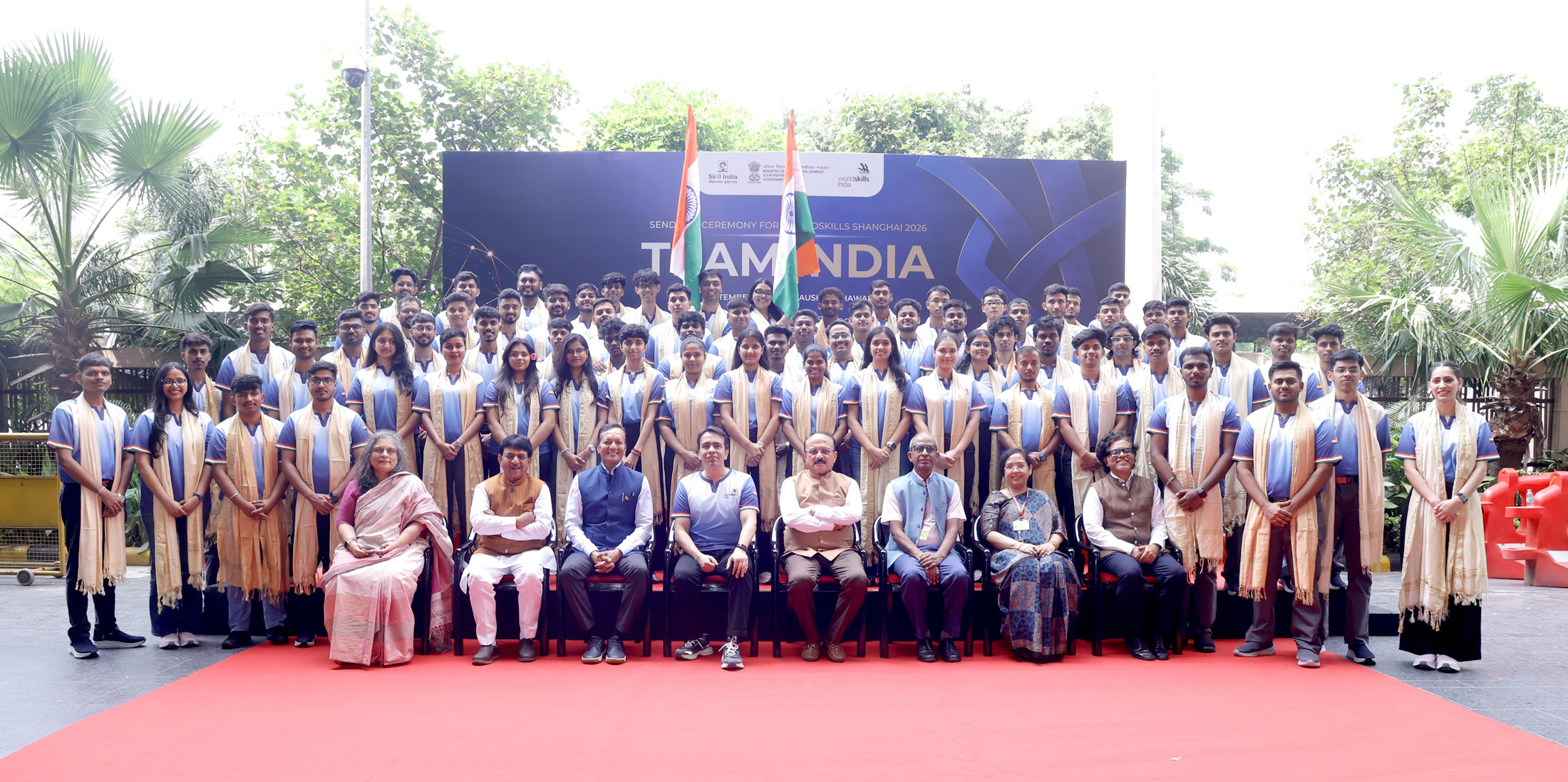
New Delhi, 16 September — The Ministry of Skill Development and Entrepreneurship sent off India’s largest-ever contingent to the WorldSkills Competition at a ceremony at Kaushal Bhawan in New Delhi. Seventy competitors will represent the country across 63 skill categories at the 48th WorldSkills Competition in Shanghai, from 22 to 27 September 2026. India will make its debut in eleven new-age and emerging categories.
Seventy names, sixty-three doors
Seventy competitors against sixty-three categories means the arithmetic is almost one to one. Seven competitors more than there are skills tells you that at most seven of the sixty-three are entered as pairs or teams; the rest is a single young Indian standing alone at a bench against the best in the world. Eleven first entries out of sixty-three is 17.5% of the contingent walking into a category India has never contested.
Jayant Chaudhary, Minister of State (Independent Charge) for Skill Development and Entrepreneurship and Minister of State for Education, told the contingent that Team India represents a confident, creative and digitally agile generation, ready to compete with the world’s best, and that participation in new-age skills reflects the growing depth of India’s skilling ecosystem. He said that at some point India must aspire to host such a global competition, and told the competitors to trust their training and compete without fear.
The send-off was attended by Kapil Dev Aggarwal, Minister of State (Independent Charge) for Vocational Education, Skill Development and Entrepreneurship in Uttar Pradesh; Ashish Sood, Minister for Home, Education, Power, Urban Development, Higher Education and Training and Technical Education in the Government of the National Capital Territory of Delhi; and Naveen Jindal, Member of Parliament and Chairman of Jindal Steel. Debashree Mukherjee, Secretary in the ministry, Dilip Kumar, Director General of the Directorate General of Training, and Arunkumar Pillai, Chief Executive Officer of the National Skill Development Corporation, were present.
Fast-forward farming begins through SPROUT
New Delhi, 16 September The SpeedSeed Phenotyping and Resource Optimization for Unified Trait Analysis facility, known as SPROUT, was inaugurated at the BRIC-National Institute of Plant Genome Research in New Delhi on 15 September 2026 by Jitendra Singh, Minister of State (Independent Charge) for Science and Technology and Earth Sciences and Minister of State in the Prime Minister’s Office.
What the facility does
SPROUT is a season-independent, controlled-environment facility built for high-throughput phenotyping, precision stress screening and the evaluation of germplasm, breeding populations, mutants, transgenic lines and genome-edited lines. Its principal crop is chickpea. The purpose is to connect advances in genomics and genome editing to precise trait evaluation, so that a gene discovered in a sequence can be tested as a trait in a plant without waiting for a season.
Why forty days is the number that matters
The minister said SpeedSeed technology can reduce the chickpea generation cycle to around 40 days. Chickpea in the Indian field is a single rabi crop: one generation a year, and a breeder who needs six generations to fix a trait needs six years. At forty days a controlled-environment cycle fits about nine times into a calendar year. The same six generations then take about eight months.
That is the whole finding, and it is worth stating plainly: the constraint on pulse breeding in India has never been the science, it has been the calendar. India imports pulses in most years. A breeding programme that can turn nine times where it used to turn once is the shortest available route out of that.
What the facility does not yet prove
A shortened generation cycle is not by itself a released variety. A line fixed in a growth chamber still has to survive multi-location field trials, still has to be notified, and still has to reach a seed chain. The release does not state how many chickpea lines are currently in the pipeline, nor the facility’s throughput in plants per cycle, and Blitz has not estimated either.
The event was attended by Manoj Prasad, Director of BRIC-NIPGR, Senthil K. Muthappa of BRIC-NIPGR, and Nitin Jain, Scientist-H at the Department of Biotechnology. The minister described the facility as part of the wider BioE3 policy, which carries climate-resilient agriculture among its strategic thematic sectors.
CAG Desk: A quiet reporting cycle
New Delhi, 16 September — No audit report of the Comptroller and Auditor General of India was tabled, and no committee report presented, in the window covered by this slot. The most recent reports carried on the Comptroller and Auditor General’s own portal are the Manipur State Finances report for 2024-25 and the Manipur General, Social, Economic and Revenue Sectors report for the year ended 31 March 2024, both dated 2 September 2026, and the Nagaland Report No. 2 of 2026 on State Finances for 2024-25 and Report No. 1 of 2026 on the Social, Economic, General and Revenue Sectors for the year ended 31 March 2024, both dated 3 September 2026.