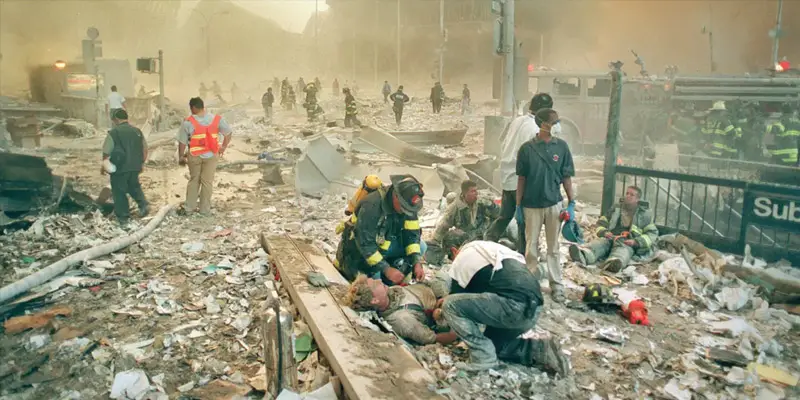
NEW DELHI: More than 1,000 people killed on September 11 in New York have yet to be identified, according to New York City’s Office of Chief Medical Examiner. Nearly 3,000 people died in the World Trade Center attacks that day.
Last month, the city announced the identity of a previously unknown victim of the terrorist attacks – the 1,654th person – using a new technology called forensic investigative genetic genealogy – or FIGG.
Since 9/11, Director of forensic anthropology in the city’s medical examiner office, Angela Soler, has sought to identify the remains of the 2,753 victims who died in the World Trade Center. So far, 60 percent of those killed have been identified.
Efforts to identify victims have been complicated by a number of factors.
Human remains were damaged in the plane crashes and fires caused by jet fuel, meaning the office had only portions of victims for DNA samples.
Because of the timing of the attacks, many firefighters were changing shifts, but some stayed to help, grabbing whatever extra gear they could find. This meant some first responders recovered were wearing uniforms with others’ names, complicating identification.
The World Trade Center site also had many more victims than the other 9/11 terrorist attack sites.
The remains of five of the 184 people killed when American Airlines Flight 77 crashed into the Pentagon were never identified because of similar conditions. According to the National Park Service, enough remains were recovered to use DNA, dental records and fingerprints to identify all 40 victims aboard United Airlines flight 93, which crashed into a field in Shanksville, Pennsylvania.
DNA testing
Remains from the World Trade Center have been packaged and sealed to help preserve DNA for testing in the years to come. Soon after the attacks, individuals were identified using fingerprints or dental records, but as time went on, when neither was available, the office turned to DNA. Officials were able to use new technology to extract DNA and retest the same remains.
DNA technology has helped the office identify 1,495 victims since 9/11 – some solely with DNA and others with multiple methods – according to the medical examiner’s office.
The new FIGG technology uses whole genome sequencing – which provides a way to read someone’s entire genetic code. It means investigators can make more potential matches to family members who are more distant relatives of the victim. Once those matches are made, the New York Police Department helps find relatives who are closer to the victims.
The medical examiner’s office in New York still gets weekly calls from loved ones asking about someone whose remains were never recovered.