Mumbai, 7 October: The Reserve Bank has done something it has not done in this cycle: it has put the cost of money up. The Monetary Policy Committee, meeting from 5 to 7 October, voted unanimously to raise the policy repo rate by 25 basis points to 5.50%, and changed its stance to “calibrated tightening”, according to the Governor’s Statement of 7 October 2026 (RBI Press Release 2026-2027/1266). The standing deposit facility rate moves to 5.25%; the marginal standing facility rate and the Bank Rate to 5.75%.
What makes the decision unusual is the company it keeps. In the same statement the Governor raised the growth projection for 2026-27 by 40 basis points, to 7.1%. A central bank that tightens while raising its growth forecast is saying the economy is strong enough to take it, and that prices, not output, are now the problem.
What India gains
A central bank willing to raise rates into a 7% growth year is protecting the thing that makes that growth usable: a rupee whose purchasing power holds. The alternative, letting a crude-driven shock seep into wages and pricing, is the path that cost India its 2010–13 decade. The statement’s own evidence of spreading inflation, the 37% diffusion figure, is the reason to act early and the reason to believe the cycle can be short.
At a glance Repo rate: 5.50%, up 25 basis points Growth 2026-27: 7.1%, a 40-basis-point upgrade CPI inflation 2026-27: 5.2%; next three quarters near 5.8% Indian crude basket: US$82.0 (July) → US$116.1 (September) Bank credit growth: 18.1% on 15 September 2026
Rs 10,000 crore SME fund gets Cabinet nod
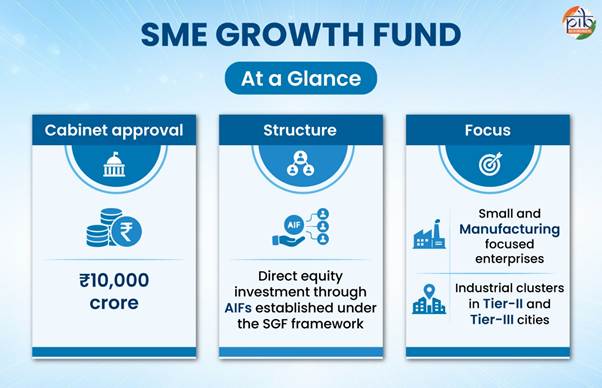
New Delhi, 7 October . The Union Cabinet on 6 October approved a government commitment of ₹10,000 crore to an SME Growth Fund, an alternative investment fund that will take direct equity in small and medium enterprises, according to the Cabinet decision issued through the Press Information Bureau (Release ID 2319532). The fund was promised in paragraph 28 of the Union Budget 2026-27.
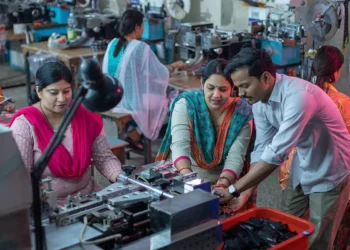
The gap it is meant to fill is specific. Existing public equity vehicles, the decision notes, mostly back early-stage and micro enterprises. A small enterprise, under the definitions in force since April 2025, has investment up to ₹25 crore and turnover up to ₹100 crore; a medium one, up to ₹125 crore and ₹500 crore. Firms of that size that want to add a plant, buy a rival or go abroad have had bank debt and little else. The majority of the fund will go to manufacturing firms, with industrial clusters in tier-II and tier-III cities named as a target.
What India gains
Growth equity is the missing rung between a bank loan and a stock exchange listing. If the fund backs even a few hundred firms to the scale at which they can export, it will have done what decades of credit schemes could not.
One master plan to reshape India’s transport network
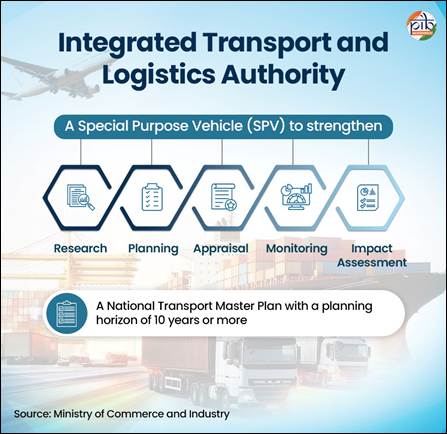
New Delhi, 7 October. India’s roads, railways, ports, airports, waterways and city transport will be planned against a single national master plan for the first time. The Union Cabinet on 6 October approved an Integrated Transport & Logistics Authority, a special purpose vehicle that will prepare a National Transport Master Plan with a horizon of ten years or more, according to the Cabinet decision (PIB Release ID 2319529).
The authority gets teeth in two places. It will carry out the technical appraisal of every Government of India infrastructure project costing ₹500 crore or more, with financial appraisal staying where it is, and it will monitor those projects after approval and assess their impact once built. It will also build a National Transport Data Repository from GSTN e-way bills, FASTag, the Vahan vehicle register, GPS feeds and urban traffic systems, so that freight flows can be read from data rather than estimated.
What India gains
Transport ministries have each planned their own network; the gaps between them are where logistics cost sits. A single appraisal of every ₹500 crore project is how those gaps get seen before the money is spent.
Telemedicine crosses 50 crore consultations
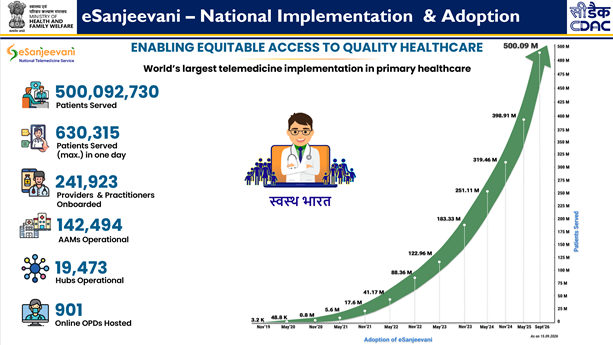
New Delhi, 7 October: India’s public telemedicine service passed 50 crore consultations on 15 September 2026, reaching 50,00,92,730 across all 36 States and Union Territories, according to the Ministry of Health and Family Welfare (PIB Release ID 2319427). The service runs through more than 1.42 lakh Ayushman Arogya Mandir spokes, 19,473 hubs and 901 online OPDs, with 2,41,923 registered providers, in 15 languages.
What India gains
A consultation that costs a bus fare and a day’s wages now costs neither. That the users skew female and older is the point: these are the people for whom the journey to a hospital was the barrier.
Rural jobs scheme expands work by 41pc
New Delhi, 7 October: The Ministry of Rural Development has notified 375 permissible works under the Viksit Bharat–Guarantee for Rozgar and Ajeevika Mission (Gramin) Act, 2025, up from 266 under the earlier framework, a rise of 41%, according to the Ministry’s notification announced on 6 October (PIB Release ID 2319426).
Photograph — place here: https://www.pib.gov.in/PressReleasePage.aspx?PRID=2319426 ·
What India gains
Wage employment that leaves behind a cold store or a market yard is employment that keeps paying after the muster roll closes.
Steel demands surges by 7.5pc as India’s growth engine stays hot
New Delhi, 7 October: India made 85.1 million tonnes of crude steel in April–September 2026, 2.9% more than a year earlier, and consumed 84.9 million tonnes of finished steel, up 7.5%, according to the Ministry of Steel’s half-year review of 6 October (PIB Release ID 2319469). Consumption outran finished-steel production of 81.8 million tonnes by 3.1 million tonnes, a Blitz calculation, and India was a net importer by volume: 4.14 million tonnes in against 3.55 million out.
What India gains
A 7.5% rise in steel use in six months is the most honest measure of construction and manufacturing in the country. The price rise is the cost of that demand, and of the import bill behind it.
Goyal courts global capital in New York
New York, 7 October: Commerce and Industry Minister Piyush Goyal met the heads of Blackstone, Neuberger Berman, General Atlantic, IBM, MetLife, AIA and The Estée Lauder Companies in New York this week, according to the Ministry of Commerce and Industry (PIB Release ID 2319908). The conversations ran to private equity, insurance under the “Insurance for All by 2047” goal, AI and quantum computing with IBM’s Arvind Krishna, and manufacturing and sourcing in India’s beauty market.
What India gains
The RBI reported this morning that net FDI in April–August was US$13.8 billion against US$9.6 billion a year ago. Meetings like these are where the next five months of that number are made.
Nainital astronomers decode a decade of OJ 287
Nainital, 7 October: A decade of nightly measurements by two dozen telescopes has produced the densest optical record ever made of OJ 287, a galaxy four billion light years away whose centre holds two supermassive black holes orbiting each other every twelve years, according to the Department of Science and Technology (PIB Release ID 2319522). The study was led by Dr Alok C. Gupta of the Aryabhatta Research Institute of Observational Sciences, Nainital, an autonomous institute of DST, and is published in The Astrophysical Journal Supplement Series, volume 286, 2026 (DOI 10.3847/1538-4365/ae8795).
OJ 287 is a blazar, a galaxy whose jet of near-light-speed plasma points at Earth, and its brightness rises in a double peak once an orbit, a pattern first recognised in 1988 from Finnish records going back to 1880. The new campaign, from 2015 to 2025, tracked the brightness and colour of the object through its most recent outburst cycle, allowing the team to fix the two black holes’ positions relative to each other at different times and to search for light from the smaller one. The DST release names 106 scientists from 18 countries and 48 institutions; the journal lists 138 authors. The two counts differ and both are reported here.
What India gains
The co-ordinating institute for a 150-year problem in astrophysics sits in Nainital.