India-Switzerland pact puts $100 billion investment
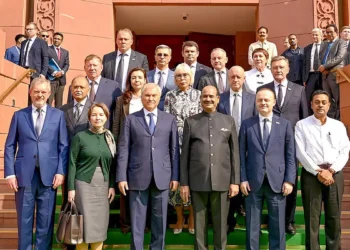
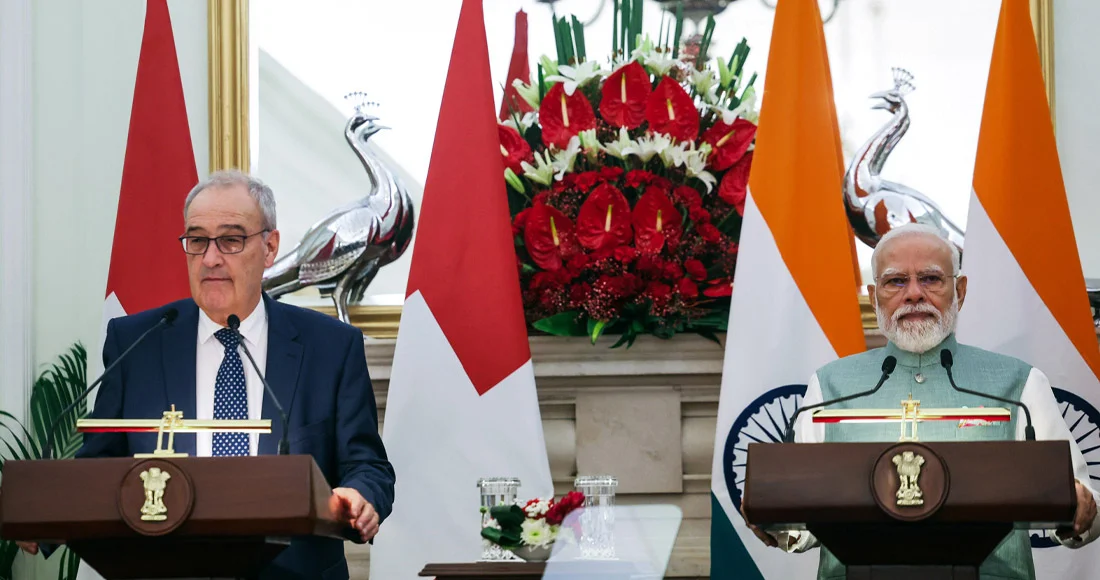
NEW DELHI, 6 October: The number that matters in the India–Switzerland visit is fifteen. That is the number of years the four EFTA countries gave themselves, in the Trade and Economic Partnership Agreement that came into force in October 2025, to bring $100 billion of investment into India and create one million direct jobs. Prime Minister Narendra Modi repeated both figures in his press statement with Swiss President Guy Parmelin at Hyderabad House on 5 October 2026, calling TEPA “India’s first FTA with any economic bloc in Europe”. Spread evenly, the pledge works out at $6.67 billion a year and 66,667 jobs a year, every year to 2040. The first of those years ends with the anniversary summit on 7 October 2026.
The transport memorandum pairs Switzerland’s Federal Department of Economic Affairs, Education and Research with India’s Ministry of Road Transport and Highways, and names electric vehicles, ropeways, tunnelling and the circular economy. The Prime Minister’s statement named the projects behind the paper: the Varanasi ropeway, the Jewar airport at Noida, mountain railways and tunnelling. President Droupadi Murmu, at the State banquet on 5 October by the Rashtrapati Bhavan release of that date, said Swiss companies “have a significant presence” in India’s roads, railway bridges and tunnels, and pointed to clean and green technology and artificial intelligence as the next areas.
At a glance
Instruments signed on 5 October 2026: 5, plus 1 announcement (Indo-Swiss Research Flagship)
Multiple-entry visa validity under the Migration and Mobility Partnership: up to 5 years, 6 months per stay
Young Professionals Exchange: 300 a year each way, expandable to 500
TEPA investment pledge: $100 billion over 15 years; direct jobs: 1 million
TEPA in force: October 2025; Prosperity Summit: 7 October 2026
What India gains
A five-year visa to Switzerland, 300 to 500 work placements a year for young Indians, and a signed route into Swiss tunnelling and ropeway engineering for Varanasi, Jewar and the mountain railways.
HAL Koraput rolls out 2,000th engine as India expands defence capacity
NEW DELHI, 6 October — At Koraput in Odisha, a factory that opened to build Soviet jet engines under licence in the 1960s hands over its 2,000th aero-engine on 6 October 2026. At Visakhapatnam, down the coast in Andhra Pradesh, a 43,500-tonne ship that will refuel warships at sea goes into the water the same day. Defence Minister Rajnath Singh presides at both, according to two Ministry of Defence press releases of 5 October 2026.
HAL’s Koraput Division has produced the R-11 and R-25 engines for the MiG-21 family, the AL-31FP that powers the Su-30MKI, and the Shakti turboshaft for HAL’s own helicopters, by the Ministry’s release of 5 October 2026. The 2,000th engine is a milestone of nearly six decades. With it the Ministry announced a second Shakti production line at Koraput, at an investment of Rs 218 crore, to meet demand from the Dhruv Advanced Light Helicopter and the Prachand Light Combat Helicopter.
What India gains
Engines and replenishment ships are the two categories India has found hardest to make at home. Koraput shows the licence route can run long enough to become a domestic industry; Visakhapatnam shows a public yard can take a 43,500-tonne first-of-class from contract to launch in about three years. Together they are the difference between a Navy that can sail and one that can stay.
At a glance
Aero-engines delivered by HAL Koraput to date: 2,000
Second Shakti engine line, investment: Rs 218 crore
Fleet Support Ships on order: 5, contract about Rs 19,000 crore, signed 25 August 2023
FSS-1 displacement: 43,500 tonnes; launched 18 months after steel cutting
Slipway-4 with 300-tonne crane: vessels up to 45,000 DWT
What India gains
A second helicopter-engine line in Odisha and a public shipyard that can now build hulls of 45,000 DWT, with 168.8 lakh man-days of work in Visakhapatnam over the life of the contract.
India, Japan open carbon-credit route under Paris Agreement
NEW DELHI, 6 October— An Indian steel mill that installs a Japanese waste-heat recovery system can now find out, step by step, how the carbon it saves becomes a credit that Japan counts against its own climate target. The Ministry of Environment, Forest and Climate Change released the Operational Manual of the India–Japan Joint Crediting Mechanism in New Delhi, by its release posted on 5 October 2026, in the presence of Japan’s Ambassador Keiichi Ono and Environment Secretary Tanmay Kumar.
The manual covers the whole project cycle: the project idea note, the approved methodologies, validation and verification, the issuance and authorisation of JCM credits, and the corresponding adjustment that stops the same tonne being counted twice. That last item is what makes this a Paris Agreement instrument under Article 6.2, rather than a voluntary offset.
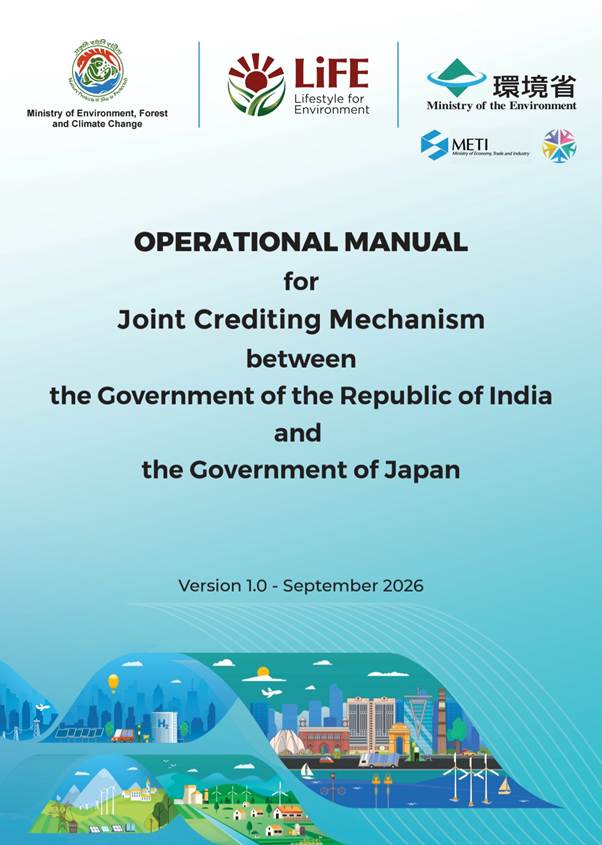
The Memorandum of Cooperation was signed on 7 August 2025, the Rule of Implementation adopted on 8 June 2026, and the manual launched on 30 September 2026, by the Ministry’s release. The mechanism, in the Ministry’s words, is to “promote the deployment of advanced low-carbon technologies, mobilise climate finance, facilitate technology cooperation and support high-integrity emission reductions and removals in India”.
What India gains
Technology that would otherwise be bought is part-financed by the buyer of the credit, and India keeps a share of the reduction for its own target. The gain is real only if the first credits are authorised quickly; a manual launched in September and a first issuance in 2028 would be a mechanism, not a market.
India finishes fourth at Asian Games
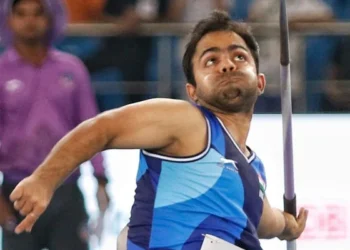
NEW DELHI, 6 October — India finished the Aichi-Nagoya Asian Games with 21 gold, 27 silver and 37 bronze medals, 85 in all, fourth in the medal table. Uzbekistan also won 21 gold; India’s 27 silvers against Uzbekistan’s 25 decided fourth place. China topped the table with 341 medals, Japan took 269 as host and South Korea 150.
The final day alone produced nine Indian medals, five of them gold, in cricket, hockey, archery and wrestling.
Prime Minister Narendra Modi, in his message of 4 October 2026 published by the Prime Minister’s Office, congratulated “all our medal winners, whose performances have brought immense joy to the nation”, and said he hoped the Games would strengthen sport at the grassroots. His office issued separate congratulations the same day to Aditi Ashok, Pranavi Sharath Urs and Diksha Dagar for the women’s team golf silver and to Antim Panghal for her wrestling silver, and on 3 October to the men’s hockey team for retaining its gold and to Aman Sehrawat for his wrestling gold.
At a glance
India, Aichi-Nagoya 2026: 21 gold, 27 silver, 37 bronze, 85 total, 4th
Final day: 9 medals, 5 gold
What India gains
A second consecutive top-four finish, and a men’s hockey title defended.
India adds record 6.05 GW wind power
NEW DELHI, 6 October — India added 6.05 GW of wind capacity in 2025-26, the most in any year, and had 58.52 GW installed by August 2026 with a further 28 GW under development, by the Ministry of New and Renewable Energy press release of 5 October 2026 announcing WinderJi India 2026. The conference and trade fair runs at the Chennai Trade Centre from 7 to 9 October, with Minister of New and Renewable Energy Pralhad Joshi inaugurating it on 8 October. About 400 exhibitors from more than 20 countries and 500 delegates attend, with national pavilions from Denmark, Germany and Spain.
The target is 100 GW by 2030. The gap from August 2026 is 41.48 GW. At the record pace of 6.05 GW a year, closing it takes 6.9 years, by Blitz arithmetic; the calendar allows a little over four..
At a glance
Wind capacity installed, August 2026: 58.52 GW
Added in 2025-26: 6.05 GW, a record
Under development: 28 GW; target for 2030: 100 GW
WinderJi India 2026: Chennai, 7–9 October; about 400 exhibitors, 20+ countries, 500 delegates
What India gains
A home market large enough to bring turbine makers from 20 countries to Chennai, and a measurable gap that tells policymakers how much faster the lines must run.
Jamnagar study links yoga and Ayurveda formulation to childhood bedwetting
NEW DELHI, 6 October — Bedwetting past the age of six is one of the commonest reasons a child is brought to a paediatrician in India, and one of the least talked about at home. A study at the Institute of Teaching and Research in Ayurveda, Jamnagar, published in the institute’s journal AYU and reported by the Ministry of Ayush on 5 October 2026, compared two groups of children aged six to 14, about 38 in all, over eight weeks. One group took Medhya Rasayan Churna, a formulation of brahmi, shankhpushpi, liquorice and giloy. The other took the same formulation and practised four asanas, Utkatasana, Ardha-Shalabhasana, Bhujangasana and Shavasana, morning and evening.
Prez Murmu begins Himachal visit
NEW DELHI, 6 October — President Droupadi Murmu begins a three-day visit to Himachal Pradesh on 6 October, as per a release of the Rashtrapati Bhavan press. On 6 October she attends the first convocation of the All India Institute of Medical Sciences at Bilaspur, the hill State’s first AIIMS, and on 7 October she visits the Atal Tunnel at Rohtang in Lahaul-Spiti, the road tunnel that keeps the Lahaul valley open through winter. A first convocation is the moment a new medical college becomes a producer of doctors rather than a building; for Himachal, which sends its serious cases to Chandigarh, that is the gain.
BHAVYA- Rasayan opens race for three chemical parks
NEW DELHI, 6 October— The BHAVYA-Rasayan scheme that the Cabinet approved on 24 July 2026, by the Prime Minister’s Office release of that date, is open for proposals. The scheme funds three chemical parks of at least 8 square kilometres each, with up to Rs 1,000 crore from the Centre per park and at least Rs 500 crore from the host State, out of a total outlay of Rs 3,030 crore over the five years to 2030-31. States compete for the parks through a challenge route; the Centre’s money goes into common effluent treatment, water, pipelines, steam and logistics, not into factories.