NEW DELHI: We will all remember Prime Minister Narendra Modi for some individual reason. I will do so because I spent my childhood in Telinipara, a small hamlet which became a dot on the industrial map of Bengal because a few Scotsmen from Dundee decided that it made more financial sense to convert raw jute into gunny on the western bank of the Hooghly river before it could be exported to Britain as a breathing container for grain or a sandbag on the self-destructive battlefields of 19th-century Europe.
Telinipara was a byproduct of the Victoria Jute Mill, whose machines began to hum in 1884, a splatter of mud huts for immigrant workers from deprived villages in Bihar.
Thanks to my grandfather, who arrived destitute from Hajipur but had the wits to become a guardian of the community, we were not poor, but every neighbour and every local friend was. There were days on which mothers gave children a meal of watery rice, not because it was on some epicure’s list but because they could not afford dal.
The first shift at the jute mill began in the deep dark of 4AM; and once the men had crossed the imposing iron gates of the factory, women engrossed in low chatter would walk towards the large field by the river to find a corner for their ablutions, sitting in a row. Everyone was illiterate.
The only schools in the vicinity were a Bengali-medium Government primary in Bhadreshwar, and an English-medium Catholic convent in the French trading outpost of Chandernagore upriver. The distance was only a few miles, but they belonged to another world.
The Bengal famine
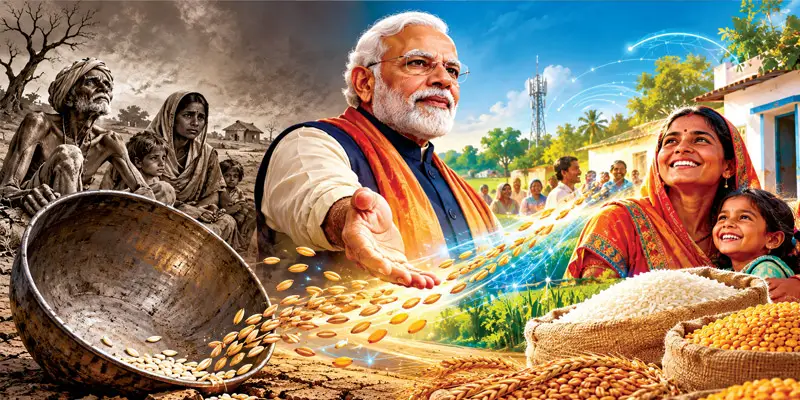
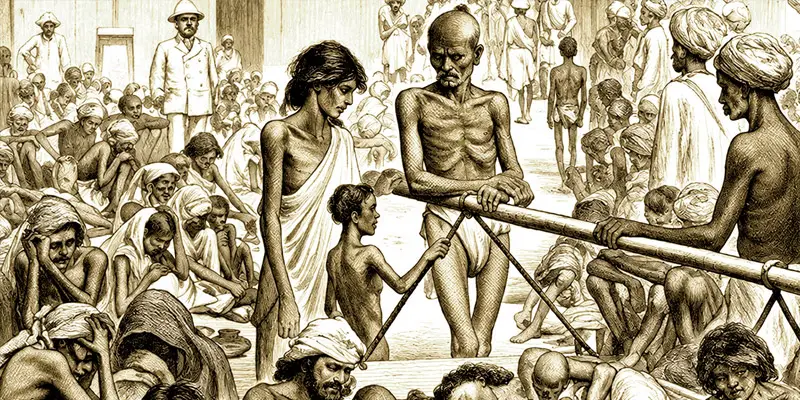
Bengal had lost millions in the famine of 1943, the last gift of the British Empire to the people who made the British a rich power. The 1950s were the age of hunger in India. Famine was recurrent. In the winter of 1966-67, just out of school and waiting for college to begin, always eager to earn some spending money from writing, I went to Ranchi to do a report on long lines of starving villagers getting a slosh of something from buckets: famine relief nourishment, available once every 24 hours.
In 1972, now ensconced in the Illustrated Weekly of India, then edited by the iconic Khushwant Singh, I was sent to Aurangabad to cover famine. It became a Cover Story. The cover image showed women breaking stones in the heat of noon for one or two rupees a day. Hunger money.
The journey of free India into the future began in 1947 with more than 70 per cent of the population of 350 million living below the poverty line. The average life expectancy was 32 years, since death at childbirth was common. Only about 15 per cent were literate. Statistics are the cold index of pain. By 2013-14 this figure had come down to 29.17 per cent. Convert that into life. That meant over 300 million Indians. Change the perspective; in absolute numbers, despite the great amelioration in life at the subsistence level, as many Indians were sunk in dire poverty in 2014 as there were in 1947.
Every Prime Minister of India has tried to lift the curse of poverty, but no prime minister put the passion into poverty elimination that Narendra Modi did in his first speech from the Red Fort in 2014, a compelling demand upon the conscience of India to remove the curse from our destiny, to remember the pain that coursed the mind and body of women as they waited for the darkness of pre-dawn and the dusk of post-sunset, to think of the blank faces of children whose stomachs protruded because they were empty and limbs were diseased because there was no medicine.
Anguish of experience
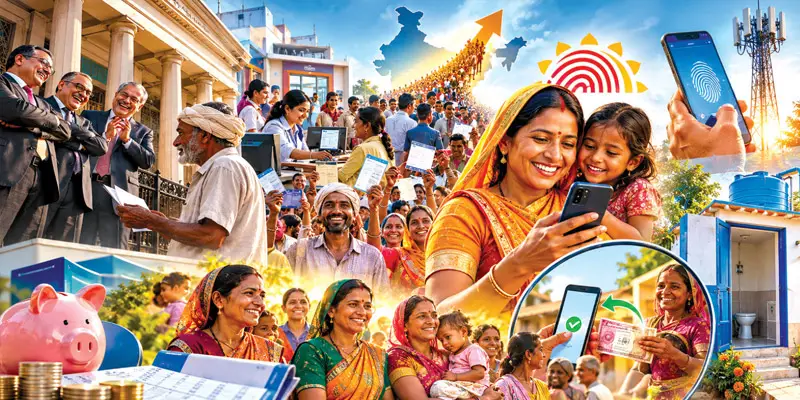
The powerful flow of words from the ramparts on August 15, 2014 was sourced in the anguish of experience. The questions of 2014 were answered in 2015. Some Opposition leaders filled the airwaves with sarcastic shrieks when banks, till then the exclusive preserve of those with money, were opened to those without. They laughed at the concept of zero-balance accounts, until there were 500 million such accounts and the foundations of fiscal empowerment were laid through a home for direct benefit schemes. Women became primary beneficiaries, for they are better guardians of family welfare than men. A nationwide drive for toilets restored dignity to their lives. Aadhaar and the mobile were instruments of an economic revolution.
The range of empowerment policies is a long paean to rapid change. The crisis of Covid became an opportunity. Wheat, rice and dal are now a fundamental right of over 800 million Indians, making this policy the largest welfare scheme in history.
The range of empowerment policies is a long paean to rapid change. The crisis of Covid became an opportunity. Wheat, rice and dal are now a fundamental right of over 800 million Indians, making this policy the largest welfare scheme in history
The economic empowerment of the underprivileged through technology will be recognised as one of the great success stories of the first quarter of the 21st century. Technology could so easily have remained a middle-class phenomenon. Today mobile technology is part of every life, filling the requirements of need, information and entertainment. It is human to take change for granted, but this was not just another stride forward; this was a quantum leap.
Foundations laid
It would be fatuous to suggest that our present stage of economic growth, or even the statistical fact that our growth is among the highest among relevant world economies, has met the aspirations or even demands of the young. We might take some comfort in one visible fact. In 1947 and 1950, when India began to plan for a future, the hope of prosperity seemed an impossible dream. Today, that helplessness has been replaced by the angst of partial achievement. The young have always had the right to demand more. But the virtual elimination of poverty, estimated now by the World Bank to be below 2 per cent, has given us the right to claim that the foundations have been laid for a benevolent state in which dreams are not the sole privilege of the elite.
Food is the most visceral fact of poverty because it is existential, but it is not the only dimension. A nation can never find its way if its course is blocked by poverty of the mind. Knowledge is also a fundamental right. The quality of our schools is uneven. There is much that remains to be done in the vast spaces that are rural India; nor is urban Indian education without its ills. There will be purists who sniff at what might be called school-factories, or the profit-driven elitism that has also emerged. But all reality is surely comparative. The state is a vital component of change, but it cannot be the only engine towards the horizon. A sensible compromise has been effected in medical care through an expanding insurance system. We are amid vast change; and every report that concentrates on what has not been built must find space for what has been constructed.
The judicious historian is an authoritarian, unsentimental judge. They do not waste time on pleasantries, for they write for the record rather than reward. Every balance sheet of the decades since 1947 will have its assets and liabilities, its profit and loss. Perhaps there should be a special column for missed opportunities. But perhaps there will be no dispute when it is recorded that the decade between 2015 and 2025 witnessed the march of modern India from the area of dark hunger to the promise of a nation that had found its way.
The virtual elimination of poverty, estimated now by the World Bank to be below 2 per cent, has given us the right to claim that the foundations have been laid for a benevolent state in which dreams are not the sole privilege of the elite