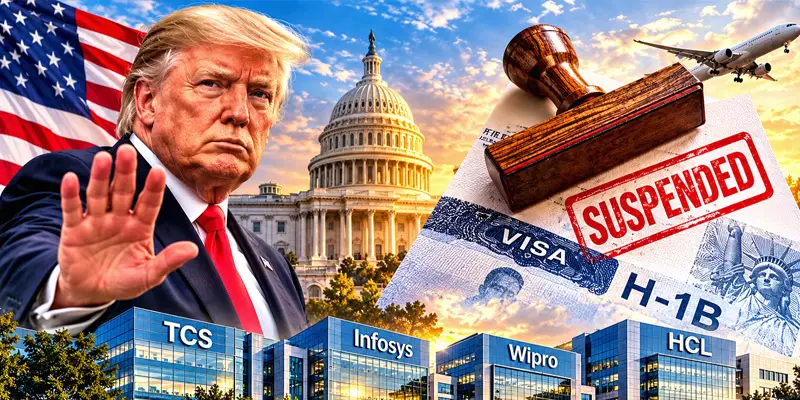
NEW DELHI: The US Government led by President Donald Trump has suspended several major technology and IT outsourcing companies, including Microsoft, Cognizant, Infosys, Tata, Wipro, HCL, Capgemini, and Adobe, from the US government’s Permanent Labour Certification Programme, or PERM, a key step in the process of obtaining employment-based green cards for foreign workers, including many H-1B visa holders.
Vice President JD Vance and the head of the US Anti-Fraud Task Force as well as Labour Secretary Keith Sonderling announced the move accusing companies of misusing employment-visa programmes and taking jobs away from American workers.
The administration said the suspension followed an ongoing investigation into the companies’ use of the visa system. Vance said the government had decided to suspend the participation of these companies in PERM programme.
“Thanks to an ongoing investigation, we have decided to suspend the PERM program for Microsoft, which means they will no longer be able to take those H1-Bs and apply for permanent resident status within the United States of America,” Vance said in a post on X.
The vice president also accused Microsoft of using foreign workers in a way that undercut US wages and displaced American employees.
“There has been no company in the United States, unfortunately, that has abused the system more than Microsoft,” Vance said at a White House news conference.
He accused Microsoft of using the system to replace American workers with foreign employees. The Associated Press reported that Vance pointed to Microsoft’s layoffs and its use of H-1B visas as evidence of what he described as abuse of the system.
“If you do the math, for every worker that Microsoft laid off, they replaced that worker with one and a half foreign indentured servants,” Vance said.
“Since 2009, just these companies alone have requested almost three million foreign workers. They’ve received over 230,000 H-1B visa approvals and over 100,000 permanent labour certifications,” said US Labour Secretary Keith Sonderling.
Labour steps in too
The US Department of Labour said it was suspending the companies from PERM, amid investigations and allegations of fraud. US Labour Secretary Keith Sonderling said the department was suspending some of the world’s largest IT outsourcing companies from the programme.
Along with Microsoft, Adobe has also been suspended from PERM processing, with the Labour Department citing multiple active federal investigations in their cases.
PERM is a key part of the US employment-based immigration process. It allows US employers to seek labour certification for eligible foreign workers as part of the process of sponsoring them for permanent residency, or green cards.
“We will not accept any new or process any pending permanent labour certification applications involving these companies,” Sonderling said.
Reuters reported that the administration cited alleged fraud and said the action was part of a broader push to make companies hire more American workers.
Microsoft did not immediately responded to requests for comment, Reuters and Associated Press reported.
Sonderling said the companies named by the administration had collectively sought large numbers of foreign workers over the years.
“Since 2009, just these companies alone have requested almost three million foreign workers. They’ve received over 230,000 H-1B visa approvals and over 100,000 permanent labour certifications,” he said.
The Department of Labour describes permanent labour certification as allowing an employer to hire a foreign worker to work permanently in the United States.
The suspension, therefore, affects the green-card pathway, rather than automatically cancelling an employee’s H-1B visa.
That distinction is important for thousands of foreign technology workers. An H-1B is a temporary work status for specialised occupations, while PERM is linked to the process of obtaining permanent employment and, ultimately, a green card.
Why this matters for Indian IT workers
The action has particular significance for Indian technology professionals because major Indian IT companies such as Infosys, Tata, Wipro and HCL have substantial operations in the US and employ workers through the country’s skilled-worker immigration system.
The H-1B programme is particularly important to Indian professionals. AP reported that technology companies are the biggest users of H-1B visas, with nearly three-quarters of approvals going to workers from India.
In September, the US had suspended Cognizant’s PERM filings amid a federal investigation into alleged fraud involving employment-visa programmes, a move that raised concerns among Indian technology workers seeking employer-sponsored green cards.
Now, the inclusion of Infosys, Tata, Wipro and HCL, alongside Microsoft, Adobe, Cognizant and Capgemini, brings several of the industry’s biggest employers under the latest PERM restrictions.
Does this mean H-1B visas are suspended?
No. The announcement does not amount to a blanket cancellation of H-1B visas for employees of the affected companies.
The immediate action concerns new and pending PERM labour-certification applications involving the named companies. The eventual effect on individual workers will depend on where their employment-based immigration case is in the green-card process.
The PERM action comes as the Trump administration steps up scrutiny of foreign-worker and international-student programmes.
The Department of Homeland Security has proposed a $70,000 fee for international students participating in the Optional Practical Training programme, according to AP. OPT allows eligible international students to work in jobs related to their field of study during or after their education in the US.
The Labour Department has also launched investigations involving universities. Reuters reported that nine universities, including Harvard, Yale and Stanford, are being investigated over allegations involving international students and wages, with subpoenas issued by the department’s inspector general.