Blitz Bureau
NEW DELHI: India registered 3,27,901 electric vehicles in July, a record, and 66 per cent more than a year earlier. The headline belongs to the scooter. The transition that has actually finished belongs to the three-wheeler.
Dealer registration data for July show electric vehicles accounting for close to one in every eight vehicles sold in India. Electric two-wheelers crossed two lakh units in a single month for the first time, taking an 11.2 per cent share against 10.6 per cent in June and 7.7 per cent in July last year. That is the number that will be quoted. The number that deserves more attention sits one segment below it: electric three-wheelers took 65.1 per cent of their market in July, up from 62.7 per cent in June and 60.3 per cent a year ago. In the three-wheeler segment the question is no longer whether India will electrify. It is what share the remaining petrol and CNG models will hold before they stop being made.
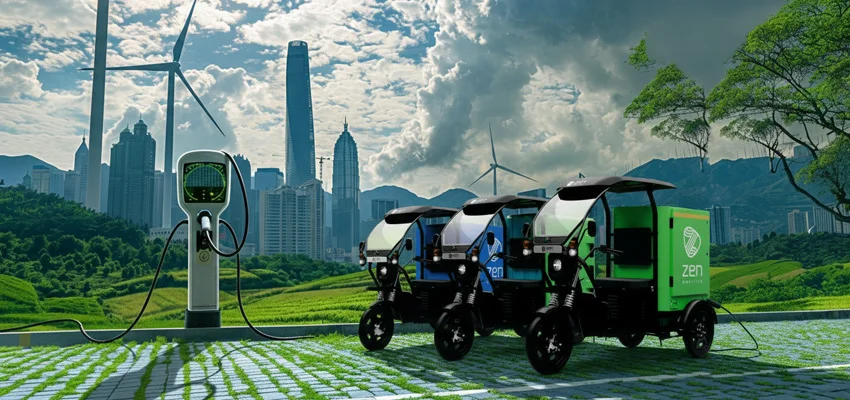
Where the switch already happened: almost two of every three three-wheelers registered in July were electric.
The country did not wait for a policy to electrify its three-wheelers. It waited for the fuel bill to make the arithmetic obvious.
At a Glance
• Total EV registrations, July 2026: 3,27,901 — a record
• Growth: up more than 66 per cent year on year
• Share of all vehicles sold: close to one in eight
• Electric two-wheelers: above 2 lakh units for the first time; 11.2 per cent share (10.6 in June, 7.7 a year ago)
• Electric three-wheelers: 65.1 per cent share (62.7 in June, 60.3 a year ago)
• Electric commercial vehicles: 3.57 per cent share, from 1.65 a year ago
• Source of data: dealer registrations, Federation of Automobile Dealers Associations
The reason the three-wheeler went first is economic rather than environmental, and understanding it explains where the rest of the market goes next. A three-wheeler in commercial use covers a high, predictable daily distance over a short, predictable route, and it is bought by an owner-driver for whom fuel is the largest single operating cost. That combination — high utilisation, fixed route, fuel-sensitive buyer — is precisely the profile in which a higher purchase price is repaid fastest. The same logic is now visible in commercial vehicles, where the electric share more than doubled in a year to 3.57 per cent from 1.65. It applies least to the private car, which sits idle most of the day and is bought on considerations other than running cost. That, and not charging anxiety alone, is why the passenger car remains the slowest segment to switch.
Read against the day’s other news, the sequencing looks less like an accident. Every electric three-wheeler on an Indian road is a small, permanent subtraction from a crude import bill that reached $49.8 billion in a single quarter. The constructive challenge now is the unglamorous middle of the system rather than the vehicle: battery cells still largely imported, a charging network that thins out sharply beyond the metros, and a second-hand market with no accepted way to value a used battery. Fix the resale valuation problem in particular and the private buyer’s arithmetic changes overnight, because the largest unknown in owning an electric car in India today is not what it costs to run. It is what it will be worth in five years.