• About us
  • Team
  • Privacy Policy
  • Contact
Sunday, September 6, 2026
  • Login
No Result
View All Result
World's first weekly chronicle of development news
  • Blitz Highlights
    • Special
    • Spotlight
    • Insight
    • Entertainment
    • Sports
  • Opinion
  • Legal
  • Perspective
  • Nation
    • East
    • West
    • North
    • South
  • Business & Economy
  • World
  • Hindi Edition
  • International Editions
    • Dubai
    • Tanzania
    • United Kingdom
    • USA
  • Blitz India Business
  • Blitz Highlights
    • Special
    • Spotlight
    • Insight
    • Entertainment
    • Sports
  • Opinion
  • Legal
  • Perspective
  • Nation
    • East
    • West
    • North
    • South
  • Business & Economy
  • World
  • Hindi Edition
  • International Editions
    • Dubai
    • Tanzania
    • United Kingdom
    • USA
  • Blitz India Business
No Result
View All Result
World's first weekly chronicle of development news
No Result
View All Result

288 Gigawatts and the Harder Half: Why India’s Energy Transition Now Turns on Storage, Not Panels

by Blitz India Media
July 27, 2026
in Energy, News
0
solar

Blitz Bureau

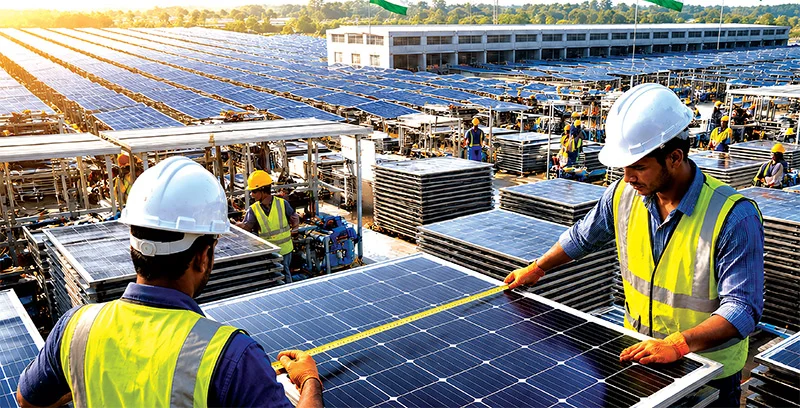
NEW DELHI: India’s installed renewable energy capacity reached 288.58 GW as of June 30, 2026, up from 76.38 GW in 2014. Adding 8.78 GW of nuclear power, total non-fossil electricity capacity stands at 297.36 GW. Solar leads with 162.15 GW — a fifty-seven-fold increase from 2.82 GW in 2013-14 — followed by wind at 57.44 GW, large hydro at 57.24 GW and bio power at 11.75 GW. In the first half of 2026 alone, India added 30.6 GW of renewable capacity, a 25% year-on-year increase, with solar additions up 43%.

Those numbers describe a genuine industrial achievement, and they also mark the point at which the transition changes character. Building generation capacity was the first problem, and India has largely solved it: panels became cheap, auctions became competitive, and the country now installs solar at a pace few nations match. The second problem is different in kind. Solar generates when the sun is up; demand in India peaks after dark, when air conditioners, lights and cooking loads arrive together. A grid with 162 GW of solar and insufficient storage does not have surplus power. It has surplus power at the wrong time of day.

The generation problem is being solved: Renewable capacity stood at 288.58 GW on June 30, with solar at 162.15 GW and 30.6 GW added in the first half of 2026 alone. The next constraint is when that power is available, not how much of it there is.

India has learned to make electricity from sunlight faster than almost anyone. The remaining question is a smaller and stubborner one: where does it keep the evening?

The Long View

• Renewables: 288.58 GW installed as of June 30, 2026 (76.38 GW in 2014)
• Non-fossil total: 297.36 GW, including 8.78 GW nuclear
• Mix: solar 162.15 GW · wind 57.44 GW · large hydro 57.24 GW · bio 11.75 GW
• Momentum: 30.6 GW added in H1 2026, up 25%; target of 500 GW non-fossil by 2030

The structural constraints deserve to be named without pessimism, because each has a known remedy. Storage capacity — batteries, pumped hydro, and the market design that pays for both — lags generation by a wide margin. Transmission has to be built where the sun and wind are, which is often not where the factories are, and a line takes longer to permit than a solar farm takes to build. Distribution utilities in several states remain financially strained, which affects their ability to sign long-term contracts at scale. And a grid running on variable sources needs far more sophisticated forecasting and balancing than one running on coal.

The way forward is now well mapped, and India is already moving along it. Pumped-storage projects use terrain the country has in abundance and last for decades. Battery storage costs are falling on the same curve solar did, and domestic cell manufacturing under production-linked incentives will shorten that supply chain. Time-of-day tariffs shift flexible demand — irrigation pumps, industrial processes, EV charging — into the solar hours, which is the cheapest storage of all because it requires no hardware. Transmission corridors built ahead of demand cost more upfront and far less in curtailed power later. India’s first act in this transition was to prove it could build clean generation at extraordinary speed. The second act, less photogenic and more decisive, is to make sure every one of those 288 gigawatts is available at seven in the evening.


Related Posts

Electronics production grows seven-fold : MeitY
News

Numbers of the Week

September 6, 2026
Puga Valley Geothermal Project
News

Puga Valley Geothermal Project: India’s First Wells Find 135°C Heat

September 6, 2026
India Investment and Consumption Growth Q1 FY2026-27
News

India Investment and Consumption Growth Q1 FY2026-27

September 6, 2026
Maharashtra Vulture Conservation Project
News

Maharashtra Vulture Conservation: 78% Survival in Tiger Reserves

September 6, 2026
GDP
News

The Quarter India Started Building Again

September 6, 2026
Growth
News

The Sector Diary — Eighteen Fields, Seven Days

September 6, 2026
Load More
Next Post
Dhamaal 4 Box Office

Two Films, Two Languages: July's Box Office Belongs to a Comedy and a Tamil Blockbuster

Recent News

Electronics production grows seven-fold : MeitY
News

Numbers of the Week

by Blitz India Media
September 6, 2026
0

7.8% Real GDP growth, Q1 (April–June) of FY 2026-27, against 6.9 per cent a year earlier — real GDP of...

Read moreDetails
Puga Valley Geothermal Project

Puga Valley Geothermal Project: India’s First Wells Find 135°C Heat

September 6, 2026
India Investment and Consumption Growth Q1 FY2026-27

India Investment and Consumption Growth Q1 FY2026-27

September 6, 2026
Maharashtra Vulture Conservation Project

Maharashtra Vulture Conservation: 78% Survival in Tiger Reserves

September 6, 2026
GDP

The Quarter India Started Building Again

September 6, 2026

Blitz Highlights

  • Special
  • Spotlight
  • Insight
  • Entertainment
  • Health

International Editions

  • US (New York)
  • UK (London)
  • Middle East (Dubai)
  • Tanzania (Africa)

Nation

  • East
  • West
  • South
  • North
  • Hindi Edition

E-paper

  • India
  • Hindi E-paper
  • Dubai E-Paper
  • USA E-Paper
  • UK-Epaper
  • Tanzania E-paper

Useful Links

  • About us
  • Team
  • Privacy Policy
  • Contact

©2024 Blitz India Media -Building A New Nation

Welcome Back!

Login to your account below

Forgotten Password?

Retrieve your password

Please enter your username or email address to reset your password.

Log In

    No Result
    View All Result
    • Blitz Highlights
      • Special
      • Spotlight
      • Insight
      • Entertainment
      • Sports
    • Opinion
    • Legal
    • Perspective
    • Nation
      • East
      • West
      • North
      • South
    • Business & Economy
    • World
    • Hindi Edition
    • International Editions
      • Dubai
      • Tanzania
      • United Kingdom
      • USA
    • Blitz India Business

    ©2024 Blitz India Media -Building A New Nation