• About us
  • Team
  • Privacy Policy
  • Contact
Thursday, August 6, 2026
  • Login
No Result
View All Result
World's first weekly chronicle of development news
  • Blitz Highlights
    • Special
    • Spotlight
    • Insight
    • Entertainment
    • Sports
  • Opinion
  • Legal
  • Perspective
  • Nation
    • East
    • West
    • North
    • South
  • Business & Economy
  • World
  • Hindi Edition
  • International Editions
    • Dubai
    • Tanzania
    • United Kingdom
    • USA
  • Blitz India Business
  • Blitz Highlights
    • Special
    • Spotlight
    • Insight
    • Entertainment
    • Sports
  • Opinion
  • Legal
  • Perspective
  • Nation
    • East
    • West
    • North
    • South
  • Business & Economy
  • World
  • Hindi Edition
  • International Editions
    • Dubai
    • Tanzania
    • United Kingdom
    • USA
  • Blitz India Business
No Result
View All Result
World's first weekly chronicle of development news
No Result
View All Result

Nineteen Lakh Homes, and a Zero Bill

by Blitz India Media
August 6, 2026
in Energy, News
0
solar-rooftop

Blitz Bureau

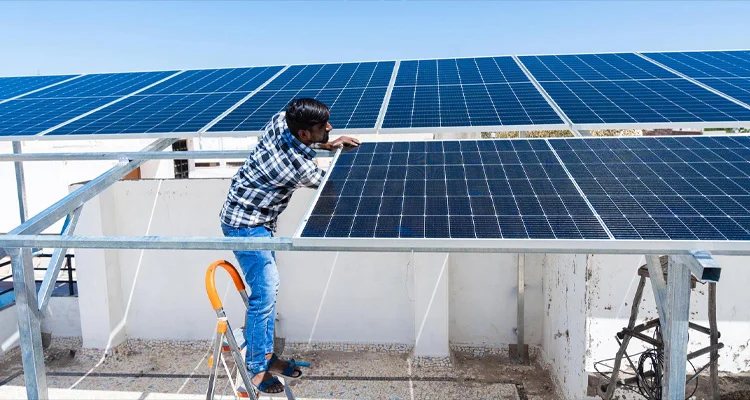
NEW DELHI: PM Surya Ghar: Muft Bijli Yojana has crossed 50.06 lakh rooftop solar installations. The number that explains what changed is not that one — it is the 7.94 lakh installed in the ten years before the scheme began. Two years have delivered more than six times what a decade did. That is not a trend accelerating; that is a different mechanism.

The month-by-month figures show where the inflection sits. Daily installations ran at 5,038 in October 2025. In July 2026 they averaged 16,328 — a rate 3.2 times higher in nine months, and a July total of 5.06 lakh households, the highest single month the programme has recorded. At that pace India is adding one lakh solar-equipped homes every six days. Roughly 19 lakh households now receive an electricity bill of zero. Another 12 lakh have earned about ₹421 crore between them by exporting the power they did not use.

The asset and the income: a household rooftop array stops being only a saving the moment surplus units flow the other way through the meter. Twelve lakh homes have now been paid for that surplus.

A subsidy that buys a panel is spending. A subsidy that turns a roof into a small generator selling power back to the grid is something else entirely.

At a Glance

• Installations: 50.06 lakh households, crossed in early August 2026
• The comparison: 7.94 lakh rooftop installations in the preceding ten years
• Best month: July 2026, 5.06 lakh households added
• Daily rate: 5,038 in October 2025 rising to about 16,328 in July 2026 — 3.2 times in nine months
• Current pace: one lakh beneficiary households every six days
• Zero-bill households: nearly 19 lakh
• Surplus sold: about ₹421 crore earned by roughly 12 lakh households
• Subsidy disbursed: ₹28,024 crore, paid by direct benefit transfer
• Scheme outlay: ₹75,021 crore

The design choice worth understanding is the one that made the queue move. Rooftop solar failed in India for a decade not because households did not want it but because the transaction was hard: a homeowner had to find a vendor, verify the equipment, apply to the distribution company for a net-metering connection, wait for an inspection, and only then hope the subsidy arrived. Each of those steps was a place to give up. What the present scheme did was collapse them into one portal and put the subsidy on direct benefit transfer, so the money reaches the applicant’s account rather than the vendor’s invoice. ₹28,024 crore has now moved that way. When a process with six exit points becomes a process with one, the adoption curve does not improve — it changes shape.

The honest challenge is what comes after the panel. A rooftop system is a thirty-year asset installed by a young industry, and the constraint is shifting from installation to everything around it: trained technicians for maintenance in small towns, distribution companies whose billing systems must credit exported units accurately and on time, and financing for the households who still find the up-front balance difficult even after the subsidy. The constructive reading is that each of these is a capacity problem rather than a policy one, and capacity follows volume — 50 lakh installed systems is precisely the base that makes a service industry viable. For a reader with a roof and a south-facing slope, the practical point is smaller and more immediate: the subsidy is paid to the applicant, not the installer, and the application is the same one whether the house is in Surat or in Siwan.

Related Posts

The Kigali Convention Centre in Rwanda
News

Three Metals India Cannot Make Itself

August 6, 2026
A university academic building in India
News

Thirty-Two Universities That Do Not Exist

August 6, 2026
tajmahal
News

The Location Becomes the Itinerary

August 6, 2026
ISRO plans seven space missions this financial year while advancing Gaganyaan with key crew-module qualification tests and new space technologies.
News

Nine Swerves in Seven Months

August 6, 2026
hospital
Health

Twenty-Two Children, and a Vector Still Unnamed

August 6, 2026
Ashwini Vaishnaw
News

Rlys utilises 39 pc of FY27 capex spent till July

August 5, 2026
Load More
Next Post
hospital

Twenty-Two Children, and a Vector Still Unnamed

Recent News

The Kigali Convention Centre in Rwanda
News

Three Metals India Cannot Make Itself

by Blitz India Media
August 6, 2026
0

Blitz Bureau NEW DELHI: India and Rwanda held the first session of their Joint Trade Committee in New Delhi at...

Read moreDetails
A university academic building in India

Thirty-Two Universities That Do Not Exist

August 6, 2026
tajmahal

The Location Becomes the Itinerary

August 6, 2026
ISRO plans seven space missions this financial year while advancing Gaganyaan with key crew-module qualification tests and new space technologies.

Nine Swerves in Seven Months

August 6, 2026
hospital

Twenty-Two Children, and a Vector Still Unnamed

August 6, 2026

Blitz Highlights

  • Special
  • Spotlight
  • Insight
  • Entertainment
  • Health

International Editions

  • US (New York)
  • UK (London)
  • Middle East (Dubai)
  • Tanzania (Africa)

Nation

  • East
  • West
  • South
  • North
  • Hindi Edition

E-paper

  • India
  • Hindi E-paper
  • Dubai E-Paper
  • USA E-Paper
  • UK-Epaper
  • Tanzania E-paper

Useful Links

  • About us
  • Team
  • Privacy Policy
  • Contact

©2024 Blitz India Media -Building A New Nation

Welcome Back!

Login to your account below

Forgotten Password?

Retrieve your password

Please enter your username or email address to reset your password.

Log In

    No Result
    View All Result
    • Blitz Highlights
      • Special
      • Spotlight
      • Insight
      • Entertainment
      • Sports
    • Opinion
    • Legal
    • Perspective
    • Nation
      • East
      • West
      • North
      • South
    • Business & Economy
    • World
    • Hindi Edition
    • International Editions
      • Dubai
      • Tanzania
      • United Kingdom
      • USA
    • Blitz India Business

    ©2024 Blitz India Media -Building A New Nation