Blitz Bureau
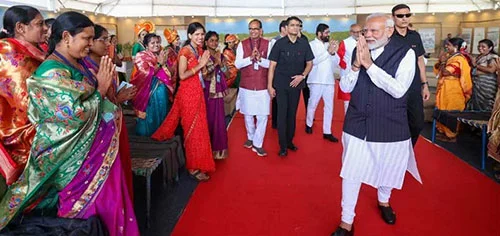
NEW DELHI: FOR the poet, it was a metaphor: the child was father of the man. For India’s Prime Minister, it was reality. There is evidence that Prime Minister Narendra Modi, born into deprivation at a time when British colonialism had ravaged the Indian economy and impoverished the people, when memories of millions dead from starvation in the Bengal Famine were part of lived experience, when the poor had been driven to a primitive existence, was motivated by the deep anguish of the poor he witnessed as a child to make their economic emancipation a central motif of his Government. The evidence lies, quite explicitly for those who can listen without bias, in his first speech from the ramparts of the Red Fort in Delhi.
Speeches are integral to democracy but marginal to public memory. Truth be told, even the most important public speech of the year, delivered by prime ministers on our Independence Day, begins to fade more quickly than we might imagine. But one recent speech can lay claim to that overused adjective ‘great’.
Personal dimension
On August 15, 2014, Prime Minister Modi lifted the narrative from the banal recitation of bureaucratese into oratory by infusing his vision of governance with a personal dimension. In a remarkable departure from convention, he dwelt on the pain of harsh and relentless poverty. He described the anguish of women, of aunts and relatives who suffered the fever of hidden toxins coursing through their bodies because they did not have a toilet at home and therefore had to wait till sunset.
He described the torture that was embedded in normalcy. That speech should be easily accessible from the inexhaustible archives of the internet. The Prime Minister then initiated, immediately, a dramatic shift in the priorities of Government which transformed the lives of the destitute, and particularly of women. Improving the life of the poor became a national mission. The absence of toilets was not a secret. But no one had made it a compulsive and compulsory priority because governance had been in the control of those who have toilets.
Sanitation, electricity, health insurance, bank accounts, and easy bank loans without collateral: they were not just another set of promises chained to a Government file. They became the signature tune of an inclusive India. Opposition voices laughed when Modi announced that millions of poor Indians who had never stepped across the doors of a bank before would get accounts through the Jan Dhan Yojana on August 15, 2014. Fifteen million accounts were opened on the first day of the scheme. The number went far beyond 300 million by the end of his first term.
A humanist’s eye
The most exceptional advance was through the digital empowerment of the poor. Technology was implicitly viewed as a middle-class asset. That changed. In a collateral benefit, the size of the Indian market has kept the price of personal technology affordable.
Numbers are an economist’s crutch but they tell some part of the story. When British imperialism dug its fangs into India with control of Bengal in the 1750s and 1760s, India had about 30 per cent of world trade; China’s share was a little higher; Britain had an estimated two per cent. By 1947 the figures had been reversed. The consequence: in 1947, 70 per cent of the population, or about 250 million Indians, lived below the poverty line.
The Rangarajan Committee estimated that in 2014, 38.2 per cent of the population, or over 454 million people, were still living below the poverty line. If you look at these figures with the eyes of a humanist rather than the perspective of an economist, 200 million more Indians were suffering from harsh poverty in 2014, when Narendra Modi became Prime Minister, than in 1947.
A few weeks ago the World Bank provided the latest statistics. The number of Indians living below the poverty line by 2023 had dipped to 2.8 per cent, despite the change in PPP (Purchasing Power Parity) from $2.15 to $3. Commentators were barely able to hide their astonishment noting that this had happened despite the shock of Covid.