Blitz Bureau
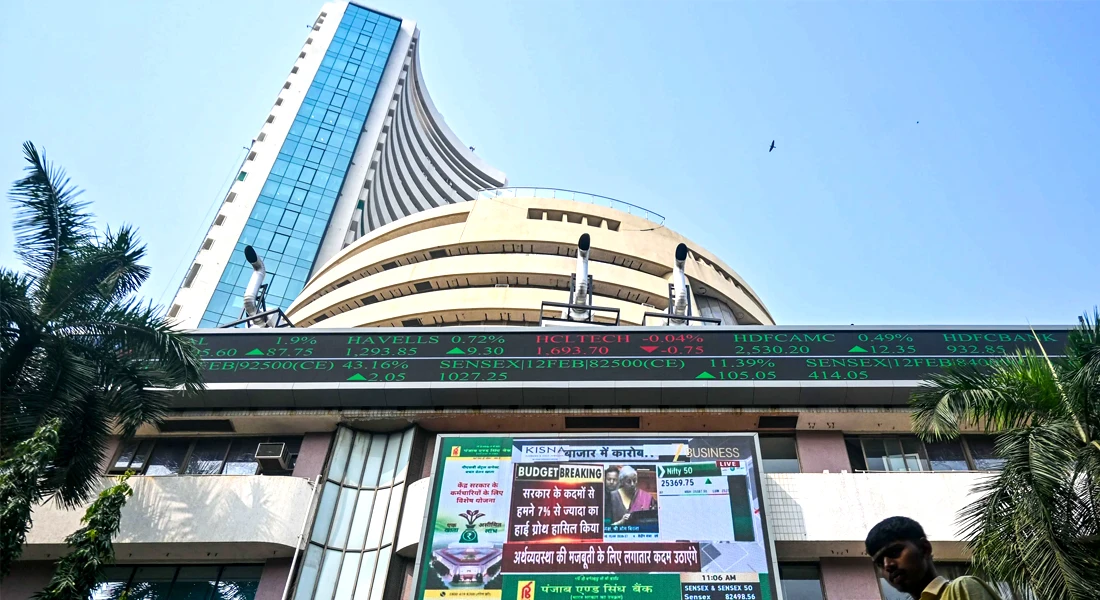
NEW DELHI: After five losing sessions, Indian equities began the week in better humour. The Sensex opened Monday at 76,608.98, up 549.21 points or 0.72%, while the Nifty 50 opened at 23,928.40, higher by 160.95 points. The trigger was not domestic: it was the price of oil. Brent crude, which had climbed above $100 a barrel last week on fears of disruption to Middle East supplies, has retreated sharply since — falling more than 5% in a single session on Friday and easing further, taking a considerable weight off the Indian market’s shoulders.
For an economy that imports close to 88% of the oil it burns, the barrel is rarely just a commodity price. It feeds the import bill, the trade deficit, the rupee, inflation and ultimately the cost of money — which is why a week of triple-digit crude produced five days of falling share prices, and why its retreat produced an immediate rebound. The gains on Monday were broad rather than narrow, with the small-cap segment participating alongside the headline indices and airline, technology and consumer-facing names among the early movers, reflecting a market repricing its energy-cost assumptions rather than chasing a single story.
Relief, priced in: The Sensex opened Monday 549.21 points higher at 76,608.98 and the Nifty at 23,928.40, as Brent’s retreat from above $100 eased the pressure that had driven five consecutive declines. Opening levels; markets move through the day.
India’s stock market has many drivers, but only one of them arrives by tanker. When the barrel falls, the whole country exhales at once.
At a Glance
• Sensex: opened 76,608.98, up 549.21 points (0.72%)
• Nifty 50: opened 23,928.40, up 160.95 points
• Previous close: Sensex 76,059.77; Nifty 23,767.45 (July 24)
• Trigger: Brent’s sharp retreat after topping $100 last week
The sensible caution is that neither last week’s fall nor Monday’s rebound tells us much about the underlying economy. Both were driven by a supply-side shock in a distant theatre, and shocks of that kind are notoriously prone to reversing when the fear that caused them fades. India’s fundamentals through the episode were unchanged: growth projections in the mid-to-high six per cent range, a broadening tax base, record renewable additions and near-record foreign-exchange reserves that give the central bank room to smooth currency swings without drama.
The constructive reading is about the direction of travel underneath the volatility. Every gigawatt of solar and wind India commissions, every point of electric-vehicle share it gains, and every unit of energy efficiency it captures makes the next crude spike a little less consequential than the last. That is a slow project, and it will not spare the market its next bad week. But it is the difference between an economy that holds its breath each time a tanker route is threatened and one that can watch the same headline with something closer to composure.