Deepak Dwivedi
The successful conduct of Assembly elections across four states – Assam, Kerala, Tamil Nadu, and West Bengal – and the Union Territory of Puducherry, has reaffirmed the credibility and institutional strength of the Election Commission of India. At a time when electoral transparency is under global scrutiny, India’s democratic machinery has delivered a powerful message of resilience and accountability.
Yet, the process was not without blemish. The conduct of a handful of senior officials on election duty raised concerns over discipline and propriety, an area where the Commission must exercise sharper vigilance in future. Still, these isolated lapses did little to overshadow the broader success of the electoral exercise.
Record turnout, strict enforcement, and global validation mark a defining moment for India’s democratic institutions
Global validation
What stands out most is the strong endorsement from the international community. Delegations from 22 countries observed the electoral process on the ground and expressed high satisfaction with its fairness and transparency, particularly in Tamil Nadu.
They noted a palpable sense of trust among voters and political stakeholders, underscoring the Election Commission’s growing credibility. For a rapidly evolving India, this global validation is both significant and symbolic.
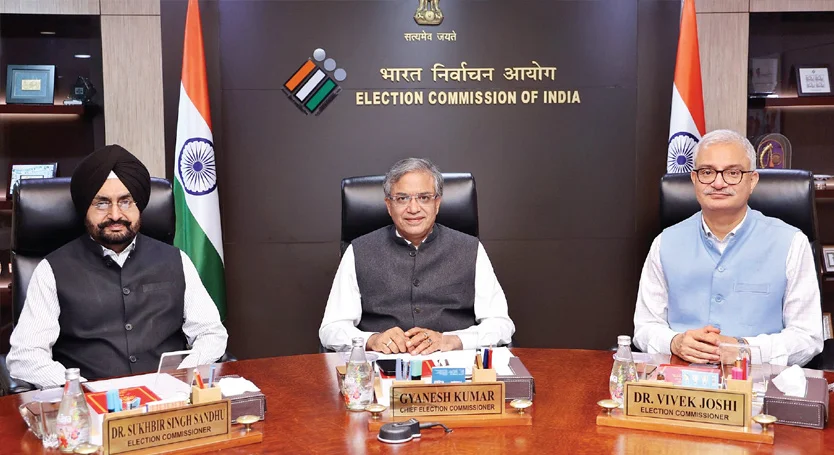
At the heart of this achievement were Chief Election Commissioner Gyaneshwar Kumar and his two deputies – Sukhbir Singh Sandhu and Vivek Joshi – along with Special Observer Pratap Singh, whose leadership and on-ground engagement played a decisive role in shaping the integrity of the process.
The elections in Tamil Nadu and Puducherry – two of the South India’s most politically significant regions – have emerged as a defining chapter in the country’s electoral history. Tamil Nadu, with a total electorate of 56.7 million, recorded an unprecedented voter turnout of 85.15 per cent, the highest since Independence.
This remarkable participation was not incidental. It reflected sustained voter outreach, robust awareness campaigns, and, critically, the continuous engagement between the Election Commission and stakeholders at every level.
Special Observer Pratap Singh’s extensive interactions with political parties, administrative officials, and field personnel helped build confidence and ensure smooth coordination throughout the process.
Strict enforcement
Equally significant was the integrity of the electoral environment. The elections were widely regarded as free, fair, and largely free from inducements – a persistent challenge in Indian politics.
Through strict enforcement of the Model Code of Conduct and proactive monitoring, the authorities were able to curb the distribution of cash, gifts, and other incentives. Seizures during the election period exceeded Rs 1,400 crore, including cash, valuables, narcotics, and liquor. Central agencies alone accounted for over Rs 665 crore, marking the highest-ever enforcement figure.
The scale of administrative deployment further underscores the seriousness of the exercise. Around 320 senior officers from the IRS, IAS, and IPS were appointed as observers, supported by nearly 15,000 personnel and 300 companies of Central armed police forces, ensuring round-the-clock vigilance across the state.
Most importantly, the elections were conducted on a level-playing field, with all political parties given equal opportunity, an outcome widely acknowledged across the spectrum.
Electoral governance
Beyond statistics and enforcement, the Tamil Nadu and Puducherry elections offer a deeper lesson in institutional trust-building. The seamless coordination between the Election Commission, administrative machinery, and political stakeholders created a transparent and accessible electoral ecosystem.
This model – rooted in dialogue, discipline, and decisive action – has the potential to serve as a blueprint for future elections across the country.
India’s electoral journey has seen similar turning points before. In 2005, during the Assembly elections in Bihar, the appointment of KJ Rao as Special Observer marked a watershed moment. His firm and uncompromising approach dismantled the entrenched influence of money power, muscle power, and booth capturing, transforming Bihar’s electoral landscape.
The recent elections in Tamil Nadu and Puducherry echo that legacy, demonstrating once again that strong leadership, institutional resolve, and transparent processes can redefine electoral outcomes.
Democratic milestone
As India continues its journey toward becoming a more mature and robust democracy, the 2026 Assembly elections in Tamil Nadu and Puducherry stand out as a milestone. They not only reinforce faith in the electoral system but also elevate India’s democratic credentials on the global stage.
In an era where trust in institutions is often contested, these elections offer a powerful reminder: when governance is firm, fair, and transparent, democracy not only survives – it thrives.
Special Observer Pratap Singh’s extensive interactions with political parties, administrative officials, and field personnel helped build confidence and ensure smooth coordination throughout the process