Blitz Bureau
NEW DELHI: The Lakhisarai crowd surge lasted about fifteen minutes. Read the sequence carefully and it is not a story about too many people — it is a story about queue geometry, a rumour, and a train timetable nobody had matched to a gate.
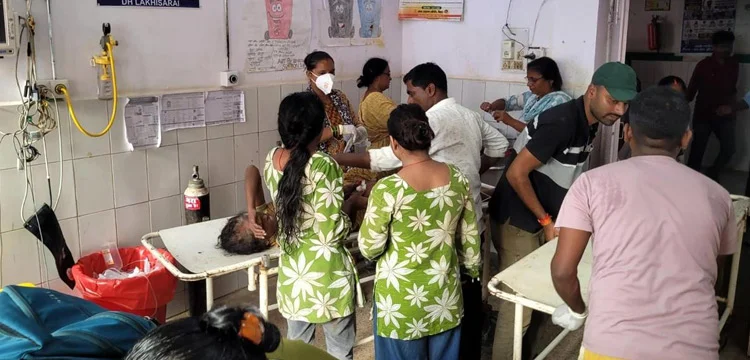
At least seven women were killed and around fourteen people injured in a crowd surge outside the Ashok Dham temple at Balgudar in Bihar’s Lakhisarai district early on Monday, on the third Monday of Shravan, one of the heaviest pilgrimage days in the eastern Indian calendar. The Chief Minister, Samrat Choudhary, called the incident deeply distressing and announced an ex gratia payment of four lakh rupees to the family of each person killed. The Prime Minister expressed his condolences through the day. Every one of the dead was a woman.
The sequence matters more than the total, because the sequence is what a district administration can actually act on. Accounts from the site place the surge between roughly 6.30 and 6.45 in the morning, immediately after two trains set down passengers at the Ashok Dham halt a short distance from the temple. Devotees moved from the halt towards the temple in a single compressed wave rather than as a stream. As that wave reached the queues, an electric pole carrying a cable came down on the right-hand side, alongside the men’s line. A rumour spread within seconds that a live wire had fallen on people. The panic ran sideways: pressure transferred from the men’s queue into the women’s queue on the left, and women went down on top of one another as they tried to turn and run. A crowd does not need to be larger than the space it is in to kill. It needs only to be told to move in the wrong direction at once.
Where it happened: the Ashok Dham complex at Balgudar, whose principal shrine is the Indradamneshwar Mahadev temple. The site sits a few kilometres from Lakhisarai town and is served by a dedicated railway halt that fills and empties in bursts.
A crowd does not need to be larger than the space it is in. It needs only to be told to move in the wrong direction at once.
At a Glance
• Where: Ashok Dham, Balgudar, Lakhisarai district, Bihar
• When: about 6.30–6.45 am, Monday 17 August 2026
• Occasion: the third Monday of Shravan, also Nag Panchami
• Dead: at least seven, all of them women
• Injured: around fourteen, per initial police accounts
• Trigger: an electric pole with cable fell beside the men’s queue
• Amplifier: a rumour that a live wire had come down
• Feeder: two trains arriving at the Ashok Dham halt together
• Relief: ₹4 lakh ex gratia announced by the Chief Minister
• The fixable part: arrival timing, queue separation, rumour control
Three of the four elements in that chain are engineering problems with settled answers, and India has already solved them at larger sites. Arrival timing is the first: where a shrine is fed by a railway halt, the gate release rate has to be matched to the train timetable, with a holding area that absorbs a trainload and releases it in bands. Queue separation is the second: adjacent men’s and women’s lines with no physical barrier between them will always transmit a shock from one to the other, and a hard barrier costs very little compared with what it prevents. Overhead cable routing over a pilgrim queue is the third, and the cheapest of all to correct before next Shravan. The fourth element, rumour, is the hardest — but public-address systems with trained announcers at fixed intervals along the queue are how the large temple trusts have learned to kill a rumour in the seconds it takes to become a stampede.
India’s temple towns are managing volumes their infrastructure was never designed for, and that is in part a measure of rising incomes and better rail connectivity — more families can now afford the journey their grandparents could not. The constructive response is to treat Shravan Mondays, Nag Panchami and the big festival dates the way large airports treat peak hours: as forecastable events with a published capacity, a staffing plan and a rehearsed evacuation route. Bihar has a working template in the Shravani Mela crowd management along the Sultanganj–Deoghar corridor. Extending the same discipline to the second-tier shrines — the ones that have grown fastest and been planned for least — is the single measure most likely to ensure that next year’s third Monday of Shravan ends with a count of pilgrims rather than a count of the dead.