Blitz Bureau
NEW DELHI: The sowing gap has narrowed from a quarter to a twentieth in five weeks. That is the recovery. What it also means is that an unusually large share of this year’s crop was planted late — and late-planted crop is decided by the rain that falls now.
Kharif planting stood at 78.74 million hectares as on 24 July 2026, against 82.62 million hectares a year earlier — a shortfall of 3.88 million hectares, or 4.7 per cent. The direction is the encouraging part: the deficit had been close to 23 per cent as on 25 June, and had narrowed to about 3 per cent year on year by the end of July on independent estimates. Crop by crop, rice is down 2.2 per cent and cotton 2.4 per cent, while pulses and coarse cereals are 6 to 8 per cent behind. The cumulative monsoon rainfall deficit stood at 11.5 per cent below the long period average at the start of August.
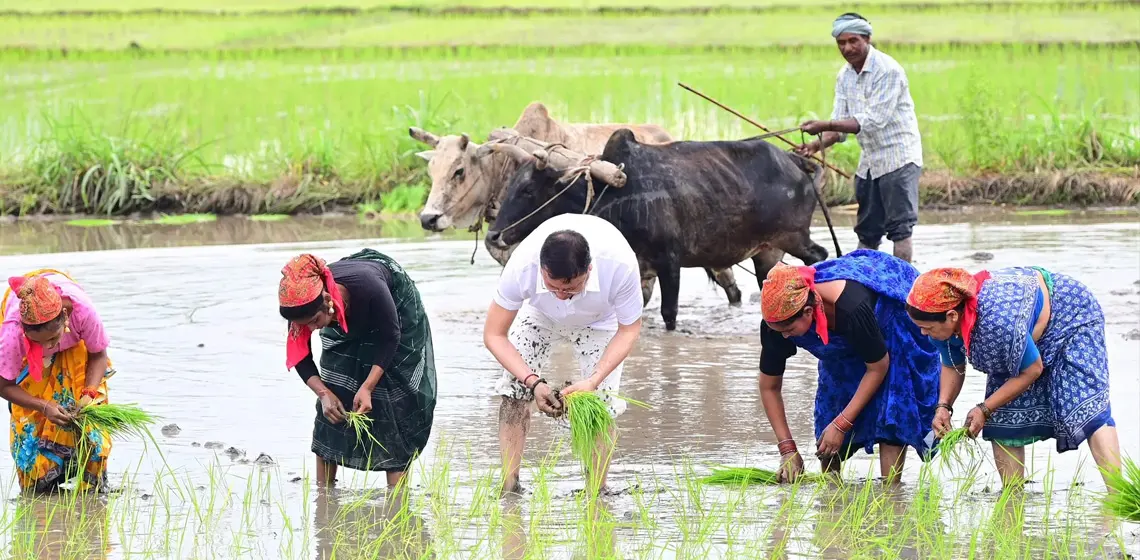
Planted late, and therefore watched closely: rice acreage is down 2.2 per cent year on year, the mildest shortfall among the major kharif crops, but a larger-than-usual share of it went into the ground in July rather than June.
India takes about 29 per cent of its monsoon rain in August, and does about 20 per cent of its kharif sowing in the same month. In a late year, both numbers do double duty.
At a Glance
• Sown area: 78.74 million hectares to 24 July 2026, against 82.62 million a year earlier
• Shortfall: 3.88 million hectares, or 4.7 per cent
• Trend: deficit near 23 per cent on 25 June, about 3 per cent by end-July
• By crop: rice −2.2%, cotton −2.4%, pulses and coarse cereals −6 to −8%
• Rainfall: 11.5 per cent below the long period average as on 1 August
• August’s share: about 29% of seasonal rainfall and about 20% of kharif sowing
• IMD outlook: below-normal rainfall, under 94 per cent of LPA, for August and the second half of the season
The reason a late kharif needs a different kind of attention is agronomic rather than statistical. A crop sown in the third week of July reaches its flowering and grain-filling stage three to four weeks later than a crop sown in mid-June, which pushes the moment of maximum water need into late August and September — the tail of the monsoon rather than its middle. Distribution therefore matters more than the seasonal total. A well-spaced August across the sowing belts of Madhya Pradesh, Maharashtra, Rajasthan, Karnataka and the eastern plains will carry a late crop comfortably; the same quantity of rain arriving in three violent spells will not, because a young late-sown crop cannot use what runs off. The pulses and coarse-cereal shortfall deserves particular watching, since these are largely rainfed and are the crops that set the retail price of dal in the second half of the year.
None of this points to alarm, and the constructive case is a strong one. Reservoir storage, the rabi crop that follows, and buffer stocks all sit between a soft kharif and a consumer’s plate, and India has spent a decade building each of those cushions. Where the effort is best directed now is at the specific district: contingency seed of short-duration pulse and coarse-cereal varieties available at the block level for any pocket that still has a gap to fill, crop-insurance enrolment closed out before the window lapses, and clear advisory in the state language on when to hold irrigation back rather than apply it. India has the data to do this at district resolution. The way to make a late kharif an ordinary year rather than a difficult one is to be precise about which districts need help, and to reach them in August rather than in October.